Yoga and Sound Healing: A Practical Guide
Discover the power of yoga and sound healing. Learn how to combine postures, breathwork, and sound baths in one transformative session.
Written by Editorial Team
You arrive at a softly lit studio expecting a gentle yoga class. The mats are arranged as usual, but the familiar playlist has been replaced by crystal bowls, a gong, and the quiet resonance of someone testing a chime. You're not sure whether you're attending yoga, meditation, or something closer to a concert where the audience lies down.
That uncertainty is common. Yoga and sound healing are now offered together in studios, retreats, and wellness programs, yet the language around them can make simple relaxation sound like a medical breakthrough. A grounded approach starts with what each practice is, what research supports, and how to choose a class that respects both your goals and your limits.
Why Yoga and Sound Healing Are Showing Up Together
A combined class often begins with movement. The teacher guides you through slow postures, invites you to notice your breathing, and gives your body time to settle. Later, you lie down under a blanket while bowls, gongs, chimes, or a human voice create an immersive listening experience.
The pairing makes intuitive sense. Yoga uses breath, posture, and attention as entry points into a quieter state, while sound healing uses listening and vibration. Both can draw attention away from racing thoughts and toward immediate physical sensations, although that doesn't mean they work in exactly the same way or produce identical outcomes.
The format also reflects a change in how people approach wellness. Someone might once have attended a vinyasa class on one evening and a separate sound bath on another. Now, many students want a single experience that begins with active participation and ends with stillness. The movement gives the body something deliberate to do, while the sound creates an environment in which the participant can rest.
Practical rule: Treat the combination as two practices placed in one session, not as proof that their effects automatically multiply.
Yoga itself has a substantial participation footprint. A Yoga Alliance executive summary reported 38.4 million Americans practiced yoga in 2022. The same source notes that independent industry summaries commonly estimate more than 300 million practitioners worldwide, while Americans spend about USD 16 billion annually on yoga classes, equipment, and accessories. These figures describe yoga's reach, not the effectiveness of every class or combined format.
The commercial interest is similarly broad. One Grand View Research yoga market analysis valued the global market at USD 127.0 billion in 2025 and projected USD 269.1 billion by 2033, with a 9.9% CAGR. The estimates vary by market definition, but they reinforce a practical point: yoga is no longer a niche offering, and sound-based experiences are entering an established wellness ecosystem.
What Each Practice Actually Is
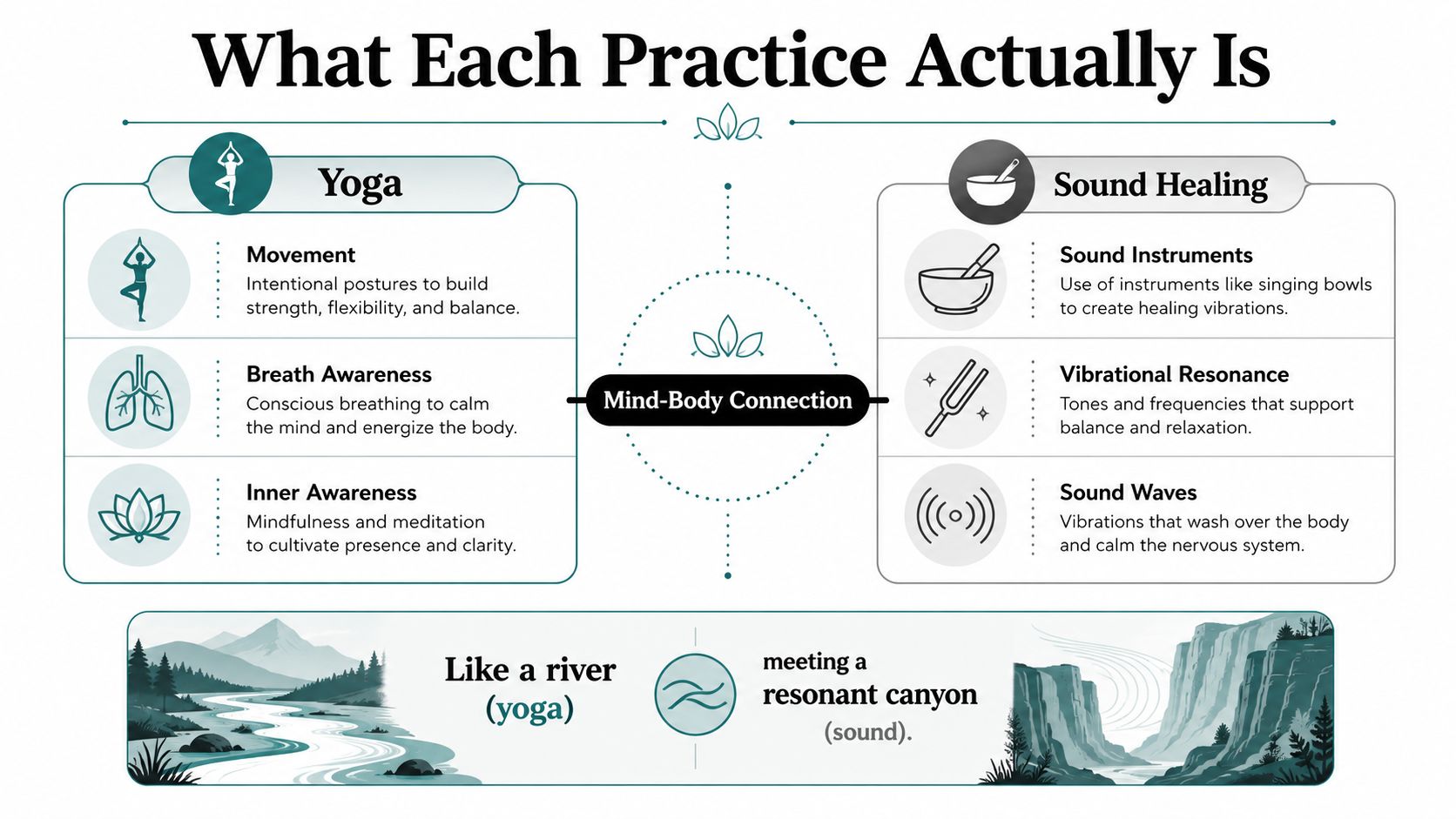
Start with yoga before adding sound to the picture. In plain terms, yoga is a mind-body discipline involving breath awareness, physical postures, concentration, and structured relaxation. It has roots in South Asian traditions and now appears in many modern forms, from physically demanding classes to slow restorative sessions.
A useful analogy is physical rehabilitation. Yoga isn't physical therapy, and a yoga teacher isn't a replacement for a licensed clinician, but both can involve deliberate, repeatable practice. You learn how to position the body, regulate effort, notice sensation, and build familiarity over time. The point isn't to force a pose. It's to develop skillful attention while moving or resting.
Sound healing describes the intentional use of tones, frequencies, instruments, or voice to shape a person's sensory and emotional experience. A facilitator might use:
- Gongs, which create broad, layered tones.
- Crystal or metal bowls, which produce sustained resonance.
- Chimes, which add lighter, higher sounds.
- Tuning forks, which provide focused tones.
- Live voice, including chanting or sustained vowel sounds.
The participant usually receives the sound rather than performing it. That distinction matters. Sound healing may overlap with meditation and some forms of music-based care, but a sound bath generally centers on listening, vibration, and rest rather than musical training or active composition. For a related explanation of terminology, see this guide to what sound therapy means.
How the practices meet
A combined session can take several forms. You might move through gentle asana and breathwork first, then spend the final part of class in a sound bath. Another teacher may begin with a short sound meditation, add slow movement, and return to sound for closing relaxation.
The format changes the role of each practice. Yoga asks you to participate through movement and breath. Sound invites you to receive. Neither requires a particular spiritual belief, although some facilitators use spiritual language, chanting, or ritual. Ask before booking if you want a secular, movement-focused, or contemplative experience.
What the Evidence Says About Benefits
The evidence is easier to interpret when you separate yoga from sound-based interventions. Research on yoga includes respiratory outcomes. A review in the National Library of Medicine describes a 12-week program associated with significant increases in FVC, FEV1, peak expiratory flow rate, breath-holding time, and ventilatory capacity, alongside a reduction in resting respiratory rate. The review also reports that 6 weeks of pranayama can improve several measures of respiratory function and prolong breath-holding time.
That doesn't mean every yoga class will produce those results. The programs, participants, teaching methods, and outcome measures differ. It does mean that breath-centered practice has been studied through measurable physiological outcomes, not only through personal testimonials.
Sound research is more limited and often examines immediate changes in mood, stress, anxiety, or pain. A Tibetan singing bowl meditation study reported significantly lower tension, anger, fatigue, depressed mood, anxiety, and pain immediately after a session. A separate 30-day sound-healing intervention in the same research discussion reported reductions in stress and anxiety. These findings support a short-session state change, not a claim that sound healing treats an underlying disease.
The combined question is newer. A 2025 randomized study involving chronic lower back pain found that both yoga and yoga plus sound healing improved, with the combined group showing greater improvement in pain, function, sleep, and quality of life. That result suggests a possible additive effect, but the evidence remains narrow, short-term, and tied to one clinical use case.
| Practice | Strength of evidence | Most studied outcomes | Typical study size | Key limitations |
|---|---|---|---|---|
| Yoga | Broader and more established | Respiratory function, stress-related outcomes, physical function | Varies by study | Styles and programs differ, and results don't transfer automatically to every class |
| Sound healing | Emerging and more limited | Anxiety, mood, tension, pain perception | Often small | Short follow-up, varied instruments, and inconsistent protocols |
| Combined approach | Early and condition-specific | Pain, function, sleep, quality of life in limited comparative work | Narrow clinical samples | Few head-to-head studies, little long-term data, and no standard format |
The unanswered question is important: what creates the benefit? It could involve vibration, expectation, group support, focused attention, lying down, or the transition from movement to rest. A careful discussion of nervous system healing should leave room for those possibilities rather than assigning every calming sensation to one mechanism.
What a Combined Session Feels Like
You'll usually start with arrival, orientation, and a brief grounding practice. The facilitator may ask about injuries, sensory preferences, or whether you're comfortable lying near particular instruments. A good intake doesn't need to be dramatic. It gives you a chance to mention anything that could affect your participation.
Movement comes first
The opening asana sequence is often gentle and accessible. You might move through shoulder circles, supported forward folds, low lunges, hip openers, or slow spinal movements. Breath cues help you match effort with attention, but you shouldn't need advanced flexibility or previous yoga experience.
The aim is preparation rather than performance. Movement warms the body, gives restless energy a safe outlet, and makes the transition into stillness feel less abrupt. Some classes remain active longer, while others use only a few postures before moving to the floor.
Sound changes the pace
During the sound portion, you may rest in savasana, lie on your side, or choose a supported position. The facilitator might play crystal bowls, gongs, chimes, or tuning forks. Sounds can arrive gently and build into a dense, immersive layer, or the session may remain quiet and spacious.
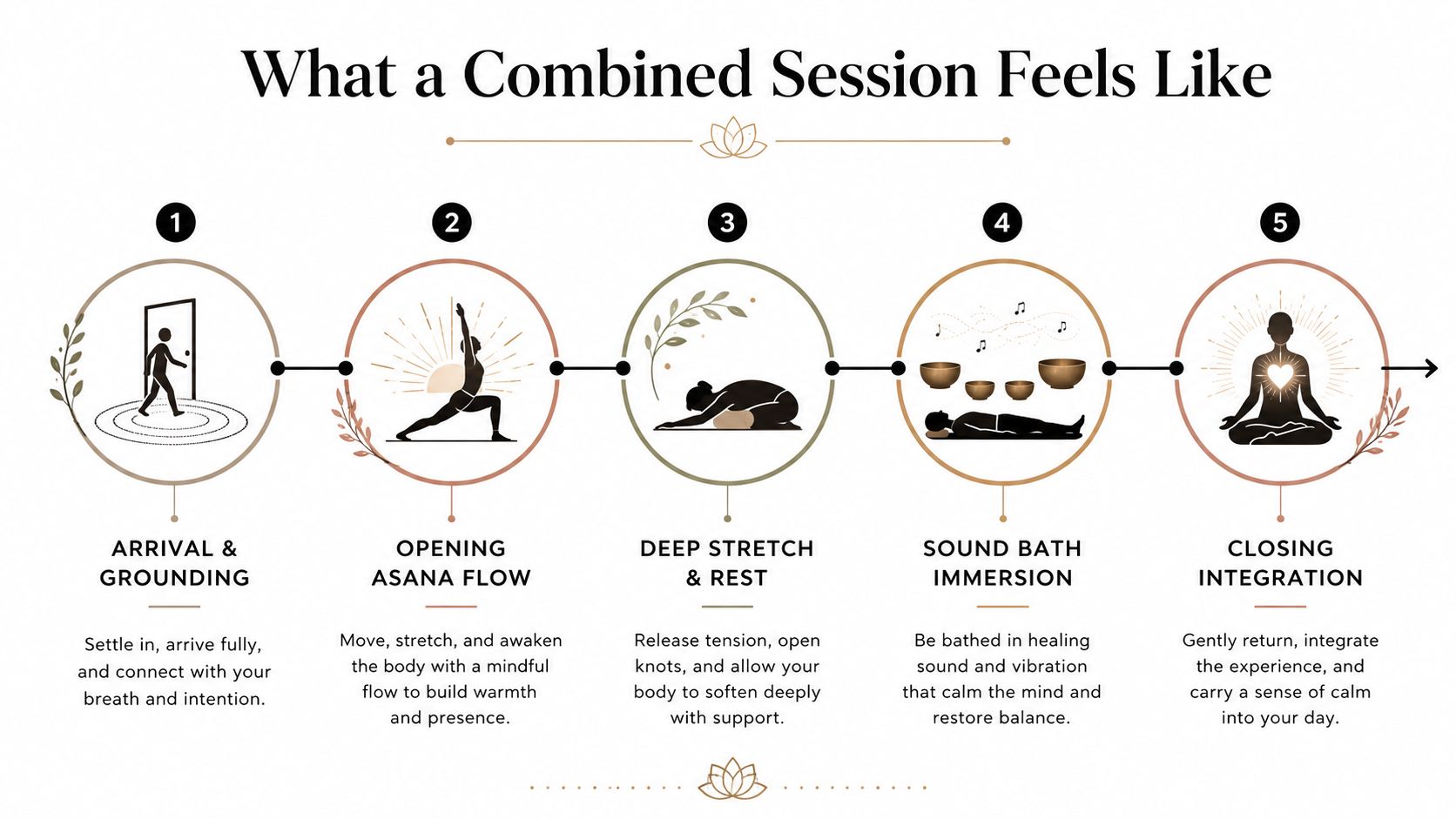
A typical class lasts 60 to 90 minutes, although local schedules vary. The closing may include seated breathwork, a short meditation, gentle movement, and optional sharing. You might feel relaxed, neutral, emotional, restless, or ready to go home. There's no required reaction.
The experience is non-performance-based. You don't have to achieve a special state for the session to count.
Benefits People Commonly Report
People often describe the sound portion as creating deeper relaxation than movement alone, especially when they're comfortable with lying down and closing their eyes. Others notice reduced perceived stress, a temporary easing of anxiety, or a clearer transition into meditation. These descriptions are meaningful as personal observations, but they aren't the same as proof of a lasting clinical effect.
Sleep is another common goal. Some participants say they sleep more easily after an evening session, perhaps because the class gives them a structured break from stimulation. The available sound research supports immediate changes in measures such as tension, anxiety, mood, and pain perception, while longer-term sleep conclusions remain less certain.
Yoga can add a different layer of awareness. After practicing slowly, you may notice where you brace your shoulders, hold your breath, or avoid a sensation. That information can carry into later yoga practice and everyday movement. A mood lift or reduction in perceived muscle tension may also occur, but the response is individual.
| Benefit | Reported strength | Evidence level |
|---|---|---|
| Immediate relaxation | Commonly reported | Supported by short-session sound findings and participant experience |
| Lower perceived stress | Frequently reported | Some support, but protocols and follow-up vary |
| Reduced anxiety | Reported across sound interventions | Emerging evidence, not a universal treatment claim |
| Easier meditation | Common personal outcome | Plausible and experiential, with limited direct comparative data |
| Better sleep | Often reported after evening practice | Evidence remains less developed for the combined format |
| Reduced pain perception | Reported in specific studies | Limited, condition-specific evidence |
| Lasting treatment of illness | Not an appropriate general claim | Not established by the available evidence |
Think in terms of a personal experiment, not a promised result. Track how you feel before class, immediately afterward, and later that day. Consistent practice may provide a more useful picture than a single memorable session, but sound healing shouldn't replace medical or psychological treatment for a diagnosed condition.
Safety and Who Should Approach Carefully
A calming sound bath isn't automatically calming for every nervous system. A 2024 U.S.-focused paper on sound-bath providers warned that yoga-informed settings can become a “trauma trap” when facilitators assume the same sounds will soothe everyone. The paper is discussed in this PubMed record on sound-bath safety and trauma sensitivity.
Loud gongs, prolonged vibration, enclosed rooms, spiritual framing, or unexpected sounds may feel uncomfortable for trauma survivors, neurodivergent participants, and people with migraines, tinnitus, or other sensory sensitivities. Tell the facilitator before class. You can ask where you'll be positioned, whether the volume can be adjusted, and whether stepping outside is acceptable.
When to ask a clinician first
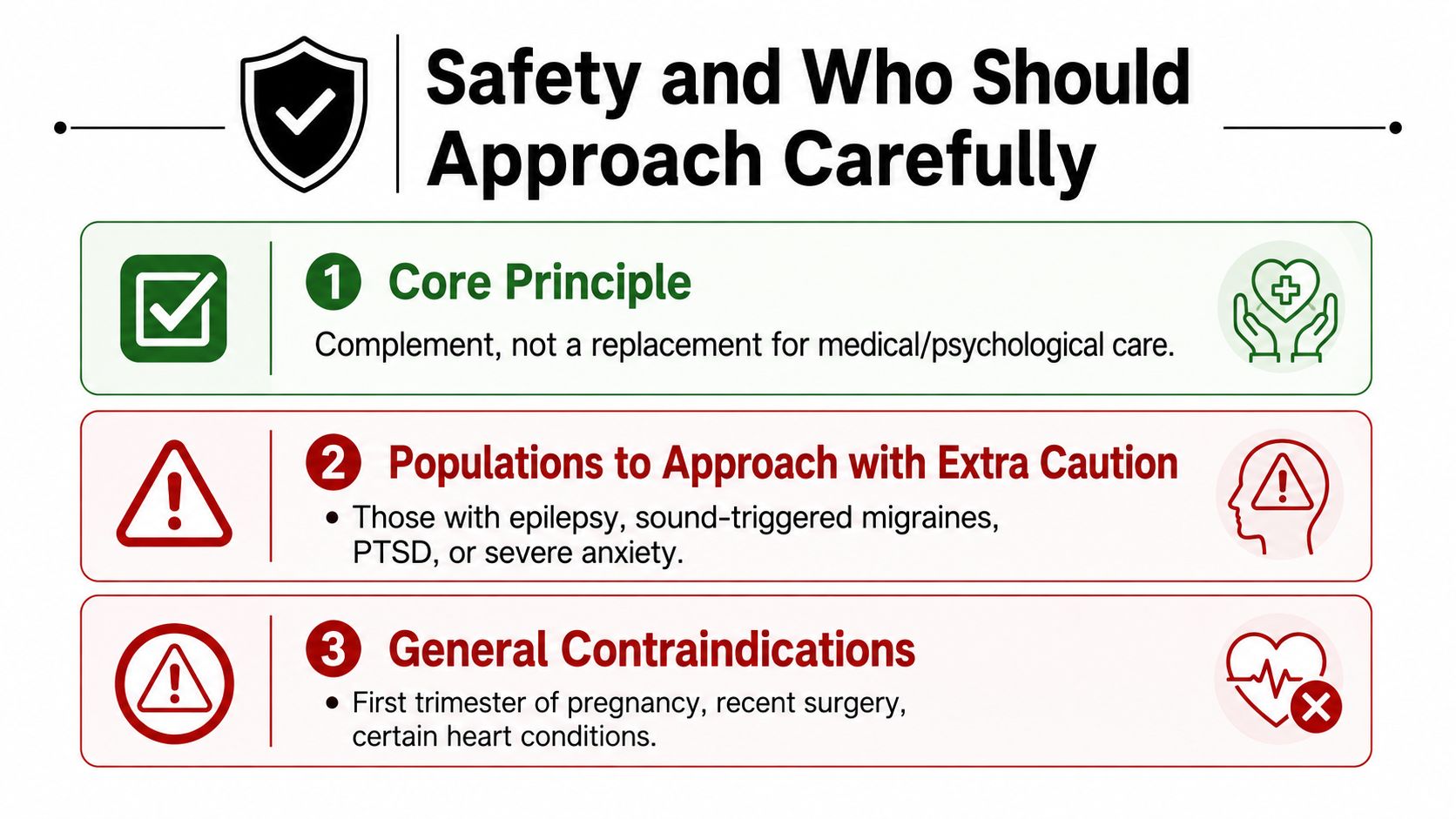
Use extra caution if you're pregnant, especially during the first trimester, or if you have epilepsy or another seizure disorder. Recent surgery, severe psychiatric symptoms, active substance withdrawal, and certain implanted medical devices, including pacemakers, may also require individualized guidance. Strong vibration or intense sound may not be appropriate for everyone with these conditions.
The safest response isn't to panic or assume a blanket prohibition. It's to ask your healthcare professional about the specific practice and tell the facilitator what guidance you've received.
Give yourself control
Start with a shorter or quieter session if you're unsure. Sit rather than lie down if being enclosed or physically still makes you anxious. Keep earplugs available when the venue permits them, and leave early if you feel overwhelmed, dizzy, panicked, or physically unwell.
Your consent includes changing position, reducing stimulation, or stopping. A skilled facilitator should make those choices easy.
Sound healing works best as a complement to appropriate care, not as a cure-all. Be cautious with anyone who promises to resolve serious medical or psychological problems through sound alone.
Choosing a Local Class and Using a Curated Directory
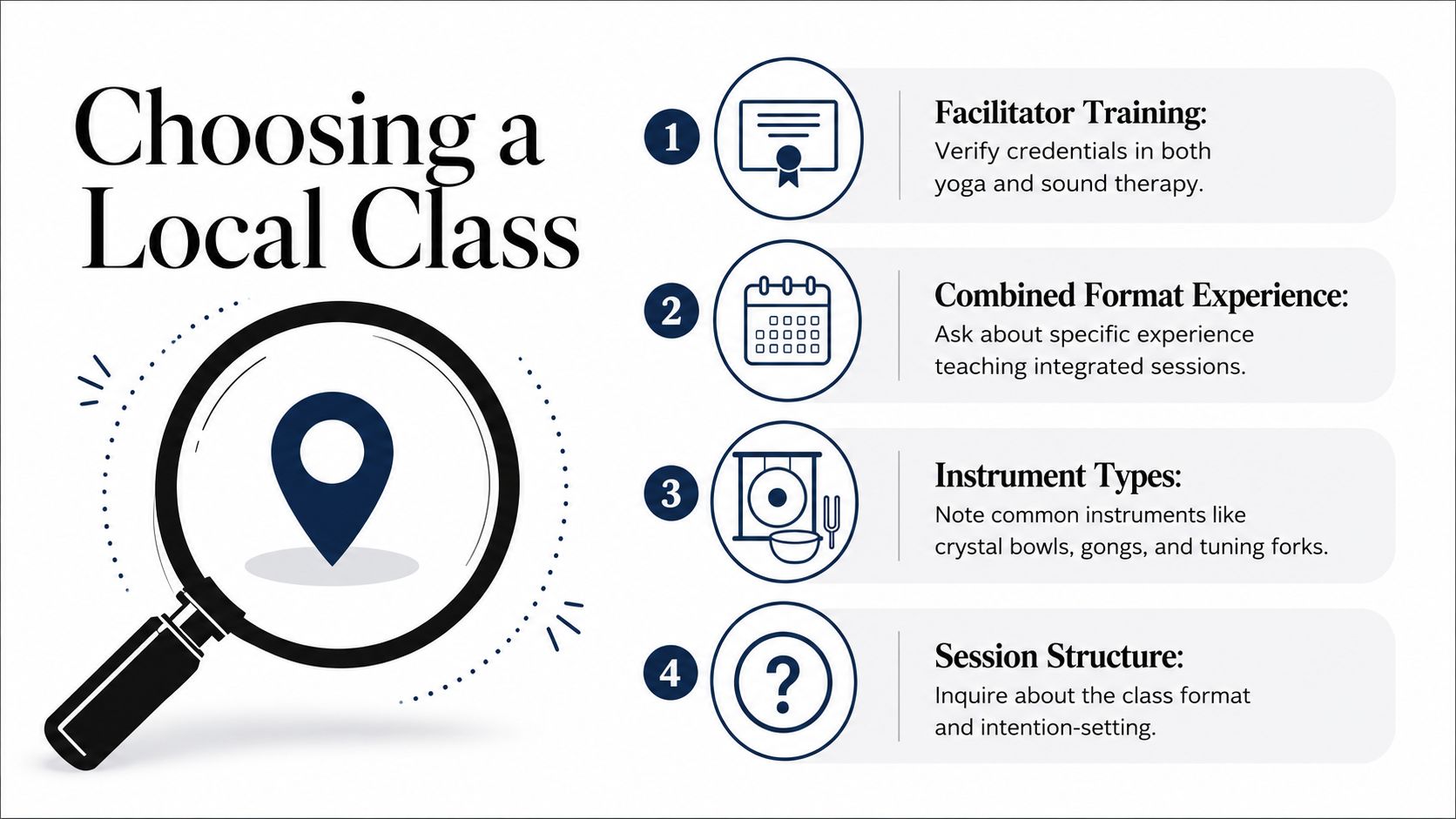
A beautiful studio doesn't guarantee a well-run session. Before booking, look for information about the facilitator's yoga training, sound-specific education, experience combining the formats, and approach to participant safety. If a profile only promises transformation but says nothing about instruments, intensity, or contraindications, ask questions before paying.
Consider the setting as carefully as the teacher:
- Training and scope: Confirm that the facilitator has relevant preparation in yoga and sound work, and ask what they do when a participant has an injury or sensory concern.
- Instrument choice: Find out whether the session uses bowls, gongs, chimes, tuning forks, voice, or several instruments together. Ask about volume and placement.
- Room conditions: Acoustics, class size, floor space, ventilation, and exits can shape your experience.
- Format: Check whether the class is movement-heavy, mostly restorative, or primarily a sound bath with a short yoga introduction.
- Practical details: Review pricing, cancellation terms, accessibility information, what to bring, and whether the session is secular or spiritually framed.
A curated directory such as Lucidoura organizes local options across yoga, meditation, sound healing, breathwork, spas, and other wellness categories, with city filters, concise place summaries, and category context. That can help you compare venues without sorting through unrelated map results, while the individual studio remains responsible for confirming current details.
For preparation guidance, this overview of how to start yoga can help you think through level, clothing, and class expectations.
Arrive early for a trial visit. Ask who will teach, what the session includes, and how the instruments will be played. Notice whether staff answer accessibility questions directly. If they welcome boundaries and explain the format without exaggerated promises, that's a useful sign.
Quick Answers to Common Questions
Is sound healing safe during pregnancy?
Don't assume it's safe in every format. Ask your prenatal clinician about the specific class, especially during the first trimester, and tell the facilitator you're pregnant before attending.
Can beginners join?
Usually, a gentle combined class can be adapted for newcomers, but formats vary. Confirm whether the movement includes basic postures, whether props are supplied, and how much time you'll spend lying down.
How often should I practice?
There isn't a standardized schedule that guarantees results. Try a consistent routine you can recover from, then evaluate changes in relaxation, stress, sleep, or comfort rather than chasing an intense experience.
What should I bring?
Wear comfortable clothing and bring water. Ask whether you need a mat, blanket, eye covering, bolster, or earplugs. If you're sensitive to sound, bring whatever helps you control stimulation.
How is this different from a standard yoga class?
A standard class may emphasize posture, strength, mobility, or breathwork. A combined session usually gives more time to guided listening and rest, so the movement may be slower or shorter.
Will insurance or a wellness budget cover it?
Coverage depends on your plan, employer, and location. Ask the provider for the exact service description and receipt details, then check your policy or wellness-benefit rules.
What if sound makes me uncomfortable?
Tell the teacher before class, choose a position near an exit, request lower intensity, or skip the session. Relaxation isn't something you owe a facilitator.
Lucidoura helps you browse curated local listings for yoga, meditation, sound healing, breathwork, spas, and related wellness experiences by category and city. Visit Lucidoura to compare nearby options, review what each venue offers, and contact a facilitator before booking your first yoga and sound healing session.