What Is Integrative Medicine and How It Changes Your Care
What is integrative medicine - Discover what integrative medicine is and how it combines conventional and alternative therapies to personalize your care plan
Written by Editorial Team
What happens when a prescription treats one symptom, but your sleep, stress, movement, nutrition, and daily function still keep you from feeling well? That question exposes the practical gap between treating a diagnosis and caring for the person who lives with it.
What is integrative medicine in real clinical practice? It isn't a replacement for conventional medicine, and it isn't a collection of wellness trends. It is a coordinated model that brings appropriate conventional treatment together with evidence-informed complementary approaches, while considering the patient's physical, emotional, social, and lifestyle needs.
The important boundary is coordination. Who is responsible for the plan? Which therapy has credible evidence for the problem at hand? Could a supplement interfere with medication? A responsible answer to those questions matters more than an impressive list of modalities.
Defining Integrative Medicine Beyond the Buzzword
What separates integrative medicine from routine medical care, alternative medicine, or wellness? The answer is not the number of therapies offered. It is how care is selected, connected, and supervised.
Alternative medicine usually means using a nonconventional approach instead of standard medical treatment. Integrative medicine combines conventional and complementary care in one coordinated plan. A clinician, clinic, or care team should clarify who oversees that plan, how treatments relate to one another, and when a complementary option should be stopped.
The National Center for Complementary and Integrative Health definition describes integrative health as coordinated use of conventional and complementary approaches. It also includes multimodal care, meaning two or more approaches are combined, while considering the person rather than focusing on a single organ system.
A visit may therefore include standard testing, medication, or surgery when those options fit the condition. It may also include acupuncture, meditation, yoga, nutrition counseling, or another complementary practice. The deciding factors are the patient's goals, possible benefits, known risks, interactions, practicality, and evidence for that specific problem. A therapy belongs in the plan because it has a reasonable role, not merely because it is labeled natural.
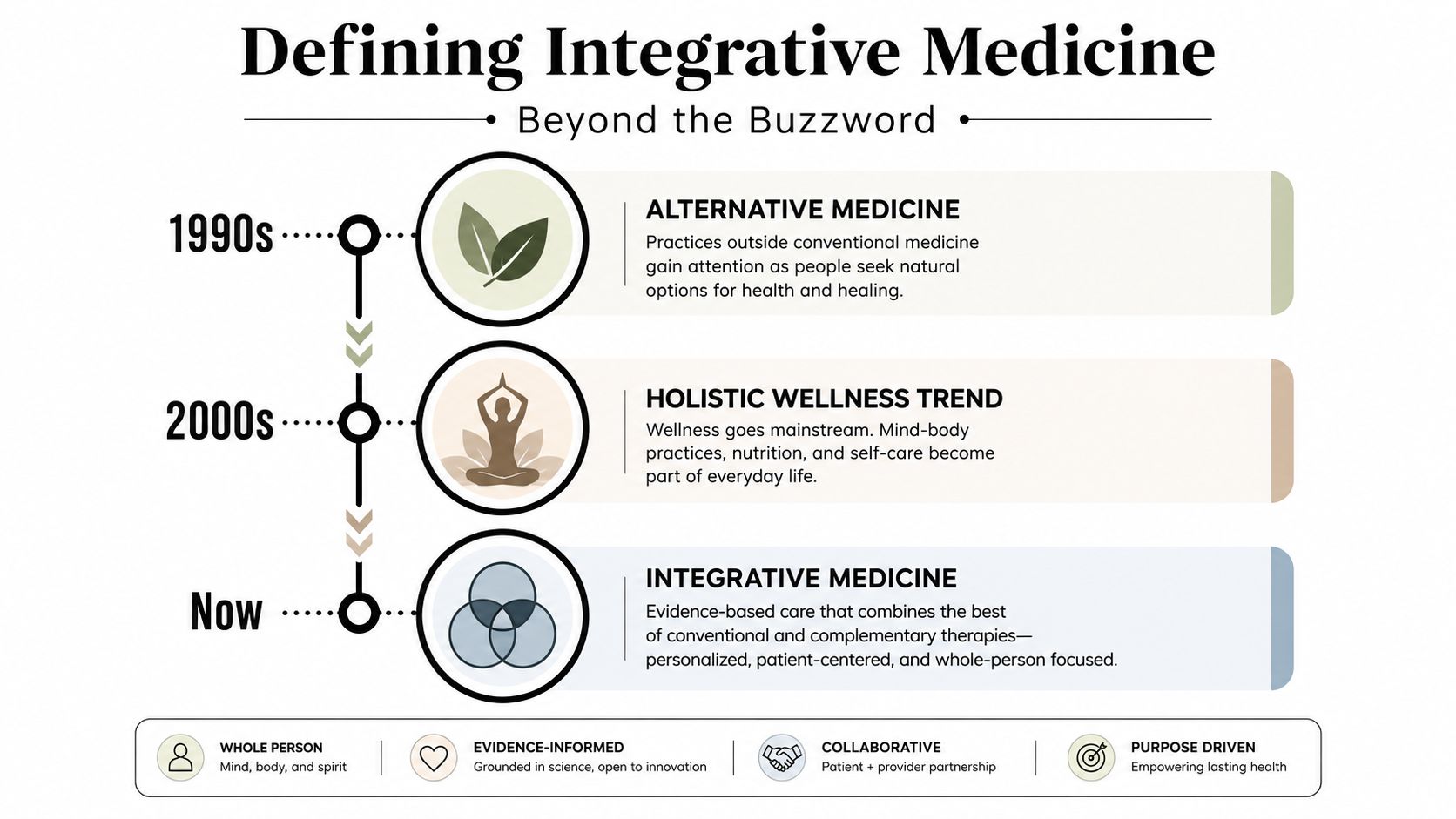
A clinical model, not a single treatment
The term grew through professional and institutional changes. The U.S. Congress directed the National Institutes of Health to create the Office of Alternative Medicine in 1991. A historical review identifies “integrated medicine” or “integrative medicine” as emerging most recently in 1995. Earlier organizing work in conventional medicine dates to 1978-1979, when the American Medicine Association and American Nurses Association helped formalize a whole-person approach. These milestones appear in the historical review indexed by PubMed.
The World Health Organization describes integrative medicine as an interdisciplinary, evidence-based approach that combines biomedical and traditional or complementary knowledge, skills, and practices. That standard helps distinguish a coordinated care model from a retail list of products. A clinic selling supplements without reviewing medications is not automatically providing integrative medicine. Meditation can support wellbeing, but it becomes part of integrative care when it is connected appropriately to the broader health plan.
Practical rule: Stopping proven treatment, promising one therapy will fix every condition, or refusing to communicate with your medical team are warning signs.
Core Principles That Guide Whole-Person Care
Whole-person care doesn't mean treating every possible aspect of your life at once. It means asking how the relevant parts of your life affect the condition being treated, then choosing interventions that fit your situation.
A useful mental model is a care map. The diagnosis is one point on the map. Other points may include medication use, physical function, sleep, mood, nutrition, stress, goals, and social circumstances. The clinician's job isn't to connect every point for the sake of complexity. It's to identify the connections that can change a safe and sensible plan.
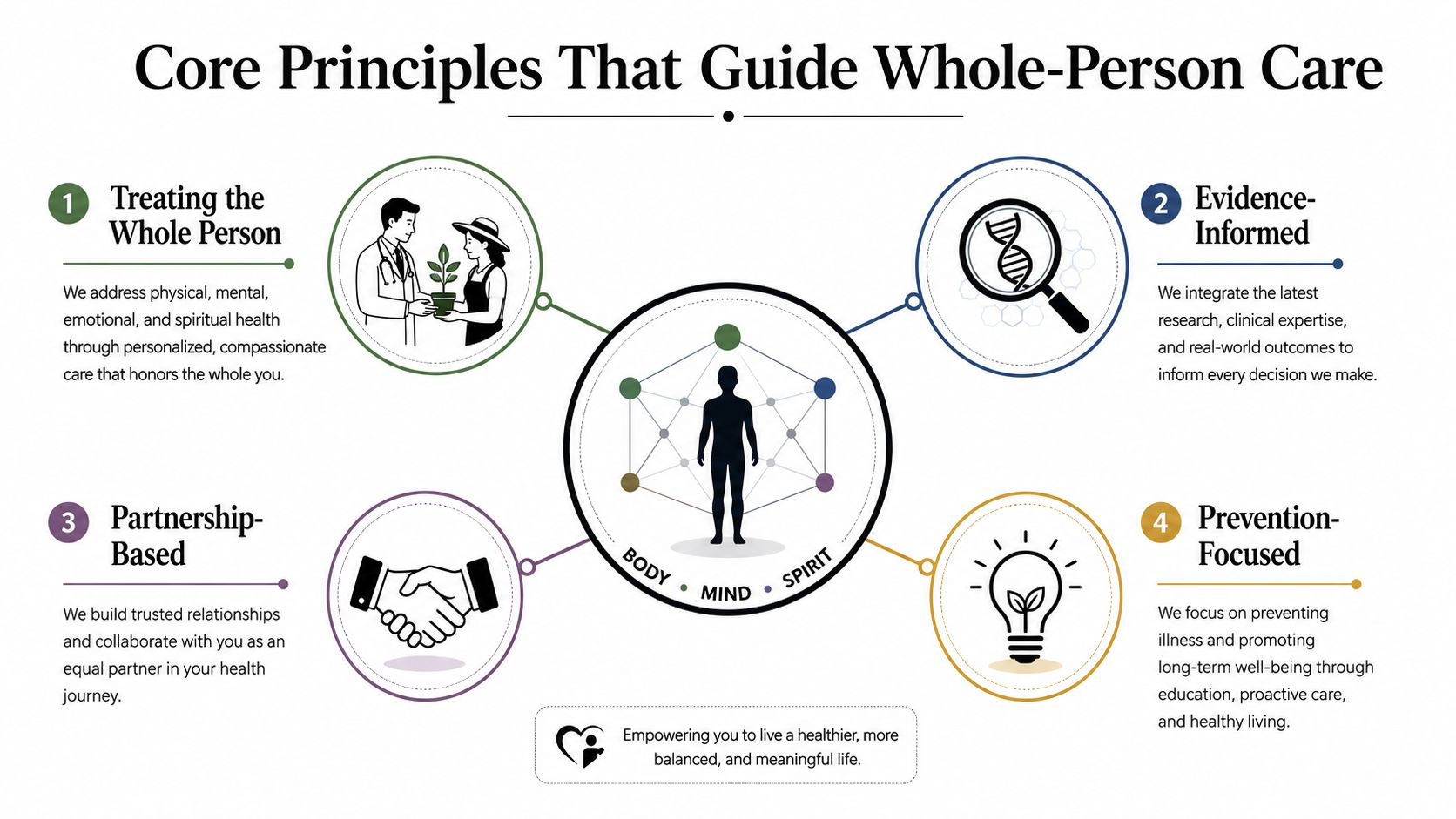
Four ideas shape the model
- Whole-person assessment: A clinician looks beyond an isolated symptom when those broader factors are clinically relevant. For chronic pain, that might include movement, sleep, mood, medication effects, and the patient's functional goals.
- Evidence-informed choices: A therapy earns a place through its potential benefits, risks, feasibility, and evidence for the specific problem. Integrative doesn't mean accepting every traditional or complementary practice without scrutiny.
- Partnership: Patients help define priorities. Someone who wants to return to walking may need a different plan from someone whose immediate priority is sleeping through the night.
- Prevention and maintenance: Care can include habits that reduce strain, support function, or help manage risk, alongside treatment for an existing illness.
Consider chronic back pain. A coordinated plan might retain appropriate medical evaluation and physical therapy, while adding a carefully selected mind-body practice or acupuncture if the clinician believes it could support pain or function. The addition isn't automatic, and it shouldn't delay assessment for serious causes of pain.
The relationship also carries practical value. A practitioner who knows what else you're doing can notice duplication, conflicting advice, or a supplement that belongs nowhere near a prescribed medication. A practitioner who doesn't ask about your regular care can't coordinate it.
Whole-person care should therefore make a plan more coherent, not more crowded. If every visit adds another test, product, or treatment without a clear purpose, the approach has drifted from integration into accumulation.
How Integrative Medicine Differs from Conventional and Alternative Care
The three approaches can overlap, but they begin from different assumptions about treatment and coordination.
| Dimension | Conventional Medicine | Alternative Medicine | Integrative Medicine |
|---|---|---|---|
| Primary relationship to standard care | Uses biomedical diagnosis and treatment as the main framework | Uses nonconventional care instead of standard treatment | Combines conventional and complementary care in a coordinated plan |
| Treatment choices | Medication, procedures, surgery, rehabilitation, behavioral care, and other established options | May emphasize traditional, natural, or complementary practices | Selects from both conventional and complementary options according to the condition and evidence |
| Evidence expectations | Relies primarily on biomedical research and clinical standards | Evidence standards vary widely | Seeks evidence-informed choices and acknowledges uncertainty |
| Coordination | Often organized through primary care and medical specialties | May operate separately from the medical system | Ideally connects the patient, medical clinicians, and complementary practitioners |
| View of the patient | May focus on diagnosis, organ system, or immediate clinical problem | Often emphasizes broader or traditional health concepts | Treats the whole person while retaining medical evaluation and safety oversight |
| Role of pharmaceuticals and procedures | Central when clinically indicated | May discourage or avoid them | Doesn't reject them when they offer appropriate benefit |
The most important difference isn't whether a clinic offers acupuncture or meditation. It is whether the care team can explain why a therapy is being added, what outcome it targets, and how it fits with the rest of treatment.
A conventional clinician may focus on controlling blood pressure, repairing an injury, or treating an infection. That focus can be exactly what the situation requires. Integrative care adds a wider lens when lifestyle, stress, function, or symptom management meaningfully affect the patient's experience.
Alternative care becomes risky when it encourages someone to abandon effective treatment or treats the word “natural” as proof of safety. Integrative care should do the opposite. It should preserve necessary conventional treatment, identify complementary options with a reasonable purpose, and make communication between providers part of the process.
Integrative medicine expands the menu of possible care. It doesn't remove the responsibility to choose carefully.
A patient should also ask who holds clinical responsibility. An integrative physician, primary care clinician, specialist, nurse practitioner, or another appropriately licensed professional may coordinate different parts of care, but every provider should understand their role and communicate relevant changes to the others.
Common Modalities and How They Fit Into a Care Plan
A modality has no universal value outside context. Acupuncture may be reasonable for one person's pain management, while nutrition counseling may matter more for another person's metabolic or digestive concerns. The question isn't “Which therapy is best?” It is “What problem are we trying to change, and what can this therapy realistically contribute?”
A plan built around a specific goal
Take someone with persistent back pain who already has an appropriate medical evaluation. The conventional foundation might include physical therapy, activity modification, and medication when needed. An integrative clinician could discuss acupuncture or a structured mindfulness practice as additions aimed at pain experience, coping, or function, while the physical therapist continues working on strength and movement.
The team should define the target in ordinary language. Is the patient trying to walk farther, sleep better, reduce reliance on rescue medication, or return to work? Without a target, adding services can feel productive without showing whether care is helping.
Meditation and yoga may support stress regulation, body awareness, breathing, flexibility, or movement confidence. They aren't interchangeable, and an instructor shouldn't be expected to diagnose a medical condition. A clinician can help determine whether the practice is suitable, particularly when pain, injury, pregnancy, or another health issue affects what movements are safe.
Nutrition counseling can translate general advice into a plan that accounts for the patient's diagnosis, preferences, food access, medications, and goals. A qualified professional can also help distinguish a practical dietary adjustment from an unnecessarily restrictive protocol.
Herbal medicine and supplements require a higher safety threshold than many people expect. The prescriber or pharmacist needs a complete list of products, doses, and medications before the patient starts them. A product can have pharmacological effects even when it is sold without a prescription.
Movement therapies, including physical therapy and carefully adapted exercise, often belong in a coordinated plan because they connect symptoms with function. The right approach depends on the person's condition and capacity, not on a generic promise that movement cures everything.
For readers exploring professional guidance, health coaching services can be one component of wellness support, but health coaching isn't a substitute for diagnosis, prescribing, or medical oversight. A coach and a clinician should have clearly separated responsibilities.
The strongest plans usually contain fewer, clearer additions. Each therapy should have a reason, an accountable practitioner, a safety review, and a way to assess whether it is helping.
Evaluating the Evidence and Understanding Safety Risks
How can you tell whether an integrative treatment belongs in a care plan rather than routine care alone? Start by separating the therapy from the label. Integrative medicine includes options with useful evidence for a specific symptom, options with uncertain results, and products that may cause harm.
A systematic review of chronic disease care shows why broad claims need caution. Researchers found only 8 eligible studies from 6,926 records, and every included study had at least three design features judged to carry uncertain or high risk of bias. Findings for physiology, function, quality of life, and satisfaction were inconsistent, although one trial suggested better cost-effectiveness than usual care. These results appear in the systematic review of integrative chronic disease care.
The finding does not establish that integrative care fails. It shows that evidence should be tied to one condition, intervention, outcome, and study design. A clinician, rather than a product seller or uncoordinated practitioner, should help decide whether an option fits alongside routine treatment.
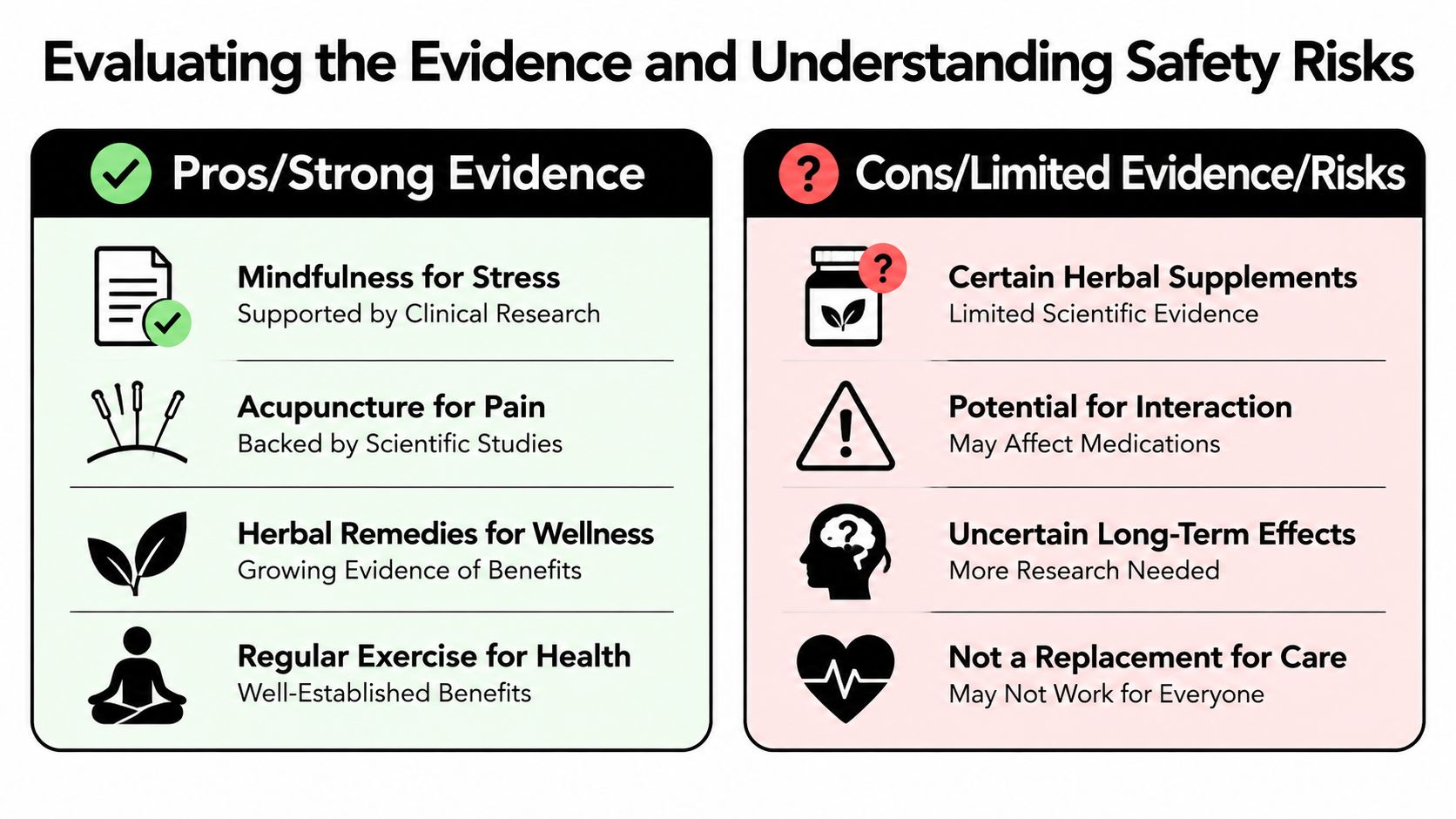
Use a safety-first evidence screen
Before accepting a recommendation, ask:
- What outcome does it address? Pain relief, sleep, nausea, anxiety, mobility, and disease control require separate evidence.
- How strong is the evidence? A controlled trial, umbrella review, clinical guideline, personal testimonial, and social media post do not carry equal weight.
- What are the risks and alternatives? Check side effects, cost, treatment delays, and medication or supplement interactions.
- How will we know whether it helps? Choose a concrete symptom or functional measure before starting.
Heart failure research demonstrates why the treatment and outcome must stay specific. A 2025 umbrella review of 22 reviews reported moderate-certainty evidence that co-enzyme Q10 or tai chi may reduce mortality and hospitalization. Evidence that acupuncture or intravenous Chinese herbal medicine improves BNP was low to very low certainty. The review also found that vitamin E may increase hospitalization and should be avoided.
Cancer care follows the same evidence standard. Oncology guidance describes integrative medicine as care used alongside, not instead of, conventional treatment. Acupuncture, massage, meditation, yoga, and related approaches may help some cancer-related symptoms, while evidence for other mind-body interventions and natural products remains low-certainty or inconclusive.
“Natural” does not mean harmless. Breast cancer guidance from the NCCN warns that ingested dietary supplements lack evidence for treating treatment-related side effects and advises against acetyl-L-carnitine for preventing chemotherapy-induced peripheral neuropathy because of possible harm. Discuss supplements with the oncology team first, and use this herbal medicine guide to prepare questions, not to self-prescribe.
Finding and Evaluating Local Integrative Medicine Providers
Finding a provider is only the first task. You also need to determine whether the person offers coordinated healthcare or uses “integrative” as a broad marketing label.
Five practical checks
- Check the professional license. Look for credentials that match the service, such as MD, DO, nurse practitioner, registered dietitian, licensed acupuncturist, physical therapist, or another regulated role. A wellness practitioner may offer useful support, but that role doesn't authorize diagnosis or prescribing.
- Verify relevant certification. Confirm board certification or professional registration through the appropriate licensing body. Don't rely only on a clinic's own description.
- Ask who coordinates care. Find out whether the provider communicates with your primary care clinician, specialist, pharmacist, or oncology team. Ask how records and medication changes are shared.
- Request the evidence rationale. A trustworthy practitioner can explain which symptom or outcome a therapy targets, what remains uncertain, and what risks matter for your history.
- Book a consultation before committing. Use the conversation to assess whether the provider asks about diagnoses, medications, allergies, conventional treatment, and urgent warning signs.
A credible clinic shouldn't promise universal results or insist that one protocol fits everyone. It should explain fees and treatment choices clearly, identify when conventional evaluation is necessary, and make it easy for you to keep your existing clinicians informed.
A directory can help you narrow local options, but it can't replace credential verification or a clinical consultation. Lucidoura's integrative medicine directory organizes local wellness and integrative listings by categories, cities, and descriptions of services, which can make initial discovery easier. Treat the listing as a research starting point, then investigate the provider's qualifications and coordination practices yourself.
Red flags deserve attention
Be cautious if a provider tells you to stop prescribed treatment, claims to cure multiple unrelated diseases, discourages questions, sells a large package before evaluating you, or presents testimonials as proof. A provider who can't explain uncertainty is not offering the transparency that evidence-informed care requires.
Questions to Ask Before Starting Integrative Treatment
Bring your medication list, diagnoses, allergies, recent treatment information, and your main health goal to the first conversation. Then ask direct questions:
- What specific symptom or outcome is this treatment intended to address?
- What evidence supports it for my condition, not just for general wellness?
- What are the known side effects, contraindications, and alternatives?
- Could it interact with my prescriptions, over-the-counter medicines, supplements, or cancer treatment?
- Who will coordinate this plan with my primary care clinician or specialist?
- What should I continue from my current treatment plan?
- How long should we assess the approach before deciding whether it helps?
- What will we measure, such as pain, sleep, mobility, nausea, or daily function?
- Which symptoms mean I should stop and contact a clinician?
- What will the full cost be, including follow-up visits and products?
Ask your primary care doctor the same questions from the other direction. Your doctor should know what you plan to add, and the integrative practitioner should know what conventional care you're receiving. Coordinated communication protects you from duplicated treatment, missed diagnoses, and avoidable interactions.
Keep a simple record of new therapies, doses, dates, symptoms, and side effects. If the plan becomes more complicated without a clear benefit, pause and ask the team to simplify it.
Lucidoura helps you discover local wellness and integrative venues through organized categories, city filters, and concise profiles describing services and amenities. Visit Lucidoura to compare nearby options, then use the questions in this guide to evaluate credentials, coordination, evidence, and safety before beginning care.