What Is Guided Meditation and How It Actually Works
Discover what is guided meditation, how sessions work, proven benefits, and where to find trusted local studios and classes near you.
Written by Editorial Team
Most advice about guided meditation starts and ends with “find a calming voice and relax.” That description is familiar, but it misses the point. Guided meditation isn't just background audio for feeling peaceful. It's a structured attention-training practice in which another person, a recording, text, video, or immersive technology gives you cues about where to place your attention, what to notice, and how to respond when your mind wanders.
That distinction changes how you choose a session and what you expect from it. Some practices emphasize breathing, others use body sensations, imagery, sound, movement, or focused observation. The common thread is guidance, not relaxation alone. A guide acts like a trail marker, helping you return to the chosen path without demanding that your thoughts disappear.
Redefining Guided Meditation Beyond Relaxation
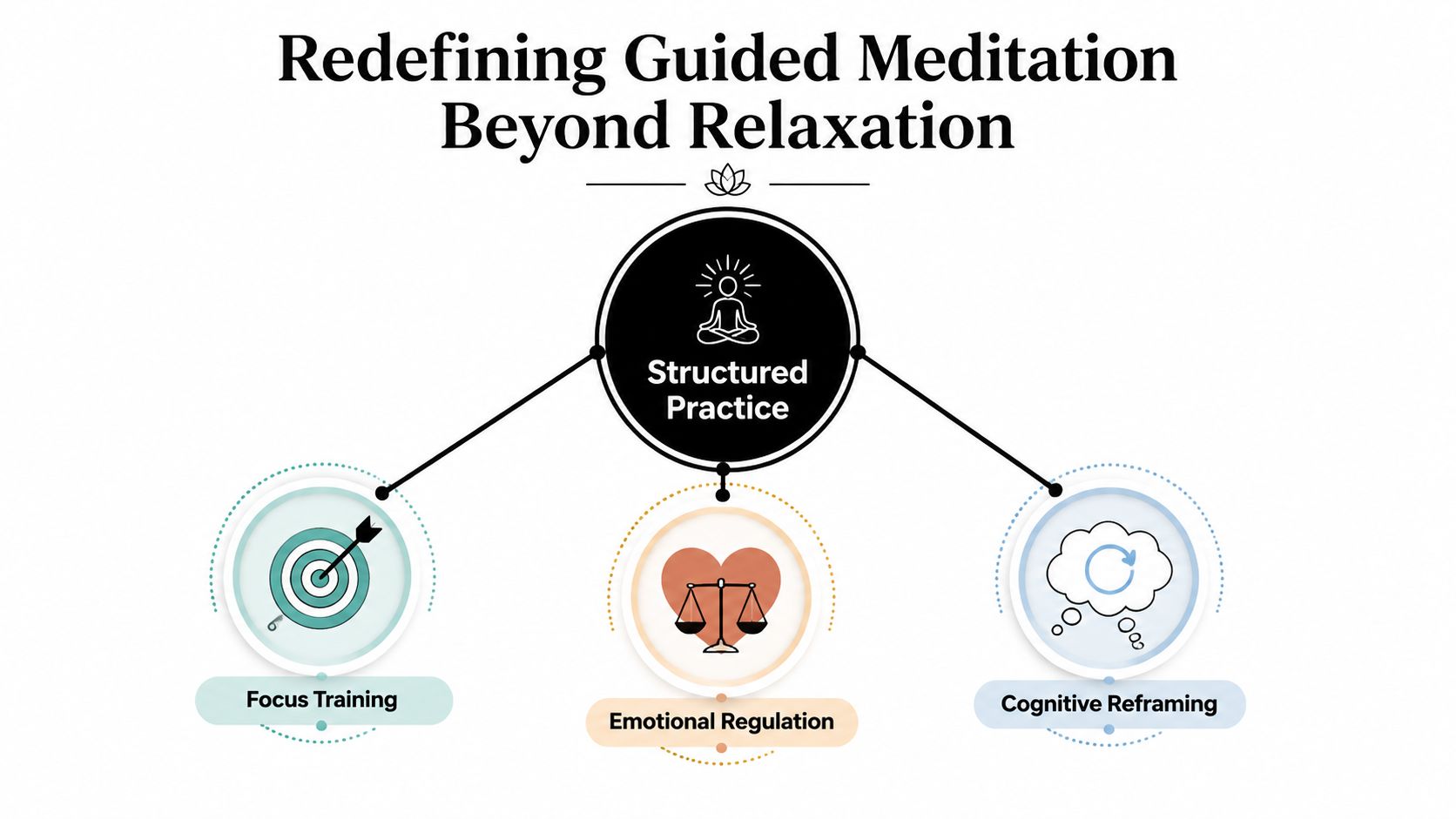
Guided meditation is best understood as an externally cued attentional protocol. You receive instructions that organize your experience, such as noticing the contact between your feet and the floor, following several breaths, observing a thought without pursuing it, or imagining a particular setting. The practice may calm you, but its central task is learning how attention moves and how you can gently redirect it.
That makes guided meditation a family of techniques rather than one fixed exercise. It can support attention training, emotional regulation, cognitive reframing, and clinical stress support, and it can be delivered in person, through text, audio, audiovisual media, or virtual reality. A recent USC report on meditation and attention describes research in which guided mindfulness practice improved attentional control in adults, reinforcing the idea that the practice involves focus as well as calm.
Four ideas people often confuse
An app feature: An app may offer guided meditation, but the app isn't the practice itself. The recording is a delivery method. Its quality depends on the clarity of the instructions, the pacing, and whether the technique suits your purpose.
A spiritual practice: Meditation has roots in religious and contemplative traditions, and some classes retain prayer, devotional language, or philosophical teachings. Other sessions are secular and focus on breathing, awareness, or stress management. Neither format automatically represents all guided meditation.
A therapy-adjacent tool: Guided meditation may complement care for stress or difficult emotions, but it isn't a substitute for mental-health treatment when you need clinical support. A responsible instructor should avoid presenting a general meditation class as a replacement for professional care.
A beginner-friendly form of mindfulness: Beginners often benefit from having someone explain what to notice and what to do after distraction. Experienced practitioners may prefer less instruction, but guidance can still be useful when exploring a new technique.
Practical rule: Judge a session by its attentional instructions, not by how soothing the voice sounds.
Ancient Roots and Modern Clinical Acceptance
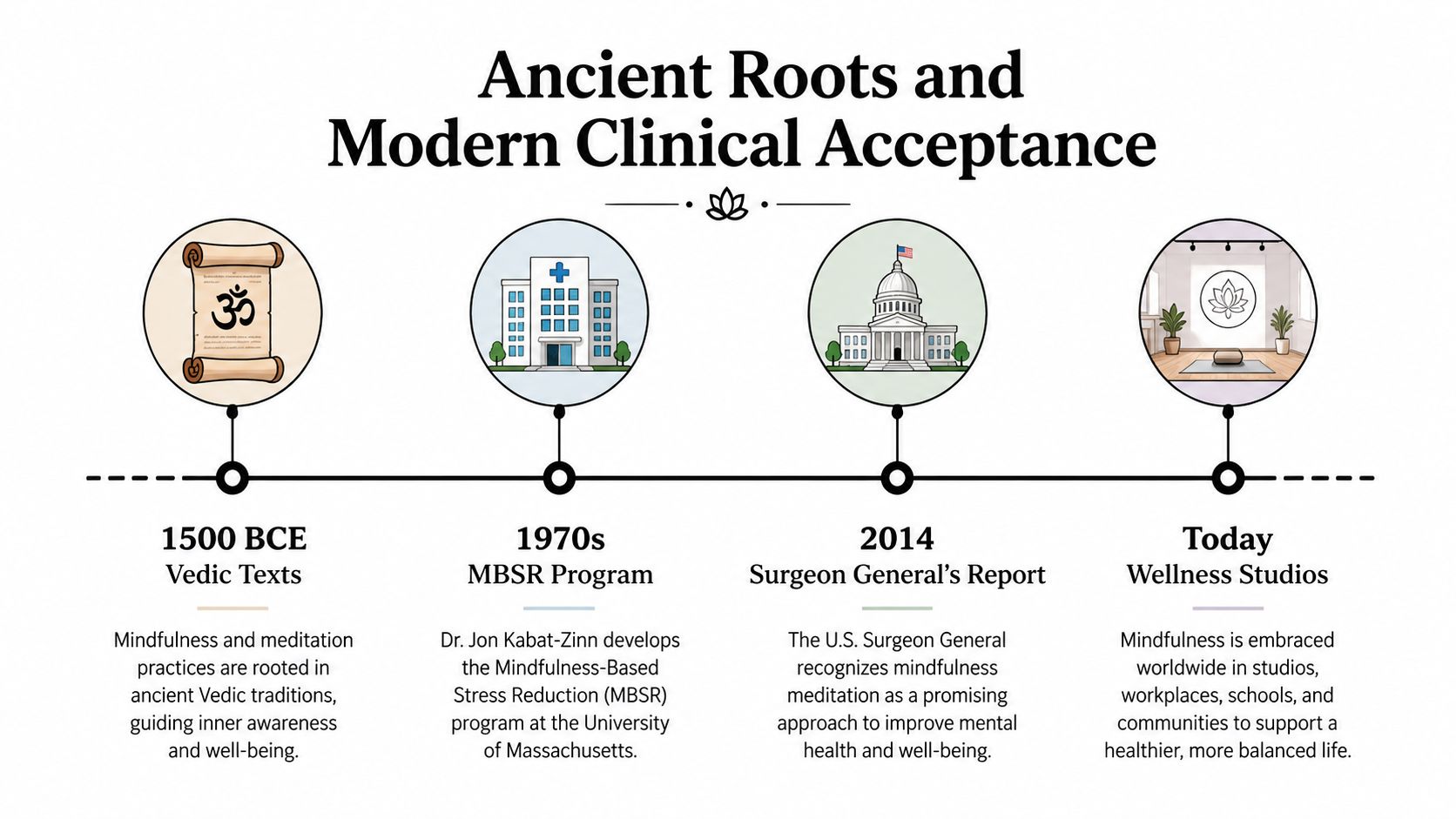
Guided meditation is not a new wellness invention. Its structure reflects an older purpose: training attention through repeated practice. Historians trace references to meditation as far back as 5,000 BCE in early Hindu scriptures such as the Vedas, giving the practice more than 6,000 years of historical continuity. That history does not validate every modern promise, but it shows that people have long worked with attention, imagery, breath, and inner experience.
Traditional practice generally asked students to develop self-direction over time. Guided meditation carries that aim into contemporary settings through a teacher's voice, a sequence of prompts, and a clear beginning and ending. The instructions act like handrails on an unfamiliar path. They tell a newcomer where to place attention, what to do after distraction, and how to return without treating wandering thoughts as failure.
From contemplative setting to clinical setting
Mainstream acceptance grew during the late twentieth century, as mindfulness-based programs entered clinical and secular environments. The 1979 launch of Mindfulness-Based Stress Reduction by Jon Kabat-Zinn helped bring meditation into hospitals, workplaces, and consumer wellness. This transition selected techniques that could be taught outside a religious community while leaving their contemplative roots intact.
A global meditation participation survey reported that meditation is practiced at least sometimes by 54% of respondents in the United States, with substantial participation also reported in India, Pakistan, Morocco, Malaysia, Mexico, and the Philippines. The same source discusses estimates placing the worldwide number of meditators between 200 million and 500 million, or roughly 2% to 6.25% of the global population.
Participation across different cultures and settings has helped create varied local entry points. A studio class can retain the inward attention of contemplative practice while adding a scheduled setting, a teacher's pacing, and the reassurance of practicing with others. For beginners, that structure can make guided meditation feel less like guessing and more like learning a repeatable skill.
Common Formats and Techniques Explained
Not every guided meditation feels the same. The best choice depends on whether you want to develop body awareness, settle mental agitation, work with imagery, explore sound, or receive more immersive support.
| Format | Primary Focus | Typical Duration | Best For |
|---|---|---|---|
| Body scan | Physical sensation and present-moment awareness | Short or extended sessions | People who think constantly and need a concrete anchor |
| Breath-focused guidance | Breath awareness and regulated pacing | Brief or moderate sessions | Beginners who want a simple object of attention |
| Visualization | Mental imagery and emotional processing | Moderate sessions | People who respond naturally to stories, places, or symbols |
| Sound bath | Listening and sensory anchoring | Session length varies by venue | Practitioners who find sustained listening easier than breath focus |
| VR-guided meditation | Immersive attention and concentration | Session length varies by program | Novices who engage strongly with visual environments |
| Movement-based meditation | Awareness through gentle physical activity | Session length varies by class | People who become restless when sitting still |
A body scan moves attention gradually through areas such as the feet, legs, abdomen, shoulders, face, and hands. You aren't trying to create a special sensation. You're learning to notice pressure, warmth, tension, tingling, or absence of sensation without immediately judging each experience.
Breath-focused guidance can be as simple as feeling the inhale and exhale. Some instructors add paced breathing, which makes the breath a more deliberate physiological input. Because breathing style can alter autonomic responses, a class should explain the cadence clearly rather than presenting every breathing pattern as interchangeable. The physiological evidence is mixed and style-dependent, as described in this review of meditation-linked cardiovascular responses.
Visualization uses the mind's ability to construct a scene. A guide might invite you to imagine a quiet shoreline, a warm light, or a difficult conversation unfolding with more space and choice. The image isn't a test of creativity. It's an attentional container that can make emotional reflection more accessible.
Sound baths use singing bowls, gongs, chimes, or other instruments as anchors. If you're curious about how this format differs from silent or breath-led practice, explore this guide to sound bath meditation. VR-guided and movement-based options add another layer of choice for people who struggle with conventional seated practice. Emerging research suggests both can affect stress, negative affect, concentration, and subjective experiences differently for novice meditators.
Evidence-Based Benefits and Realistic Expectations
Guided meditation is not a universal remedy for stress, sleep, focus, pain, and mood. Its clearest, most consistent benefit is a reduction in negative stress symptoms, especially anxiety and distress. Findings for sleep and attention remain insufficient or low in some reviews, so expectations should match the strength of the evidence.
A 47-trial systematic review found moderate anxiety reductions after 8 weeks, with an effect size of 0.38 and a 95% confidence interval of 0.12 to 0.64. At 3 to 6 months, the effect size was 0.22 with a 95% confidence interval of 0.02 to 0.43. The same systematic review of mindfulness meditation programs reported smaller but measurable reductions in depression and pain. Evidence for improved sleep and attention remained insufficient or low.
Why short sessions can still matter
A lengthy retreat is not required to begin. One clinical study associated 5 to 12 minutes of daily guided mindfulness meditation with decreased stress and anxiety and increased mindfulness. Another found that 8 weeks of brief daily meditation improved negative mood, attention, working memory, recognition memory, and state anxiety, as reported in the PubMed study on brief daily guided mindfulness. Short sessions function like repeated practice drills. Each one gives attention a manageable period in which to notice distraction and return.
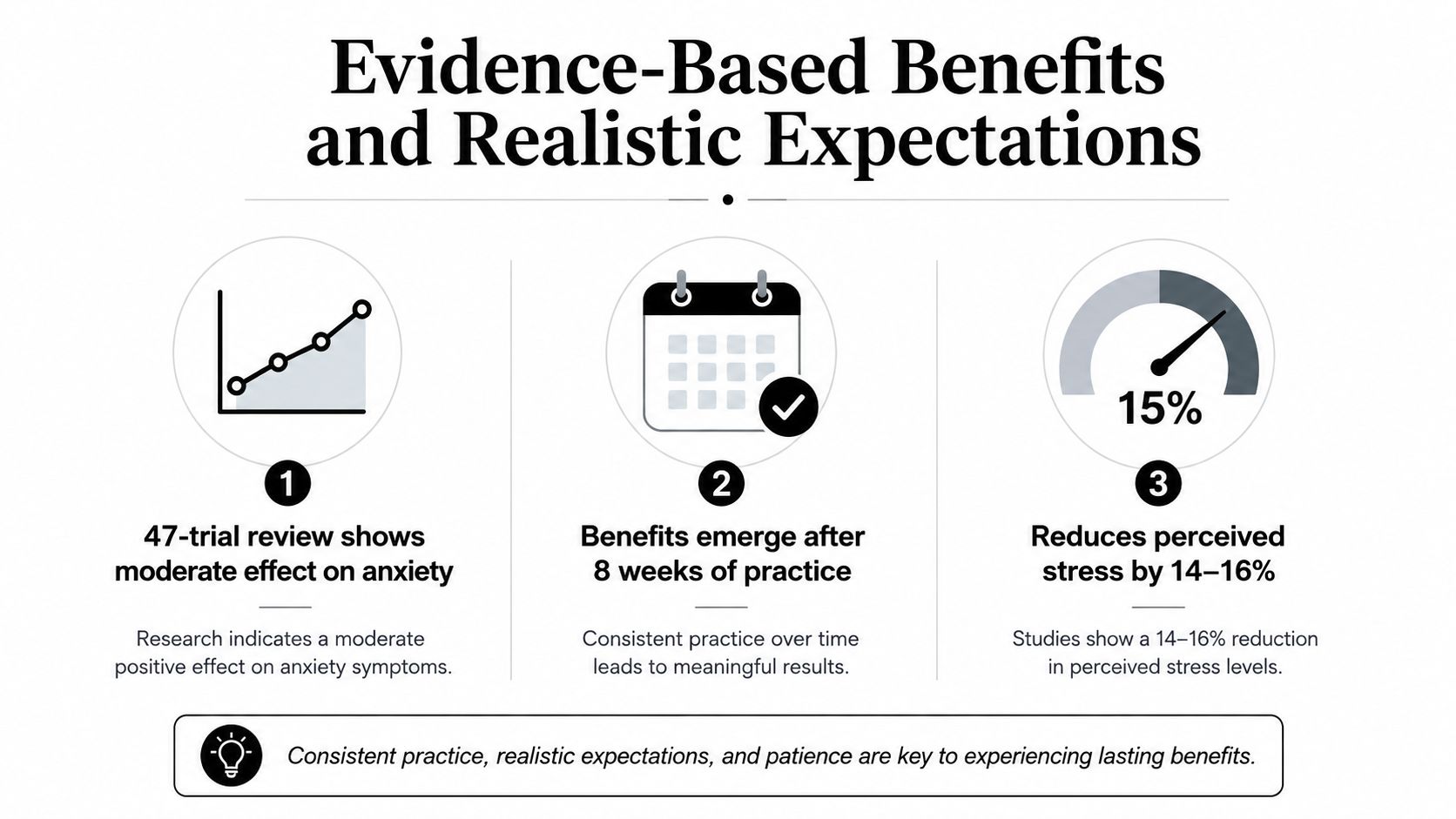
A single session may leave you calmer, more settled, or more aware of mental busyness. That immediate feeling is different from a demonstrated long-term outcome. For anxiety or distress, repeated structured practice over at least 8 weeks is a more realistic frame than expecting one recording to change your baseline.
Meditation does not guarantee pleasant sensations. Restlessness, sadness, boredom, and unexpected memories may arise. If practice consistently intensifies distress, stop and seek appropriate professional guidance instead of forcing yourself to continue. For more context on stress responses and regulation, read this resource on nervous system healing.
What to Expect During Your First Session
You'll usually arrive at a room arranged for stillness rather than performance. Depending on the venue, you might sit on a cushion, chair, mat, or reclined surface. The lighting may be soft, but comfort matters more than atmosphere. You don't need special clothing, flexibility, or the ability to empty your mind.
The instructor typically begins by helping you settle. You may hear prompts to feel the support beneath you, notice the room, soften unnecessary tension, or follow a few natural breaths. The guide then introduces a primary anchor, such as the breath, body sensations, sounds, or an imagined scene.
A typical sequence
First, you orient to the present. Your eyes may close, lower, or remain open with a relaxed gaze. The instructor's voice often becomes quieter and slower, leaving pauses long enough for you to test each instruction.
Next, attention narrows. You might track the breath at the nostrils, feel the movement of the abdomen, or scan from one part of the body to another. When a thought appears, the instruction usually isn't to fight it. You notice that attention has wandered, then return to the selected anchor.
Finally, the guide widens awareness again. You may notice the whole body, the sounds around you, and the transition back to ordinary activity. The session ends gradually so you aren't pushed from deep stillness into immediate conversation or movement.
Wandering thoughts aren't evidence that you're bad at meditation. Noticing the distraction and returning is the repetition that trains attention.
You may feel relaxed, alert, heavy, light, warm, restless, or emotionally neutral. Some people become sleepy, especially in a reclined session, while others discover that stillness makes their thoughts more noticeable. None of these responses is a required result. A useful first session is one in which you understand the instructions and learn something about your attention.
Practical Tips for Building a Beginner Practice
Start with a practice you can repeat, not one that sounds impressive. The clinical evidence on brief sessions suggests that a short daily routine can be meaningful, especially when you're learning the mechanics of returning to an anchor.
Make the first month simple
- Choose a small window: Begin with a brief session that fits your actual schedule. Morning, lunch, or the transition home can work, but consistency matters more than an ambitious duration.
- Use clear guidance: Select a recording or class that names the technique, gives instructions at a manageable pace, and identifies itself as suitable for beginners.
- Keep the cue visible: Place headphones, a cushion, or a calendar reminder where you'll see it. The goal is to reduce the number of decisions between intention and practice.
- Expect distraction: Don't measure success by silence. Count each gentle return to the breath, body, sound, or image as part of the exercise.
- Review your response: Afterward, note whether you feel clearer, sleepier, more agitated, or unchanged. That information helps you choose a better format next time.
Audio works well if you prefer privacy and predictable timing. A live class gives you a teacher who can explain posture and pacing, while an in-person studio can make practice easier to protect from household interruptions. Outdoor settings may suit people who find natural sounds more engaging than indoor silence. You can explore considerations for choosing outdoor meditation spaces.
Guidance isn't equally necessary for everyone. Novices often benefit from explicit cues, while experienced practitioners may want fewer prompts. Research on VR-guided, imagery-based, movement-based, and conventional formats suggests that the method can change the experience, so treat your first choice as an experiment rather than a permanent identity.
Finding Trusted Local Guided Meditation Studios
A local guided meditation studio should make its format easy to understand before you book. Look for the session type, whether the class is seated, reclined, movement-based, sound-led, or immersive, and whether the instructor describes the practice as beginner-friendly. A vague listing can leave you unsure whether you're signing up for mindfulness instruction, a sound bath, breathwork, or a spiritual gathering.
Use a practical comparison rather than choosing by atmosphere alone.
- Read the format: Check what guides attention and whether the class includes breath pacing, visualization, body awareness, sound, or movement.
- Check the instructor description: Look for clear information about training and teaching approach. Credentials don't guarantee a perfect fit, but transparent descriptions help you evaluate the setting.
- Match the environment: Consider seating, accessibility, noise level, lighting, and whether you're comfortable with touch, scent, group sharing, or hands-on adjustments.
- Notice related amenities: Some wellness venues combine meditation with services such as infrared saunas, float therapy, breathwork, or sound healing. These may complement your interests, but they aren't interchangeable with guided meditation.
- Start with the right commitment: Choose a single introductory session if you're uncertain. A repeat class or structured series may suit you once you know the instructor's style.
A curated directory can reduce the clutter of general search results by grouping meditation studios, sound-bath spaces, wellness clubs, and related venues under clear categories and city filters. Lucidoura offers local listings with concise descriptions of modalities and amenities, allowing you to compare nearby wellness spaces without treating every meditation experience as identical.
Before attending, contact the venue if you have questions about physical access, emotional support, session intensity, or what to bring. The right studio won't promise instant transformation. It will explain the practice clearly, set reasonable expectations, and give you enough information to decide whether its approach fits your needs.
Explore Lucidoura to find local meditation and sound-bath venues, compare session styles and wellness amenities, and choose a guided practice you can experience in person. Start with a beginner-friendly listing near you, then book the session that matches how you prefer to learn, focus, and settle.