What Is Contrast Therapy and How Does It Actually Work
Learn what is contrast therapy, how alternating hot and cold works, what the research really shows, who should avoid it, and where to try it locally.
Written by Editorial Team
Contrast therapy is the deliberate alternation of heat and cold exposures, and its documented research history reaches back to at least 1938. A systematic review identified 28 clinical research articles, but only 10 studies involving 264 participants met the criteria for stronger evaluation, so the practice has a plausible mechanism and limited evidence, not miracle status.
You may be considering it after a demanding workout, a long day on your feet, or a restless week when you want something more focused than just sitting in a steam room. You leave a warm sauna, cross cool tile, and face a cold plunge while your body negotiates the sudden change. That intense switch is the experience people mean when they ask, “What is contrast therapy?”
The basic answer is simple. Contrast therapy alternates hot and cold conditions to create repeated widening and narrowing of blood vessels, sometimes described as a vascular pumping effect. The experience may feel energizing, calming, or useful for temporary soreness, but the strongest claims about lasting cardiovascular, immune, mental-health, or performance benefits go beyond what current research can firmly establish.
The First Time You Step Between Hot and Cold
You step out of a wood-paneled sauna, feel cool air settle on your skin, and walk toward a cold plunge. Contrast therapy is the deliberate alternation between hot and cold exposures, often called contrast baths or contrast water therapy. The practice is defined by the switch itself, not by heat or cold alone.
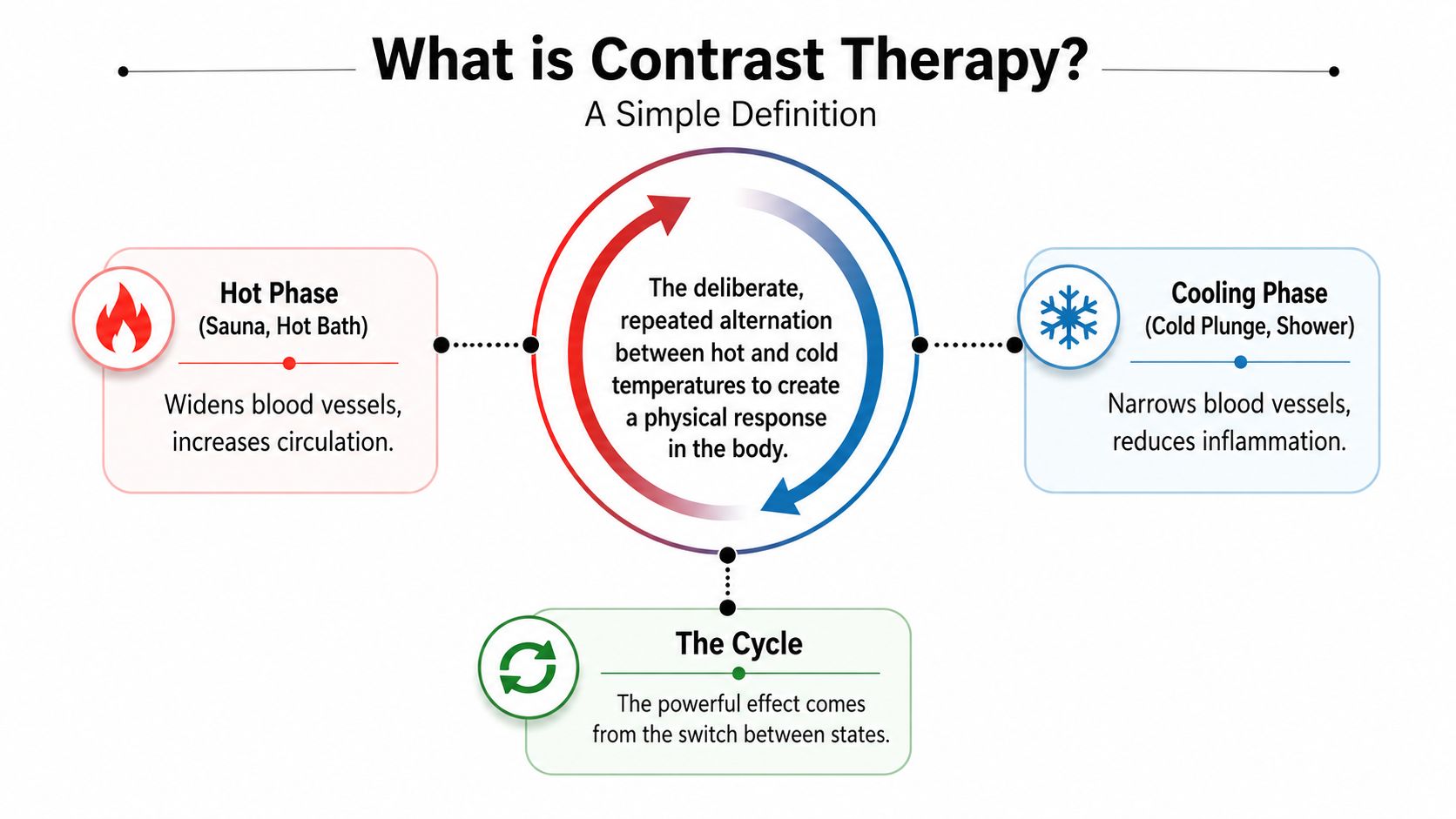
Historically, practitioners used contrast baths in rehabilitation and recovery settings. The approach has since appeared in spas, bathhouses, athletic recovery studios, and wellness clubs, where a person might move between a hot pool and a cold pool, or between a sauna and a plunge tank.
Two ways to experience the contrast
The first format uses water immersion. A person moves between warm and cold baths, tubs, or pools. Because water transfers heat efficiently, the temperature shift can feel immediate and physically pronounced.
The second format pairs a sauna with a cold plunge. The sauna heats the body through hot air, while the plunge cools it through cold water. Some venues use traditional Finnish saunas, others use infrared saunas, and the exact setup depends on the facility.
The sequence usually follows a repeating pattern:
- Heat phase: Spend time in a sauna or warm bath.
- Transition: Leave the heat and allow a brief pause if needed.
- Cold phase: Enter a cold plunge or use another cold exposure.
- Recovery: Warm naturally and notice how your body feels before repeating the cycle.
Contrast therapy isn't "using a sauna" or "taking an ice bath." Those practices may have their own effects, but contrast therapy depends on deliberately moving between opposite temperature states.
Practical rule: The transition should challenge you without forcing panic, numbness, or dizziness.
The experience has also become popular because it creates a clear ritual. You step into heat, tolerate a short cooling phase, recover, and repeat. That structure can make recovery feel intentional, even when the measurable physiological effects remain modest.
How Heat and Cold Talk to Your Blood Vessels
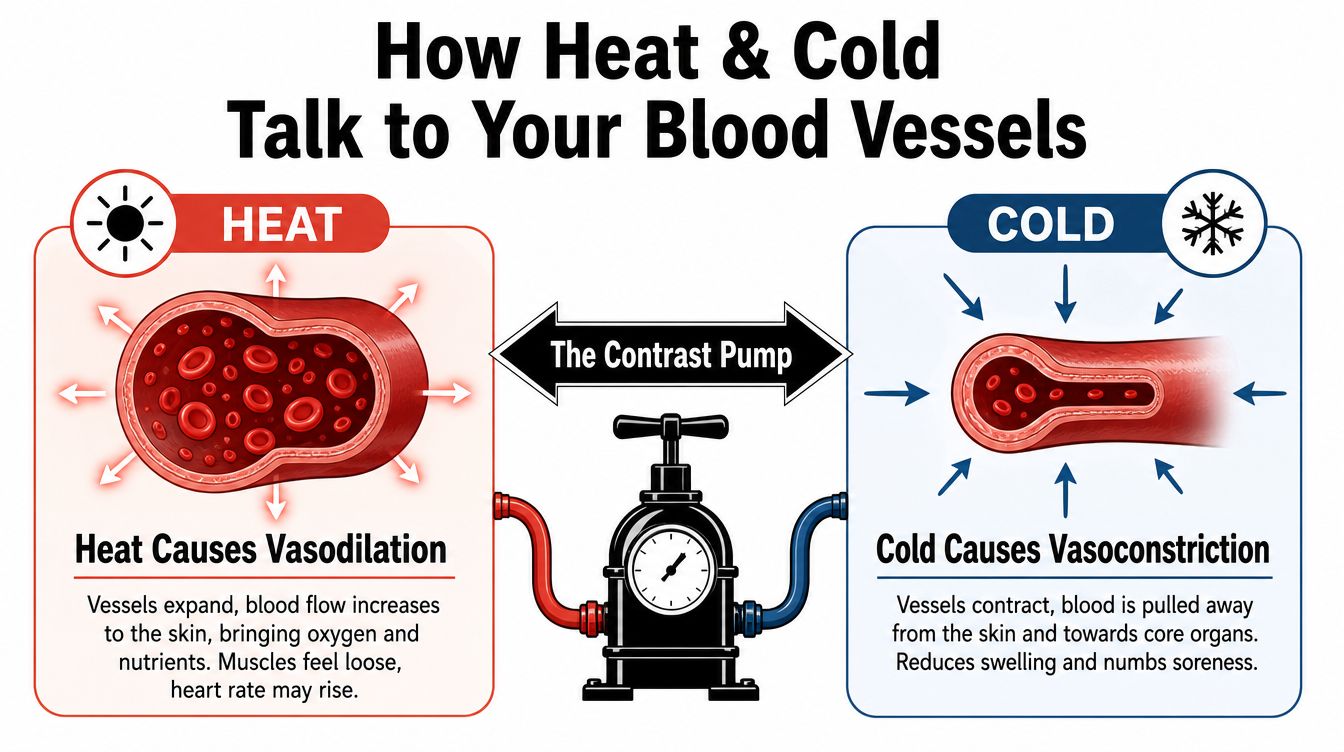
Think of your surface circulation as a two-way pump. Heat opens the output, allowing more blood to move toward the skin. Cold narrows the vessels near the skin, reducing local blood flow and encouraging the body to conserve heat. Alternating between the two creates a repeated push and pull.
During the hot phase, vasodilation means that blood vessels widen. The skin may flush, the body feels warmer, and muscles can seem looser. During the cold phase, vasoconstriction means that vessels narrow. This reduces local perfusion and can temporarily decrease swelling and the sensation of soreness.
Researchers often describe this alternating response as a vascular pump effect. The theory is straightforward: heat increases superficial circulation, cold reduces it, and the repeated transition changes how blood moves through tissues close to the skin.
A simple hot and cold cycle
| Phase | Main vascular response | What you may notice |
|---|---|---|
| Heat | Vessels widen | Warmth, flushing, relaxed muscles |
| Cold | Vessels narrow | Cooling, numbness, reduced soreness |
| Transition | The response changes direction | A strong shift in sensation and alertness |
The best-supported explanation concerns superficial blood flow and skin temperature, not a deep-tissue flushing process. A review of 10 studies involving 264 participants found weak evidence for improved superficial blood flow and skin temperature, while intramuscular temperature didn't significantly change in typical protocols. That suggests the effects are mostly closer to the surface than many wellness advertisements imply. Read the review of contrast therapy mechanisms.
This distinction matters. Contrast therapy may influence how warm, swollen, tight, or sore an area feels, but that doesn't mean it penetrates far into muscle or repairs injury directly. The body still relies on sleep, nutrition, gradual training, and medical care when an injury needs assessment.
Watch the embedded explanation after you've understood the basic vessel response. It can help turn the abstract “pump” idea into something easier to visualize.
A Typical Sauna and Cold Plunge Protocol
A first session often feels less dramatic than social media suggests. You enter a sauna, let your body warm gradually, step into cold water for a short period, then return to a neutral temperature before deciding whether to continue.
One representative example uses a 10 to 20 minute sauna at roughly 80 to 90 degrees Celsius, followed by 30 seconds to a few minutes in cold water at 10 to 15 degrees Celsius. The person may repeat the sequence for 3 to 4 rounds, ending with cold when they want an energizing finish. These figures come from the example protocol described in the brief, not a universal prescription.
A water-based version might use a hot tub at 38 to 40 degrees Celsius, then a cold bath or plunge. A sauna-and-plunge venue may give you different instructions because the heat source, water temperature, supervision, and room design all change the experience.
What one session feels like
You begin warm, breathing normally and allowing your skin and muscles to acclimate. The cold phase then creates the sharpest moment, often bringing an involuntary gasp or strong urge to exit. The point isn't to prove that you can tolerate the most intense exposure. It's to remain controlled and stop before your body gives you warning signs.
Beginners generally do better with shorter and milder contrasts. You don't need to copy an influencer's extreme routine, and you shouldn't assume a longer session produces a better result. A venue with staff guidance can help you adjust the timing rather than treating a sample protocol as a rule.
Why protocols differ
Athletic recovery programs, clinical rehabilitation, and spa-style wellness sessions may use different sequences. Some people finish cold for a more stimulating sensation, while others finish warm because they prefer a calmer transition out of the session.
A useful starting point: Treat the first visit as an assessment of your response, not a test of toughness.
Leave enough time to recover between rounds. If you feel light-headed, confused, unusually breathless, or unable to warm yourself comfortably, stop the session and tell staff. Contrast therapy should feel demanding but manageable, not like a contest against your body's warning system.
What the Research Actually Shows
The research supports a narrower claim than the marketing often suggests. Contrast therapy appears promising for perceived muscle soreness and some short-term recovery outcomes, but the evidence doesn't establish it as a reliable performance enhancer for everyone.
A systematic review of exercise-induced muscle damage pooled data from 13 studies. It found that contrast water therapy produced significantly greater improvements in muscle soreness than passive recovery at five follow-up points, including less than six hours, 24 hours, 48 hours, 72 hours, and 96 hours after exercise. Review the findings on contrast water therapy and soreness.
That result can guide expectations. You might feel less sore after exercise, particularly compared with doing nothing, but reduced soreness isn't the same as faster tissue healing or guaranteed improvement in your next workout.
What short-term recovery evidence means
One study described in the same literature used a 14-minute protocol with endurance cyclists. It compared cold water immersion at 15°C, hot water immersion at 38°C, contrast therapy alternating 38°C and 15°C, and passive recovery. Across a five-day trial, sprint and time-trial performance were significantly better after cold water immersion and contrast therapy than after hot water immersion or passive recovery.
This is useful evidence, but it's still a specific protocol involving a particular group and comparison. It doesn't prove that every sauna-and-plunge session will improve performance, or that contrast therapy works better than sleep, carefully planned training, or other recovery methods in every situation.
The historical record also calls for restraint. A systematic review identified 28 clinical research articles published from 1938 onward, yet only 10 studies met inclusion criteria for stronger evaluation. Those studies included 264 participants, with individual sample sizes ranging from 16 to 51, and were published between 1939 and 2007. See the earlier systematic review of contrast baths.
The fairest conclusion is calibrated: contrast therapy is a partially supported recovery option, particularly for soreness, with limited and inconsistent evidence for broader functional benefits. It may be worth trying if you enjoy it, but it shouldn't replace fundamentals or be sold as a clinically proven solution.
For readers comparing cold-based practices, the explanation of what cryotherapy treatment involves can help distinguish whole-body or localized cryotherapy from the alternating hot-and-cold format described here.
Hype Versus Honest Expectations
Contrast therapy's popularity has grown faster than the certainty of its evidence. Wellness language often turns a short-term sensation into a promise of systemic transformation, but those are different things.
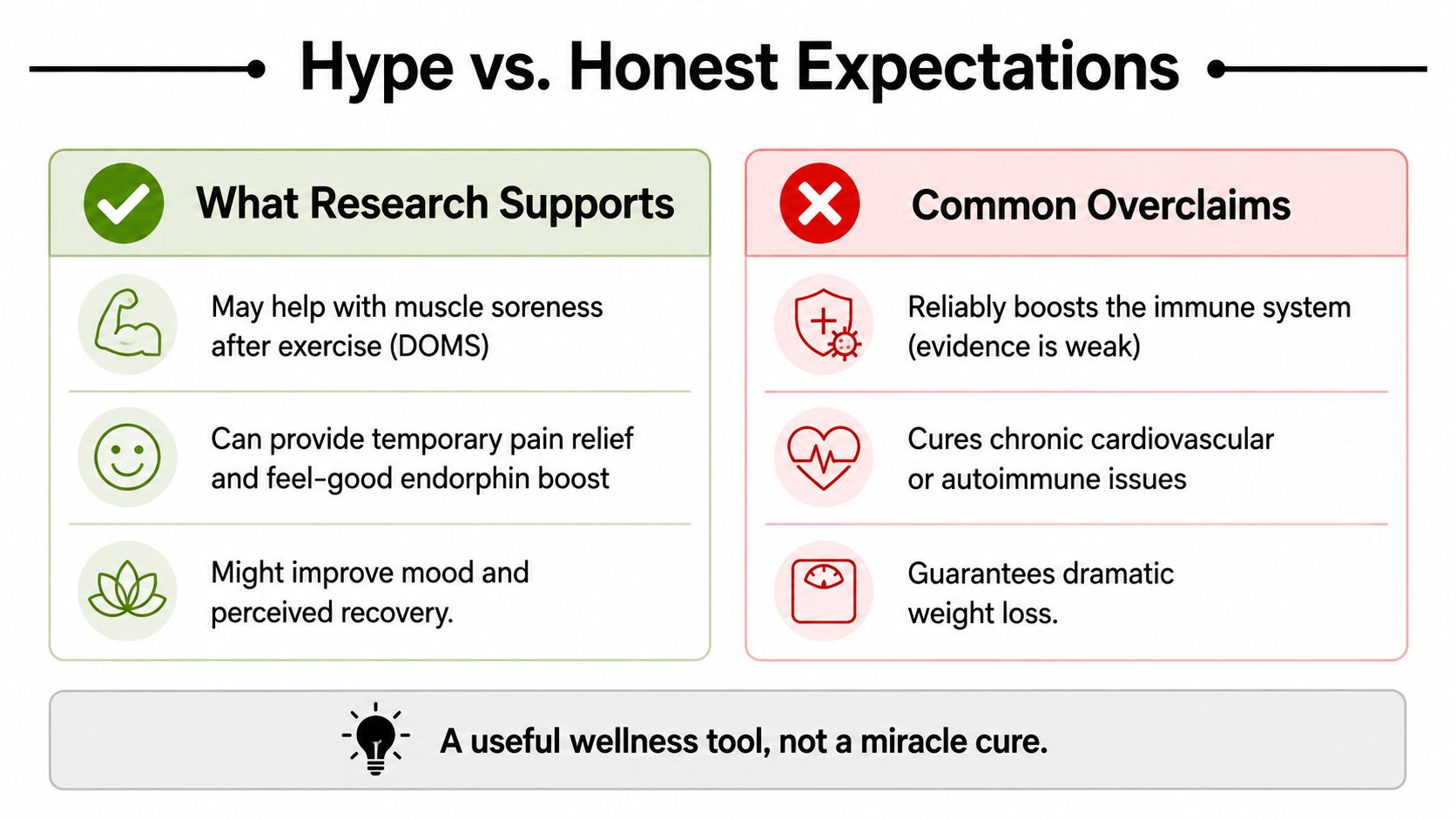
You may see claims that hot-and-cold exposure reliably boosts the immune system, corrects chronic cardiovascular problems, produces lasting mental-health benefits, or delivers dramatic weight loss. Current evidence doesn't justify those promises. Recent commentary from the American Medical Association's discussion of cold plunges and contrast therapy says research hasn't shown that contrast therapy speeds recovery or provides lasting cardiovascular, mental-health, or immune benefits. It also notes that protocols vary widely, making broad conclusions difficult.
Separate sensation from proof
The practice can still feel valuable. Heat may feel relaxing, cold may feel invigorating, and completing a controlled challenge can give the session a strong psychological shape. Those experiences are real, but a pleasant or powerful feeling doesn't prove that contrast therapy has repaired tissue, strengthened immunity, or changed long-term health.
A more defensible set of expectations looks like this:
- Soreness: It may reduce perceived muscle soreness after exercise.
- Short-term recovery: It may help some athletes recover between efforts.
- Mood and ritual: You may enjoy the alertness, relaxation, or sense of reset.
- Long-term health: Current evidence doesn't establish durable immune, cardiovascular, or mental-health benefits.
The contrast therapy literature also includes randomized trials rated poor quality in a 2025 review, which helps explain why confident consumer claims exceed the strength of the data. Protocols differ in temperature, exposure length, order, participant health, and comparison group, so “contrast therapy” can describe very different experiences.
Contrast therapy can be a useful wellness ritual without being a miracle cure.
Use that sentence as a filter when evaluating a venue or advertisement. A responsible provider should explain the setup, screen for relevant health concerns, and let you choose a conservative starting point. Marketing that promises to cure disease or guarantees dramatic body changes deserves skepticism.
Who Should Pause and Talk to a Doctor First
The temperature shift is the central feature of contrast therapy, but it's also the reason some people need medical guidance. Heat and cold can produce abrupt changes in circulation and blood pressure, which may increase the risk of dizziness, fainting, burns, or cold injury in vulnerable people.
The contrast therapy safety guidance from Peloton lists several conditions and situations that warrant caution or professional advice. A recent review also emphasizes that safety deserves more attention than many benefit-focused articles provide.
Cardiovascular concerns
Speak with a clinician before trying contrast therapy if you have heart disease, arrhythmias, or uncontrolled high blood pressure. The heart and blood vessels must respond to rapid temperature changes, and a medically supervised setting may be more appropriate than an unscreened spa session.
The same caution applies if you have a history of circulation-related events or have been told to avoid intense heat or cold exposure. Don't assume that being physically fit removes cardiovascular risk.
Temperature and sensation concerns
Cold exposure may be unsuitable without guidance if you have Raynaud's phenomenon, severe cold sensitivity, or diabetes-related circulation problems. Neuropathy or reduced sensation also matters because you may not accurately feel excessive cold or heat until tissue damage has occurred.
Pregnancy requires individualized advice rather than a generic internet protocol. Ask your obstetric clinician before using a sauna, hot bath, or cold plunge.
Skin and other health considerations
Avoid immersion over open wounds or active skin infections. Discuss contrast therapy with a medical professional if you have bleeding disorders, significant circulation problems, or another condition that could affect how your body handles temperature stress.
Stop immediately if you feel faint, confused, unusually weak, or unable to control your breathing. Tell staff rather than trying to push through it, and don't re-enter the heat or plunge until you've received appropriate guidance.
For broader sauna precautions, review these sauna safety tips for screening and preparation. A quality venue should ask about health conditions, explain emergency procedures, provide clear entry and exit instructions, and avoid pressuring guests to use extreme temperatures.
Safety comes before intensity: If you aren't sure whether your heart, circulation, nerves, pregnancy status, or skin condition makes contrast therapy appropriate, ask a clinician first.
Where to Try Contrast Therapy Locally
Contrast therapy appears in several kinds of wellness venues, and the setup can vary considerably. Traditional bathhouses may offer hot and cold pools. Modern wellness clubs often pair an infrared or Finnish sauna with a dedicated cold plunge. Athletic recovery studios may build the experience around post-training use, while some luxury spas offer a guided hot-and-cold ritual.
The venue type affects the level of support you'll receive. A staffed recovery studio may explain how to enter the plunge and monitor your pacing. A self-guided bathhouse may give you more independence but less individualized instruction. Before booking, check whether the venue lists the actual modalities, whether staff provide an orientation, and whether the facility screens guests for contraindications.
Lucidoura is a curated directory of local wellness businesses, including venues with saunas, cold plunges, bathhouses, and recovery-focused modalities. Its categories and city filters can help you narrow a search by location and offering instead of sorting through unrelated general search results. You can use the directory of spas and wellness venues near you as a starting point for comparing local options.
What to look for in a listing
- Specific equipment: Look for a sauna, cold plunge, hot pool, or contrast suite named clearly.
- Beginner support: Check whether staff explain timing, temperature, and transitions.
- Health screening: Prefer venues that ask about medical conditions before exposure.
- Clean facilities: Confirm that pools, changing areas, and shared equipment appear well maintained.
- Transparent format: Find out whether the experience is private, guided, self-directed, or shared.
Trying contrast therapy at a curated local venue can be a sensible first step. You can learn how your body responds without immediately buying equipment or copying an extreme home routine, and you can ask practical questions before entering the water.
Your First Visit Without the Guesswork
Arrive prepared, but keep the first session conservative. Bring swimwear, sandals, a water bottle, and a robe if the venue doesn't provide one. Drink water before and after, and avoid arriving already dehydrated or overheated.
Ask staff to explain the full sequence before you begin. Tell them you're new, start with shorter and milder contrasts, and take time between rounds to notice your breathing, balance, and temperature. If you feel dizzy, panicked, numb beyond what feels manageable, or unwell, exit and stop.
A good venue won't pressure you to stay longer or use colder water. It should explain the equipment, provide a clear way to leave each station, and take your health history seriously.
You may find the practice more useful as a familiar ritual than as a one-time challenge. Track how you feel afterward, including soreness, energy, comfort, and sleep, without assuming every positive sensation proves a medical benefit.
Lucidoura helps you find local saunas, cold plunges, bathhouses, spas, and recovery spaces through organized wellness categories and city-based discovery. Visit Lucidoura to compare nearby venues and choose a supervised place to experience contrast therapy with realistic expectations.