Nervous System Healing: A Practical Calm Guide
Discover nervous system healing techniques to restore calm regulation. Your step-by-step path to balance and resilience starts here.
Written by Editorial Team
You're lying in bed, exhausted but wired, scrolling for one more answer because your body still won't settle. The day looked ordinary on paper, yet your shoulders never dropped, your jaw stayed tight, and now you're trying to figure out whether this is stress, trauma, a bad week, or something deeper that needs actual care.
Nervous system healing gets used as a catchall for all of that, which is why it's so confusing. It can mean helping your body leave survival mode, supporting the brain's ability to rewire with practice, or repairing an actual nerve or injury issue that needs rehabilitation.
That distinction matters. If you treat a regulation problem like a nerve injury, you can end up over-medicalizing normal stress responses. If you treat a clinical injury like a wellness issue, you can miss the care that would help you most.
What It Means to Heal the Nervous System
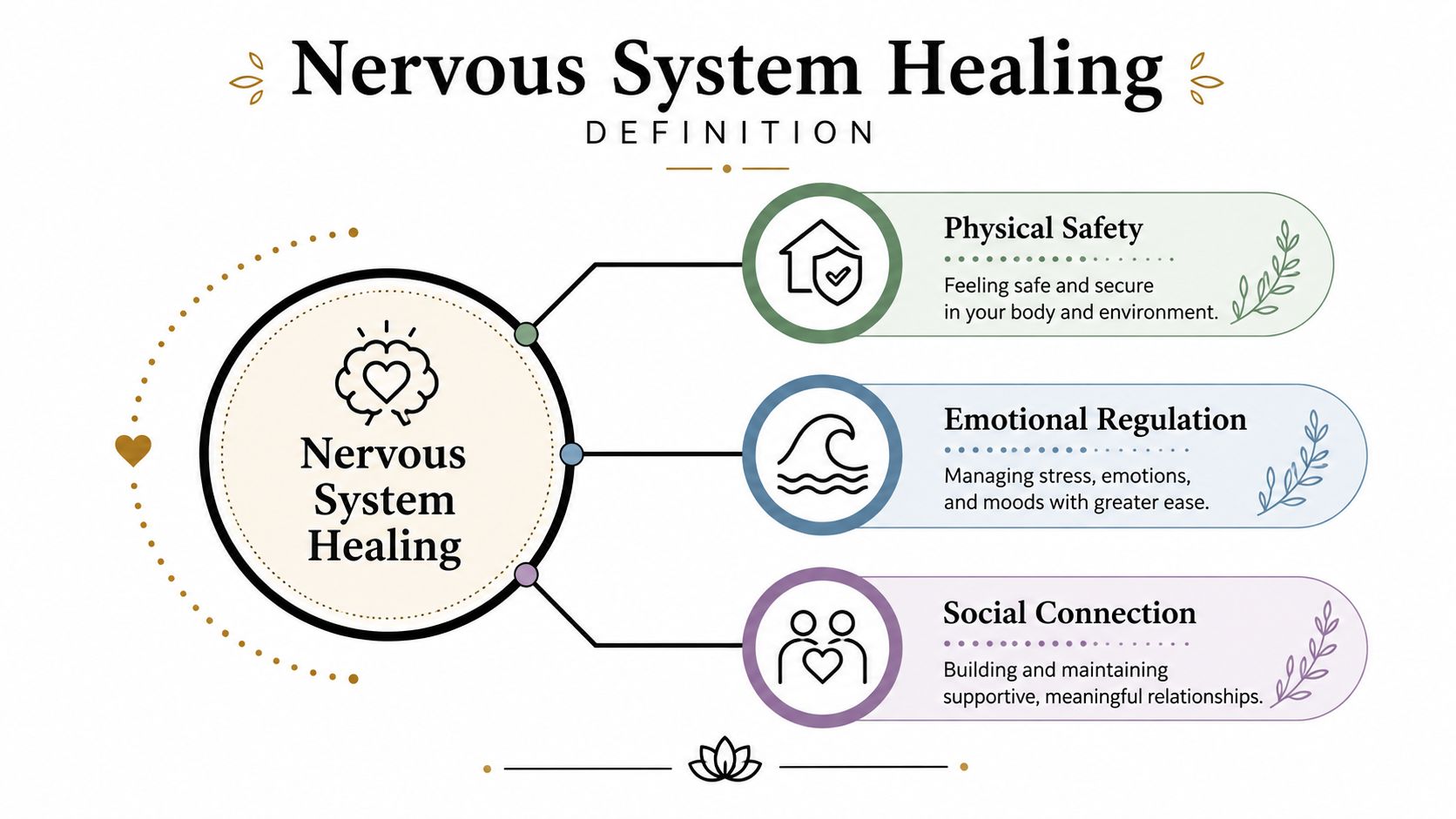
The cleanest way to understand nervous system healing is to stop treating it like one thing. A person with a compressed nerve after injury, a burned-out parent stuck in hypervigilance, and someone relearning habits after a stroke are all working with the nervous system, but they're not working on the same layer.
Three layers keep getting mixed together
At the first layer is biological repair, which is about nerves, axons, and tissue. Modern research has moved away from the old idea that central nervous system damage is irreversible, but it still describes healing as limited regeneration plus rewiring plus rehabilitation, not a single miracle fix. That shift exists for a reason, since spinal cord injury still carries major burden, with about 17,000 new spinal cord injury cases each year in the United States and about 1.2 million people in the U.S. living with paralysis due to spinal cord injury (review on nervous system healing history).
The second layer is neuroplastic rewiring, which is the brain and body learning through repetition, attention, environment, and support. A person practicing speech after stroke, or retraining movement after injury, is using this layer every day.
The third layer is autonomic regulation, which is the body's shifting between calm, alert, and shutdown states. That's the layer meant when they say they want to “calm their nervous system.”
Practical rule: if the problem changes with rest, breath, touch, or a safer environment, regulation may be the main issue. If the problem involves loss of function, injury, or neurological symptoms, clinical evaluation belongs in the picture too.
Why the phrase feels so broad
People say “my nervous system needs healing” when they're talking about fatigue, panic, freeze, migraines, trauma triggers, nerve pain, or all of the above. That's understandable, but it blurs the decision about what kind of support makes sense next.
The rest of this guide keeps those layers separate on purpose. Once you know whether you're trying to support repair, rewiring, or regulation, the next choice gets simpler and a lot less random.
How the Autonomic Nervous System and Polyvagal Theory Work
Think of the autonomic nervous system like a car with a gas pedal and a brake. The sympathetic nervous system is the accelerator, it mobilizes you for action. The parasympathetic nervous system is the brake, it supports rest, digestion, and recovery.
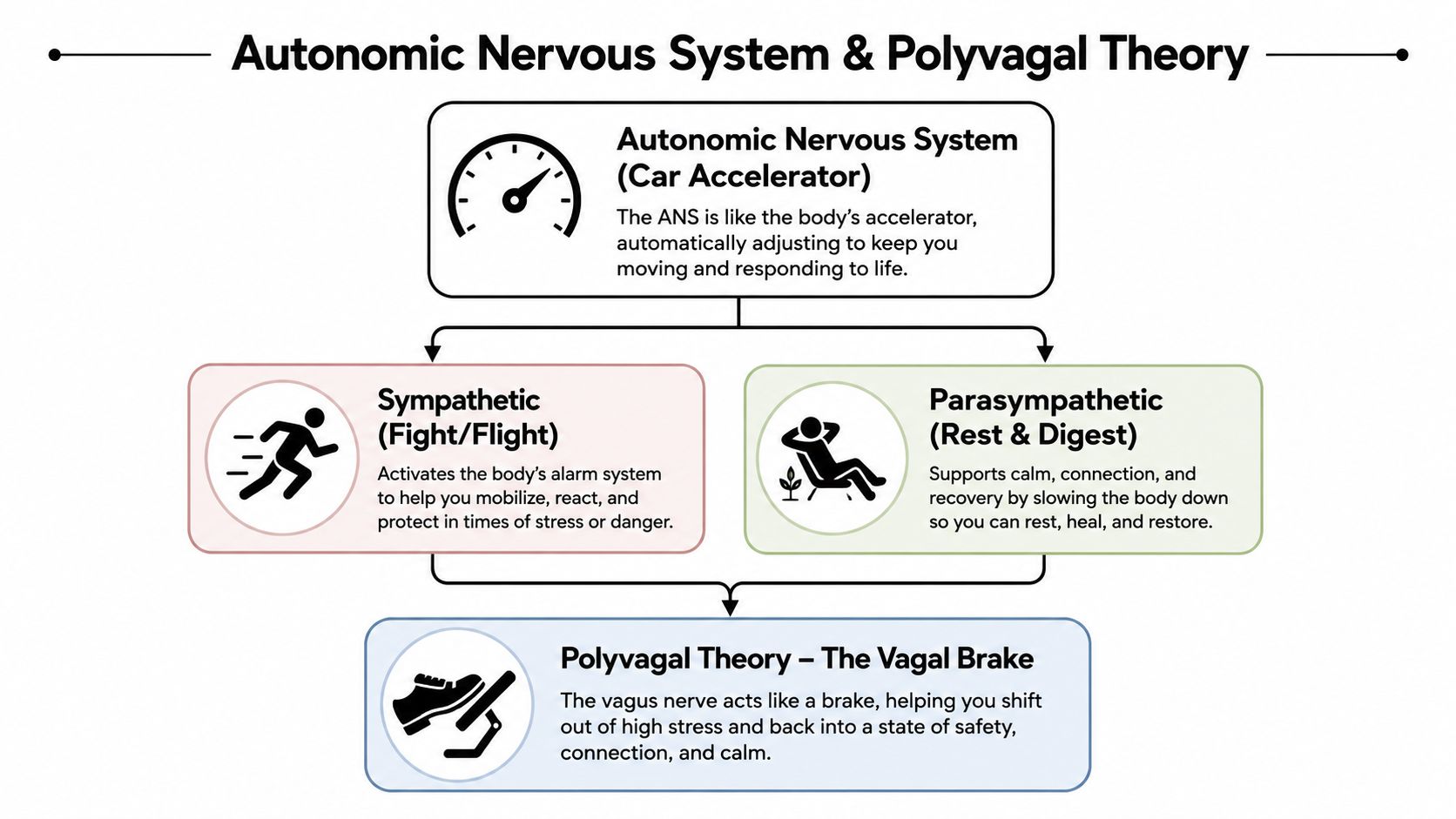
When people are chronically stressed, the issue usually isn't that the brake disappeared. It's that the system keeps tapping the gas, or can't fully settle after it does.
Polyvagal language without the fog
Polyvagal theory adds a more detailed map of those states. In plain language, the ventral vagal state is the “safe and social” zone, where a person can make eye contact, speak clearly, and feel present. The sympathetic state is mobilization, which can feel like urgency, worry, anger, or the need to keep moving. The dorsal vagal state is shutdown, which can look like numbness, collapse, or a heavy, disconnected kind of tired.
Those states are not moral categories. A person in shutdown isn't lazy, and a person in mobilization isn't weak. Their system is responding to what it reads as safe or unsafe.
The useful working definitions
Vagal tone is often used to describe how effectively the vagal system supports regulation. Neuroception refers to the body's automatic sense of safety or threat, often before conscious thought kicks in. Both words help only if they make the body's pattern clearer, not if they become jargon for its own sake.
A stressed client might call their week “anxiety,” but the body may be doing different things hour by hour. On Monday they're revved up and over-explaining. By Thursday they're flat, avoiding messages, and staring into space. Both can be protective responses.
The goal isn't to force calm. It's to help the system move through activation and recovery without getting stuck at either extreme.
What Healing Actually Involves at Each Level
Once the layers are separated, the word healing stops sounding vague. At the repair layer, it means helping damaged tissue and nerves reconnect as well as they can. At the rewiring layer, it means teaching the brain and body a new pattern through repetition. At the regulation layer, it means lowering threat load enough that recovery becomes possible at all.
Biological repair needs more than waiting
Peripheral nerves still have real regenerative capacity, but functional recovery depends on whether regenerating axons reconnect with the right targets. That's why proximal-nerve electrical stimulation matters in the literature, because it can improve the speed and accuracy of axonal regeneration by biasing regrowth toward better reinnervation (Frontiers review on electrical stimulation).
That's a very different problem from chronic stress. A person recovering from a peripheral nerve injury may need rest, physical therapy, desensitization, and regeneration-supportive care. Spontaneous recovery alone may not be enough.
Rewiring is practice, not wishing
A stroke survivor retraining speech isn't “positive thinking” their way into recovery. They're using repetition, feedback, and time to reorganize pathways so a function can return in a workable form. That is neuroplasticity in action.
The same principle shows up in everyday life, just at a smaller scale. A person who learns to pause before reacting in conflict is also changing a circuit, only the circuit is emotional and behavioral instead of motor.
Regulation lowers the threat load
A chronically stressed professional may not have a nerve injury at all. They may need the body to stop reading every email, noise, and interruption as a threat. Breath, movement, sleep, safe contact, and steady routines matter here because they create conditions where the system can stop bracing.
The historical shift matters because it keeps expectations honest. Nerves are not fully repairable on demand, but recovery can still be meaningful when repair, rewiring, and regulation are matched to the actual problem. That's the difference between trying random wellness tools and choosing the right support on purpose.
Modalities Worth Your Time and How to Read the Evidence
A perfect method isn't necessary. What matters is a method that matches the goal. Breathwork, meditation, somatic therapy, yoga, sound healing, heat or cold exposure, and acupuncture all sit in different places on the map, and they shouldn't be judged as if they do the same job.
| Modality | Primary Layer | Evidence Strength | Best For |
|---|---|---|---|
| Breathwork | Regulation | Strongest as a self-regulation entry point | Fast state-shifting, anxiety, sleep prep |
| Meditation | Regulation and attention training | Established, but technique matters | Building steadiness and awareness |
| Somatic therapy | Regulation and rewiring | More specialized, therapist-dependent | Trauma patterns, body-based triggers |
| Yoga | Both | Broadly supportive, variable by style | Combining movement, breath, and presence |
| Sound healing | Regulation | Thin to moderate, often experience-based | Low-effort relaxation and downshifting |
| Cold and heat therapy | Regulation | Mixed, depends on tolerance and context | Acute state changes, tolerance training |
| Acupuncture | Regulation and symptom support | More formal clinical context | People wanting a regulated, hands-on option |
What each one actually changes
Breathwork and meditation are usually the easiest entry points because they work through the state layer first. They don't need a full life overhaul, just repetition and enough safety to avoid turning practice into another stressor. If sleep or overactivation is the main complaint, those are often the cleanest first tries.
Somatic therapy goes deeper when trauma is organized in the body as a pattern of bracing, collapsing, or bracing again. Yoga sits between movement and stillness, which is why some people find it easier than seated meditation and others find it more activating. Sound healing can be helpful as a low-effort cue for relaxation, especially when effort itself feels overwhelming.
Cold and heat are different. They're more like acute switches, useful for some bodies but too intense for others. Acupuncture is often experienced as a regulated clinical intervention, which makes it appealing for people who want something structured and hands-on.
Read the evidence by asking one question first: does this modality change my state, my habits, or my tissue-level recovery? If the answer is unclear, it probably isn't the right first tool.
For a related example of how context changes the value of a wellness practice, the ideas in this guide to forest bathing benefits show why environment can matter as much as technique.
A simple filter for choosing
If you're wired and can't wind down, start with breath or a gentle downshift practice. If you're disconnected, frozen, or overly analytical, body-based work may fit better than more mental processing. If you have a real injury, prioritize rehab-informed care before layering on wellness trends.
The point isn't to rank these tools as good or bad. It's to stop asking one modality to solve three different problems.
A Trauma-Informed Starter Routine You Can Try This Week
Trauma-informed work starts with consent, not intensity. A routine that helps one person settle can overload another, so the safest version is small, repeatable, and easy to stop if your body says no.
Start with one state shift a day
Day one can be 4-7-8 breathing or a gentle coherent breathing session. Keep it short, sit with your feet supported, and stop if you get dizzy or spaced out. The aim is not a perfect pattern, it's a small move toward steadiness.
Day two can be a soft body scan or a few minutes of yoga nidra. If stillness makes you uneasy, keep your eyes open and orient to the room between breaths. Day three can be a sound bath or restorative yoga session, ideally one that feels spacious rather than demanding. Day four can be a slower walk or a warm shower, both of which can help the body exit threat mode without a lot of cognitive effort.
Safety comes before intensity
Cold plunges are not a first-line trauma practice. They can feel helpful, but they can also spike the stress response when the system already runs hot. Breathwork needs the same respect, because too much too fast can create the opposite of regulation.
A simple marker helps here. If a practice leaves you clearer, warmer, and more present, that's a good sign. If it leaves you foggy, panicky, or emotionally flooded, scale down or switch methods.
A few grounded guardrails
- Shorter is safer: one to five minutes is enough to start when your system is on edge.
- Choose familiar settings: a quiet room, a closed door, or a park bench can matter more than the technique itself.
- Use touch if it helps: a hand on the heart or belly can be more stabilizing than more mental instructions.
- Stop for new symptoms: dizziness, intense dissociation, panic, or numbness that lingers are signs to pause and get support.
For a shorter, practical companion to breathing-based work, this breathwork for sleep guide fits well with a nighttime routine.
Knowing When a Studio Helps and When a Clinician Helps
A wellness studio is a strong fit when the main need is regulation. A licensed clinician is the right next step when the problem looks neurological, function-limiting, or stuck in a way that wellness tools can't responsibly address.
A simple symptom-to-action map
If the pattern is fatigue, sleep disruption, low-grade anxiety, tension, or feeling overactivated, a studio-based practice can be a good place to start. Breathwork, meditation, yoga, sound baths, and restorative sessions are designed to help people build steadier states.
If the pattern includes new neurological symptoms, loss of function, persistent dissociation, concussion-like concerns, flashbacks that feel unmanageable, or a known diagnosis, that belongs in clinical care. Rehab specialists, neurologists, primary care clinicians, and trauma therapists can assess what's happening and what level of treatment is appropriate.
Good rule of thumb: if the symptom changes your ability to function or raises concern about injury, don't treat it like a spa problem.
Parallel care is normal
The two paths can run together. Someone might work with a somatic therapist for trauma and still attend a sound bath once a month. Another person might use a yoga class for regulation while also seeing a clinician for migraine or post-concussion follow-up.
That combination works best when each provider knows the other is in the picture. You don't need to turn every wellness session into a medical appointment, but you do need to be honest about symptoms, triggers, and what makes you worse.
The confusion usually starts when people assume every calming practice is therapy, or every therapy session should feel calming. Neither is true. The right support depends on whether you're building regulation, supporting rewiring, or treating a condition that needs clinical oversight.
Finding Trusted Local Venues for Nervous System Work
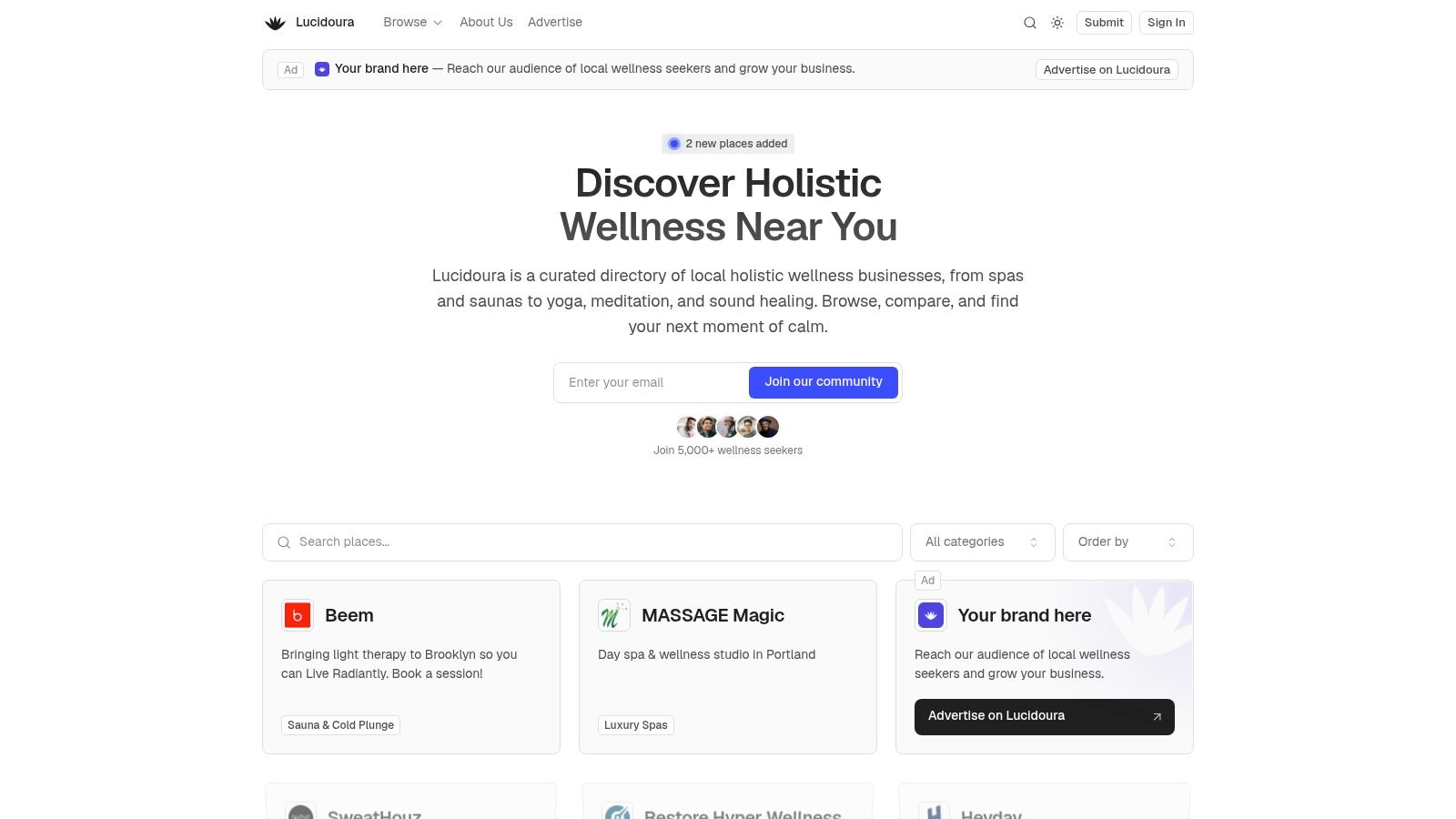
The easiest way to move from theory to a real session is to choose the venue type first, not the trend. Lucidoura organizes local options into categories like sound healing and meditation studios, yoga and breathwork spaces, spas with infrared saunas, cold plunges, float therapy, and acupuncture, integrative-medicine clinics, and spiritual shops, which makes it easier to match the place to the goal.
Match the place to the layer
If you want regulation, start with sound, breath, meditation, or restorative movement. If you want a more clinical setting, look for acupuncture or integrative-medicine listings. If you're curious about contrast therapy, saunas, or float spaces, those belong in a different bucket from trauma therapy, even if they can feel calming.
The city filter and tag filters help narrow the list quickly, and concise place summaries make it easier to compare options without opening ten tabs. The site also publishes updates through its blog, and this sound bath meditation guide gives a useful example of how a single modality can be framed for different goals.
What to check before the first visit
- Trauma-informed language: does the site explain how it handles consent, pacing, and comfort?
- Clear intake: do they ask about health conditions, sensitivity, or contraindications?
- Safety answers: will staff explain what to expect before you arrive?
- Fit for your goal: does the venue offer the modality you want, not just a general wellness vibe?
If you want a local session that fits your actual nervous system state, use the directory to compare categories first, then choose the place that matches your need instead of the trend.
If you're ready to turn this into something real, start by choosing the layer you want to work on, regulation, rewiring, or recovery. Then visit Lucidoura to compare local wellness spaces, read concise place summaries, and find a session that fits your body instead of overwhelming it.