7 Meditation Classes for Beginners to Try in 2026
Compare 7 meditation classes for beginners, from free online sessions to local studios, retreats, sound-inspired options, pricing, and booking tips.
Written by Editorial Team
You search for meditation classes for beginners and find a confusing spread of options. One app offers a short guided session, a local studio advertises drop-ins, a Buddhist center lists retreats, and an online school promotes a full multi-week curriculum. They're all called meditation classes, but they demand very different amounts of time, money, attention, and commitment.
The right starting point depends on what you want next. You might need a free sample, recurring local community, flexible online access, a specific Buddhist tradition, or a structured course that keeps you accountable. The options below explain what happens in class, the commitment and pricing cues to check, the main advantages and limitations, and the best first step for each format.
For nearby options, Lucidoura's curated wellness directory helps you browse meditation and wellness venues by category and city. Several recommendations here are online or nationally accessible, so you can start without living near a studio.
1. UCLA Mindful for a free, secular introduction
If your schedule is unpredictable and you want to test meditation before paying, start with UCLA Mindful. Part of UCLA Health's Mindful Awareness Research Center, it combines experienced instruction, free live online sessions, beginner-friendly drop-ins, guided practices, and a free mobile app through the UCLA Mindful program.
The live format fits around work, school, or family responsibilities. Several virtual drop-ins run during the week, and their short sessions let you try guided practice without committing to a course. Registration is generally unnecessary for drop-ins, which makes booking simple when you are still deciding whether live instruction suits you.
Best first move: Reserve one live session before collecting recordings. A teacher can address wandering attention, posture, and beginner questions in real time, while the app works better for practice between classes.
What you'll get and what to check
UCLA Mindful teaches meditation through a secular, health-oriented approach. You do not need to join a religious tradition, and the program's consistent instruction gives beginners a clear starting point. If the free sessions work for you, Mindful Awareness Practices courses offer a more organized route with greater commitment.
Check the schedule before booking. Live sessions follow Pacific Time, so confirm the start time in your location. MAPs course pricing and registration details can vary by session, and you may need to open the specific course page to see the full requirements.
This program is worth considering if free access, experienced instruction, and a hospital-affiliated setting matter to you. It is a weaker fit if you want a local studio, a fixed cohort, or retreat-style immersion. Select a beginner-friendly live session, join a few minutes early, and keep the guided library or app ready for practice afterward.
2. Spirit Rock for a Buddhist retreat or sliding-scale series
Spirit Rock Meditation Center fits beginners who want meditation classes connected to a Buddhist tradition. Its programs draw from the U.S. Insight, or Vipassanā, tradition and include online series, live teaching, practice groups, and retreats. Review the current calendar through Spirit Rock Meditation Center, including short retreat formats for newcomers.
You will get the most from Spirit Rock if you want an established lineage, experienced teachers, and a practice that goes beyond quick productivity. Online classes offer a lower-commitment starting point. Short beginner retreats provide concentrated instruction in sitting, walking, silence, and group practice, but require more time and preparation.
Review the cost before assuming the listed contribution is fixed. Spirit Rock uses sliding-scale pricing and offers scholarships. The individual registration page will show the time commitment, participation format, and any retreat-specific requirements.
Match the format to your available energy
A retreat demands more than a weekly drop-in. An in-person event may involve travel, uninterrupted time, and extended quiet. Decide whether that setting will support your attention or create unnecessary pressure. If an outdoor setting interests you, this guide to outdoor meditation spaces can help you assess whether practicing in nature suits your preferences.
- Book an online series for regular instruction without travel and a manageable weekly commitment.
- Reserve a short beginner retreat when you can protect the required time and want immersion.
- Ask about scholarships early if the sliding-scale contribution remains difficult.
- Check availability promptly when a specific teacher or date matters, because popular offerings may fill.
Spirit Rock is a strong match for learners who welcome Buddhist-informed teaching and traditional vocabulary. Strictly secular instruction will be a better fit at UCLA Mindful or in an MBSR course. Before booking, read the teacher biography and course description. Look for the emphasis you want, whether breath awareness, insight practice, compassion, or retreat discipline.
For your first class, confirm the start time, prepare a quiet space, and allow time to settle before instruction begins. For a retreat, read the participation guidelines in full and plan travel, meals, and periods without ordinary distractions.
3. Insight Meditation Society for live online learning
The Insight Meditation Society's Online Learning Center suits beginners who want a scheduled class without traveling to a retreat. Its live courses, practice groups, talks, and programs include evening and weekend options. Visit the IMS Online Learning Center to compare start dates, course lengths, and sliding-scale or scholarship options before booking.
IMS is a strong fit for beginners who want live interaction, teacher guidance, and a clear calendar while continuing to practice at home. Evening classes can work around a conventional workday. Weekend programs offer a more concentrated learning block, with less disruption than a residential retreat. Check the time zone and full schedule first, then choose one course that matches your available time.
A practical fit for tradition-minded beginners
The teaching comes from an established Insight meditation lineage, so classes provide more context than a random guided recording. This format works well if you want to understand the purpose behind a practice, not only receive instructions for sitting.
The trade-off is a more tradition-specific vocabulary. Read the course description and teacher notes before enrolling so unfamiliar terms do not catch you off guard. A late evening session may also be inconvenient if the listed time falls late where you live.
IMS is a strong fit for beginners who want live interaction, a respected lineage, and schedule options that sit between drop-in practice and retreat immersion. Register for one course rather than several talks at once, especially during your first week. Before class, place your device on a stable surface, test the audio, and keep a chair available if floor sitting causes discomfort. Arrive early enough to settle, and prepare one question if you want guidance during the discussion. A live online class should accommodate ordinary distractions while still giving you a consistent learning routine.
4. Insight Timer for free sampling and self-paced practice
Insight Timer is the best option for beginners who don't yet know what style they prefer. The platform combines a large free library of guided meditations, live classes, community sessions, and teacher-led multi-lesson courses. You can start through the Insight Timer meditation platform without paying, then decide whether its optional MemberPlus features are useful.
The abundance is both the appeal and the problem. You can sample breath meditation, body scans, loving-kindness, sleep practices, movement-based sessions, and talks from many teachers. That makes the platform useful for discovering whether you prefer a calm voice, precise instruction, silence between prompts, or a more conversational teaching style.
Peer-reviewed analysis of a free mindfulness app found strong user ratings, 4.7 out of 5 on Google Play from 3,415 reviews and 4.8 out of 5 on Apple's App Store from more than 2,000 reviews, while more frequent engagement was associated with improved mindfulness mastery scores in that app's users. Read the peer-reviewed app analysis for the study details. These findings don't guarantee that every Insight Timer teacher will suit you, but they support using digital practice as a serious sampling route.
Avoid the endless browsing trap
Choose one teacher and one course for your first week. If you keep switching, you'll learn more about the platform's search function than about your own response to meditation.
This guide to guided meditation can help you identify the instruction style you want. MemberPlus may add unlimited courses, downloads, and other features, but pricing can vary by region and promotion, so check the current rate inside the app before subscribing. Insight Timer is ideal for free exploration and flexible scheduling, but it demands more curation than a university program or fixed course.
5. The DEN Meditation for a local studio atmosphere
A shared room can make meditation easier to sustain. The DEN Meditation suits beginners who want that studio energy, with in-person sessions across multiple Los Angeles neighborhoods and a substantial virtual schedule available through The DEN Meditation.
The classes aim for an approachable experience rather than a formal or intimidating one. A scheduled session gives your practice a clear start and finish, while the presence of other attendees can provide useful accountability. Virtual classes keep the routine going when commuting is impractical, although they cannot fully reproduce the physical community of a studio.
Match the format to your commitment
Intro specials are worth booking first so you can compare the studio and virtual experience before paying for ongoing access. The DEN also offers class packs, unlimited monthly or annual memberships, and an on-demand library.
Membership makes sense for people who expect regular attendance and will use benefits such as guest passes or member discounts. Occasional visitors should start with a single class or introductory offer. Unlimited access becomes worthwhile only after recurring attendance fits your schedule and budget.
- Introductory offers provide the clearest first test of the teaching style, setting, and online platform.
- Class packs work better for people whose schedules change often and cannot support a fixed weekly habit.
- Unlimited access suits consistent attendees who have already confirmed that live classes fit their routine.
- The on-demand library fills gaps between live sessions, but relying on it for every practice removes much of the structure that attracts studio-based beginners.
The in-person advantage is concentrated in Los Angeles. Outside that area, virtual classes are the practical route, with more scheduling flexibility and less physical connection.
Before booking, read the class description and arrive early with any questions. Ask whether the session includes breathwork, sound, visualization, or extended stillness. These formats create different experiences, so choose the description that matches your comfort level rather than assuming every meditation class follows the same pattern.
6. Kadampa Meditation Centers for repeatable local drop-ins
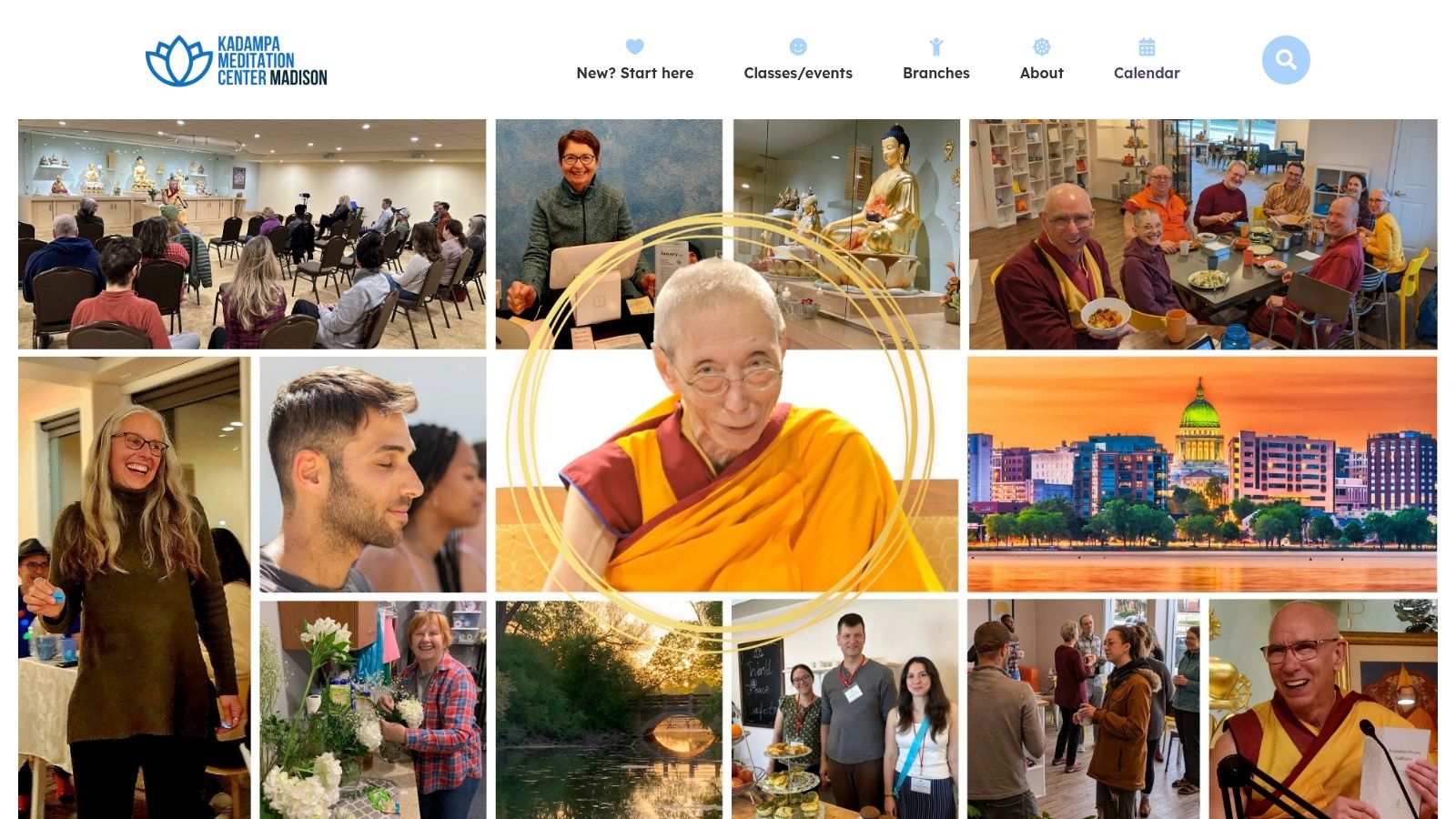
Kadampa centers are a practical choice for learners who value local access, repeatable drop-ins, and tradition-based teaching. Their centers in the New Kadampa Tradition offer beginner classes, short introductory series, local calendars, and, in some locations, family sessions or informal community time. Review the local schedule at Meditation in Madison, which also shows how a center can present its offerings.
The strongest reason to choose this format is repetition. A weekly class gives you the same place, teacher, and rhythm, making practice easier to maintain than selecting a new meditation each day. Many locations welcome drop-ins and do not require prior experience, so you can test the format without committing to a retreat or a multi-week curriculum.
Know the teaching framework before booking
Kadampa classes are taught within a Buddhist framework. Book one if you want meditation connected to teachings, ethics, visualization, and a defined tradition. If secular mindfulness instruction in a clinical or workplace style is your goal, Kadampa may not be the right fit.
Local arrangements vary. Check the individual center's page for the current contribution, registration rules, class length, teacher approach, and whether the session offers a general introduction or belongs to a more committed study program. Do not assume every center follows the same schedule or format.
Before booking, confirm that the class matches your desired level of commitment. A drop-in suits a changing schedule and cautious first visit. A short series is better if you want accountability without enrolling in a full curriculum. Ask whether newcomers can sit in a chair, and arrive early enough to raise questions privately.
For your first class, wear comfortable clothing and tell the teacher if Buddhist terminology is unfamiliar. A well-run introduction should explain the context clearly without expecting beginners to know the vocabulary.
7. Mindful Leader MBSR for a complete curriculum
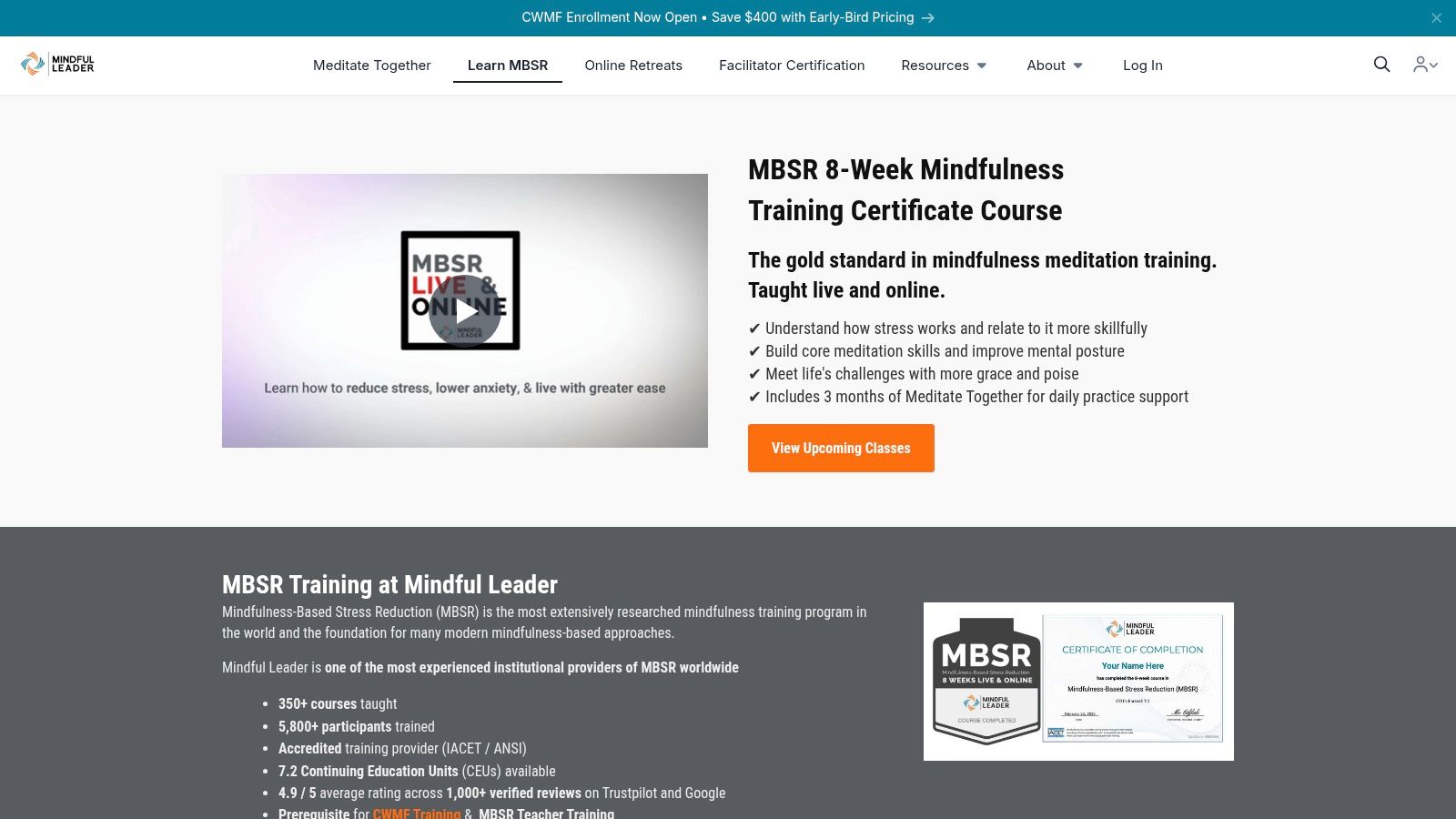
MBSR is the right path for beginners who want a full curriculum, scheduled accountability, and teacher-led instruction rather than open-ended sampling. Mindful Leader's live online Mindfulness-Based Stress Reduction course includes orientation, eight weekly live sessions of about two and a half hours, a one-day retreat, home practice, and certified teachers. Review current cohorts and enrollment details through Mindful Leader's MBSR training.
MBSR goes beyond booking a single class by placing you in a group committed to a shared curriculum. You follow a sequence of skills, practice between meetings, and work toward a defined course experience. Multiple cohorts across U.S. time zones can make scheduling easier. Tiered pricing, payment plans, and some scholarships may also suit different budgets better than a single fixed fee.
Choose this format when you want external structure and repeated practice focused on stress. A 2025 dose-response trial protocol is testing daily meditation durations of four, 10, 20, and 30 minutes, so the field has not established one minimum effective dose for newcomers. Read the published trial protocol for its research design. MBSR is a structured option, not the only valid route, and it makes the most sense when independent practice is unlikely to keep you engaged.
Prepare for the workload
Reserve time for the weekly class and retreat before enrolling. Home practice also affects the experience, so avoid starting while your schedule is unstable. Confirm the orientation date, retreat date, missed-class policy, payment plan, scholarship eligibility, cancellation terms, and whether CEU access applies to your enrollment.
For a complementary look at breath-centered practices, read this guide to breathwork benefits, but keep the formats distinct. MBSR fits beginners seeking a complete, teacher-led curriculum with a clear start and finish. A single guided class or free sample is the better first booking if you only want to test whether meditation suits you.
Beginner Meditation Classes, 7-Provider Comparison
| Provider | Implementation complexity 🔄 | Resource requirements ⚡ | Expected outcomes ⭐📊 | Ideal use cases 💡 | Key advantages ⭐ |
|---|---|---|---|---|---|
| UCLA Mindful (UCLA Health – MARC) | Low for drop-ins; moderate for MAPs | Low, free app/sessions; MAPs may cost | Foundational mindfulness; evidence-informed guidance | Sample free sessions; secular medical-affiliated learning | Reliable instructors; free library; hospital affiliation |
| Spirit Rock Meditation Center | Moderate, course series and retreats | Moderate–High, retreat time commitment; sliding-scale fees | Deep insight practice; retreat-based progress | Seek high-caliber teachers; structured retreats or series | Renowned teachers; sliding-scale & scholarships |
| Insight Meditation Society (IMS) – Online | Moderate, live courses and practice groups | Low–Moderate, sliding-scale fees; variable session length | Structured insight teachings; steady practice opportunities | Remote retreat-center teachings; regular scheduled practice | Respected lineage; frequent, varied offerings |
| Insight Timer | Low, on-demand + live; self-directed | Very low to Moderate, free tier; optional MemberPlus | Wide exposure; variable quality; self-paced skill building | Try many teachers/styles; casual daily practice | Massive free library; frequent live events; community |
| The DEN Meditation | Low for virtual/drop-ins; moderate if joining membership | Moderate, membership for regulars; best in-person in LA | Studio-style consistency; community-supported practice | Prefer studio vibe; LA in-person or unlimited virtual use | Studio community, perks, on-demand content |
| Kadampa Meditation Centers (NKT) | Low, weekly drop-ins and short series | Low, drop-in-friendly; local pricing varies | Practical, structured Buddhist-based practice | Local drop-ins; travelers seeking repeatable access | Wide US presence; easy entry points |
| Mindful Leader – 8-Week MBSR (live) | High, 8-week course + one-day retreat | High, weekly 2.5-hr sessions, homework, tuition | Measurable stress-reduction skills; evidence-based outcomes | Committed beginners seeking structured training | Certified instructors; CEUs; clear curriculum |
Choose One Class and Make It Easy to Begin
Choose a free sample if you want to test guided instruction without financial pressure. UCLA Mindful gives you a secular, university-based starting point, while Insight Timer lets you compare many teachers and practice styles from home. Choose a local drop-in if community and a recurring place will keep you accountable. The DEN is the stronger studio-style choice in Los Angeles, while Kadampa centers offer repeatable local classes within a Buddhist framework.
Choose a flexible online program if commuting or fixed geography gets in the way. Spirit Rock and IMS offer live teaching, calendars, and sliding-scale options, with different relationships to the Insight tradition. Choose a retreat if you want immersion and can protect the time. Choose MBSR if you want a full curriculum, weekly accountability, home practice, and a defined course rather than a casual introduction.
Before booking, confirm the current schedule, time zone, contribution or price, registration requirements, cancellation policy, and whether the class is secular or tradition-based. Ask whether the practice is seated, walking, breath-led, body-focused, movement-inclusive, or heavily guided. A 2025 study found that kinetic meditation produced higher focused attention than static meditation, while audio guidance improved attention but also increased cognitive load. The authors suggest clearly guided movement-based practice can be more accessible for novices who find stillness intimidating. Read the Frontiers study on kinetic and static meditation for the details.
For your first class, log in or arrive early, wear comfortable clothing, silence notifications, and keep your expectations modest. Wandering thoughts are part of the practice, not proof that you've failed. A 2026 practice report found beginners had the highest distraction barrier, at 48.7%, while a 2025 review reported that only 4.7% of initial digital meditation users remained active after 30 days. Those figures make habit support and a welcoming teacher more important than finding the supposedly perfect technique. See the 2025 review of digital meditation engagement for its discussion of retention.
Recent research also reports that difficult effects deserve honest attention. A 2025 survey found that nearly 60% of U.S. meditators experienced at least one side effect, and about 30% reported challenging or distressing effects, as summarized in the same research discussion. If a practice feels activating, pause, open your eyes, change position, or speak with the instructor. Seek appropriate professional support when distress feels intense, persistent, or unsafe.
Judge the first session by whether the format feels sustainable, not by whether your mind becomes completely quiet. If you want a nearby meditation, sound-healing, yoga, or other wellness venue, use Lucidoura's city filters and curated categories to compare practical local options without sorting through unrelated search results.
Lucidoura helps you discover curated local meditation, sound-healing, yoga, breathwork, and other wellness spaces by category and city. Visit Lucidoura to compare nearby venues and choose a meditation class that fits the way you want to begin.