IV Drip Therapy Cost: What You Actually Pay in 2026
IV drip therapy cost in 2026 explained: real price ranges by drip type, hidden fees, insurance rules, and how to compare local providers before you book.
Written by Editorial Team
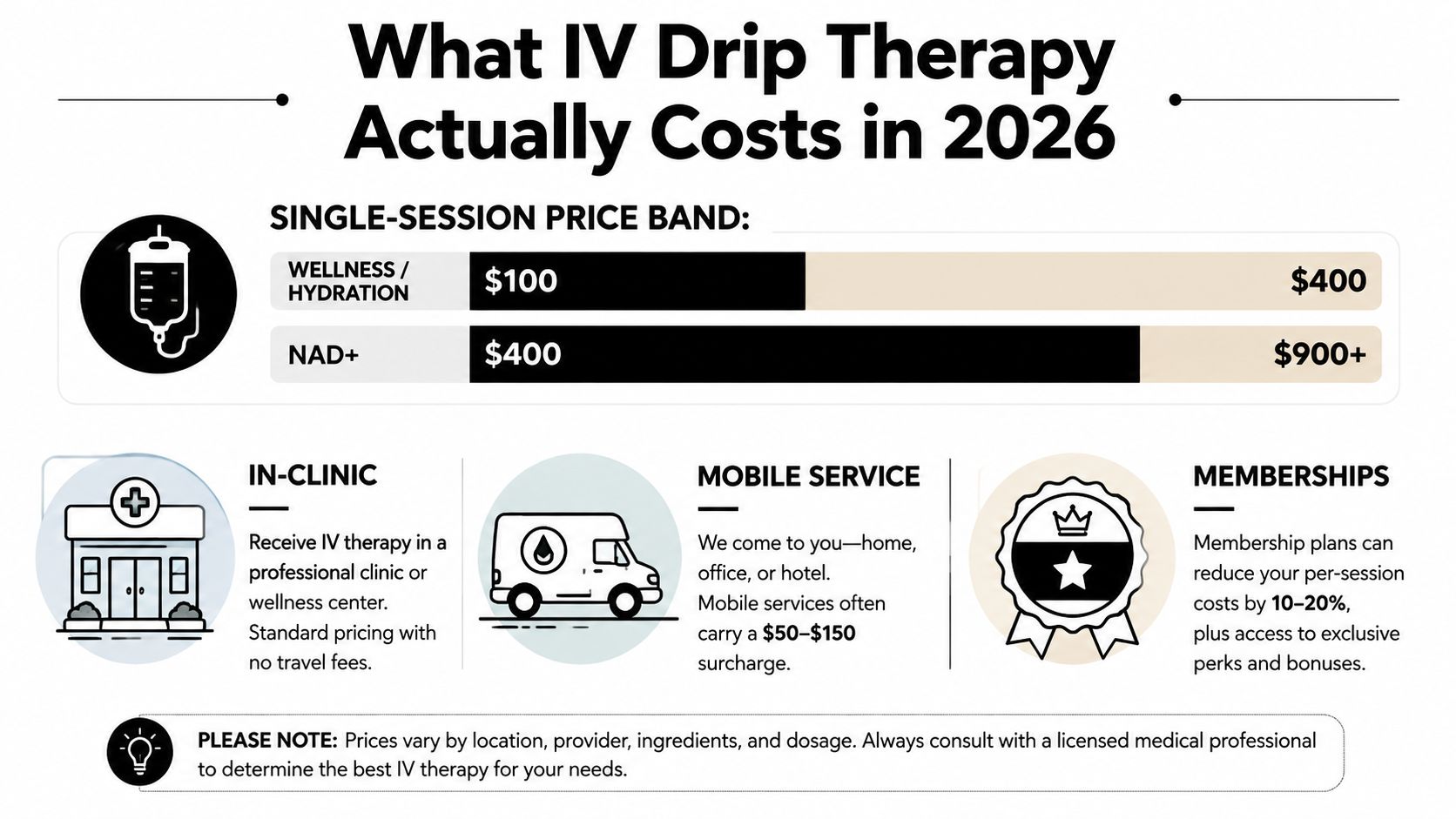
Most wellness IV drips cost $100 to $400 per session, while NAD+ infusions commonly run $400 to $900 or more. Your real IV drip therapy cost depends on the formula, clinic or mobile setting, consultation requirements, add-ons, and whether you buy one visit or a full course.
The advertised menu price is only the starting point. A basic hydration drip may look affordable until a clinic adds an intake charge, travel fee, booster injection, or membership requirement. A premium infusion may be worth paying for when it reflects stronger clinical oversight, transparent ingredients, and appropriate monitoring, but a polished label alone doesn't justify a higher bill.
This guide breaks down the price stack so you can compare local providers on total spend, not just the bold number on an Instagram menu.
What IV Drip Therapy Costs in 2026
A single IV session generally costs $100 to $400, while NAD+ protocols commonly reach $400 to $900 or more, according to 2026 pricing guidance from Promd Columbia's IV hydration cost guide. A separate 2026 index found basic hydration menus priced from $64.99 to $249, confirming that location, staffing, and extras can change the starting number. Review the comparison in the 2026 IV cost index from Drip Compass.
The advertised number versus the amount you pay
Clinics list IV therapy by formula, but your purchase includes more than ingredients. The formula affects ingredient cost and infusion complexity. The setting determines whether you pay for a clinic chair or a clinician traveling to your home, hotel, or office. The booking model may add a consultation, membership, or recurring course.
A JAMA review of IV hydration spas reported a median session cost of $179 and found that elective treatments generally were not covered by insurance because they were not considered medically necessary. Current market guidance places basic hydration near $100 to $150, Myers' Cocktail sessions around $150 to $300, and premium NAD+ infusions at $400 to $900 or more. The published IV hydration pricing breakdown provides those ranges and the insurance context.
Use a simple cost-stack model
Calculate the complete bill before comparing providers:
- Menu price: The listed drip or infusion.
- Add-ons: Boosters, injections, medication, or extra nutrients.
- Setting premium: Mobile delivery, after-hours service, or a premium location.
- Savings: Membership, package, referral, or promotional discount.
Practical rule: Ask for the price of your exact formula in your exact setting, with every expected fee included.
A course of treatment makes the total more important than the single-session sticker. Multiply the full visit cost by the planned number of sessions, then add any consultation or membership charges. This is the figure to compare in a local provider directory, where clinic, mobile, and membership options can be reviewed side by side.
Labor, medical oversight, sterile supplies, pharmacy sourcing, facility costs, and unused inventory all affect the bill. A saline base rarely explains the entire charge, especially when a provider includes broader monitoring or concierge delivery.
Ask, “What will this treatment cost from consultation through the end of the course?” That answer is more useful than “How much is an IV drip?”
Price Tiers by Drip Type
In 2026, observed menus list basic hydration drips from $64.99 to $249, hangover-labeled IVs from $169 to $349, Myers’-labeled formulas from $149 to $339, and beauty or glow formulas from $149 to $399. These figures come from the Drip Compass IV cost index. Use the ranges as a screening tool, then compare the exact formula and setting.
| Drip Type | Typical 2026 Price | Key Ingredients |
|---|---|---|
| Basic hydration | $100 to $200 | Saline, electrolytes, B-complex, modest vitamin additions |
| Myers' Cocktail and immunity blends | $150 to $300 | Magnesium, calcium, B vitamins, B12, vitamin C, sometimes glutathione |
| Beauty, athletic recovery, and high-dose vitamin formulas | $200 to $400 | Glutathione, amino acids, vitamin C, lipotropic compounds |
| NAD+ protocols | $400 to $900 or more per session | NAD+ delivered through a slower, more closely monitored infusion |
Tier one, hydration and electrolytes
Basic hydration is the entry tier. The bag usually contains saline or another fluid, with a limited mix of electrolytes or vitamins. The charge covers clinical screening, catheter placement, sterile supplies, chair time, and operating costs, not only the fluid itself.
Choose this tier for straightforward hydration when a clinician confirms that IV treatment fits your situation. A dramatic menu name does not justify a higher bill if the contents amount to basic fluids and a small vitamin blend.
Tier two, Myers' and immunity formulas
Myers' Cocktail and immunity blends add nutrients such as magnesium, calcium, B-complex vitamins, B12, vitamin C, or glutathione. Market guidance places Myers' Cocktail sessions around $150 to $300, while the IV Therapy Map market report lists Myers' formulas at $179 to $300.
The added cost may cover ingredients, preparation, and administration time. It may also reflect branding. Ask for the dose and full ingredient list before booking, because two formulas with the same label can have different contents and monitoring.
Tier three, beauty and recovery
Beauty, athletic recovery, and high-dose vitamin formulas combine several ingredients, often including glutathione, amino acids, vitamin C, or lipotropic compounds. The 2026 index places beauty or glow IVs as high as $399, while independent consumer guidance commonly puts mainstream wellness sessions between $99 and $399. The Drip Compass cost calculator can help estimate the session total before you compare local providers.
More ingredients do not automatically produce a better choice. Match the formula to a defined goal, confirm that each addition is clinically appropriate, and include the number of planned sessions when calculating the course cost.
Tier four, NAD+
NAD+ is the expensive outlier. Current U.S. market guidance places NAD+ sessions around $400 to $1,500 or more, depending on dose, infusion length, and clinical model, according to the 2026 IV Therapy Map pricing overview. Other consumer guidance places premium NAD+ sessions around $400 to $900 or more, so pricing varies sharply between protocols.
The higher bill usually reflects the active ingredient, slower infusion, added chair time, and closer clinical oversight. Treat NAD+ as a separate financial decision, then compare the full treatment course across clinic, mobile, and membership options in a local provider directory.
The Hidden Fees That Change Your Final Bill
A clinic can advertise a reasonable drip price and still produce a much larger receipt. The problem is usually not one outrageous charge. It's the stack of smaller charges that appear after you select the appointment type, location, and extras.
Start with the service model
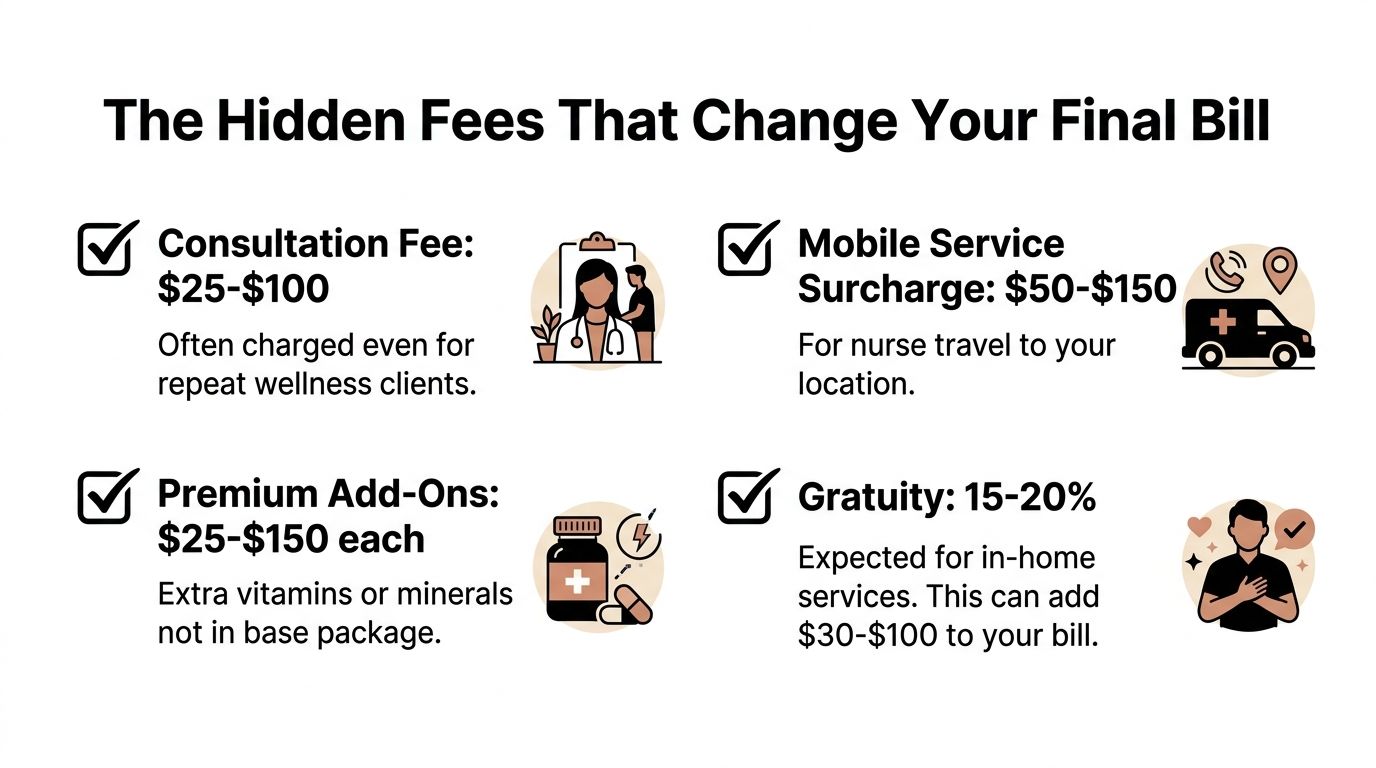
Ask whether the listed price includes the clinical intake. Some clinics charge a separate consultation fee, while others bundle it into the first appointment. A mobile provider may add a travel or concierge charge because a nurse spends time and resources reaching your location rather than serving several patients in one clinic.
After-hours appointments, peak-day bookings, hotel visits, and office calls can create additional premiums. These aren't automatically unreasonable, but the provider should disclose them before you pay.
Then inspect the add-on menu
Popular extras include glutathione pushes, B12 injections, lipotropic compounds, and anti-nausea medication. A drip that looks complete on the main menu may be designed to encourage these additions at checkout.
Memberships can complicate the comparison further. A monthly fee may reduce the per-session price, but it only makes financial sense if you use the included benefits and understand expiration, cancellation, rollover, and minimum-commitment terms. Don't compare a member price at one clinic with a cash price at another.
Ask for one all-in number: consultation, infusion, mobile travel, boosters, medication, gratuity policy, and taxes where applicable.
The Harley Street Medical Wellness IV cost guide also highlights a cost that many U.S. menus omit, consultation fees, and shows that higher-end protocols may be sold as courses rather than isolated appointments. That distinction matters because recurring treatment turns a low-looking session price into a larger course commitment.
Before booking, send the same written request to each provider: “Please quote the total cost for this exact drip, including intake, all required fees, travel, add-ons recommended by your clinician, and any membership requirement.” If the clinic can't answer clearly, you haven't received a usable price.
What Happens During a Session
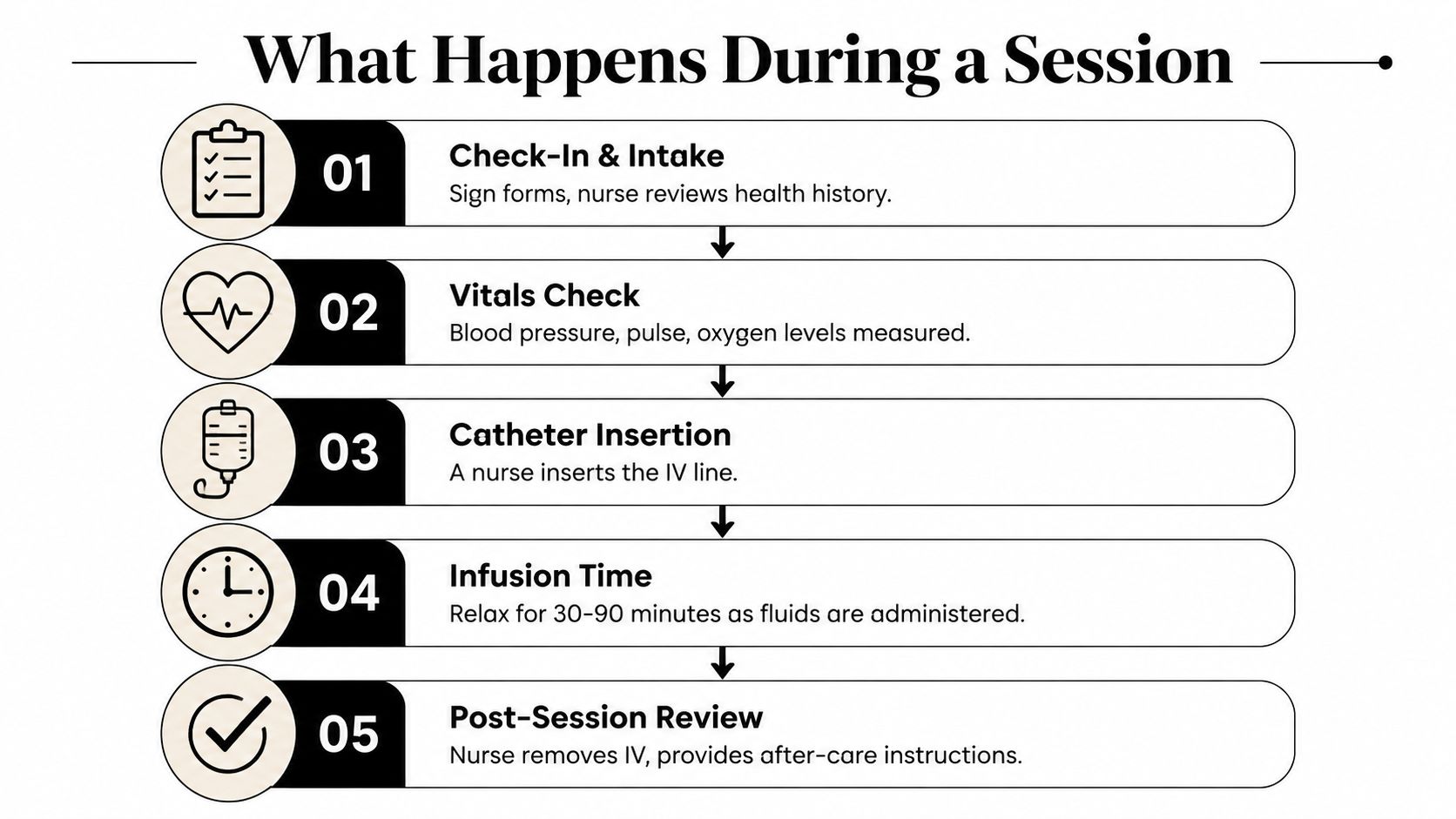
A first visit usually begins before the IV bag appears. You complete intake paperwork or a screening call, then a nurse reviews your health history, medications, allergies, current symptoms, and reason for seeking treatment. A responsible provider should use that conversation to determine whether the requested formula and route are appropriate.
The nurse checks your vital signs and selects a vein, commonly in the arm or hand. After cleaning the skin, the nurse places the catheter, connects the line, and starts the infusion at a controlled rate. The process involves sterile supplies, trained labor, observation, and documentation, not just the cost of fluid in a bag.
What you'll notice during infusion
Many patients spend the appointment seated or reclining while the provider monitors the line. You may notice a cool sensation in the arm or a mild taste associated with some vitamin formulations. Tell the nurse immediately if you feel pain, swelling, dizziness, shortness of breath, or unusual discomfort.
The appointment ends with catheter removal, a check of the insertion site, and after-care guidance. The clinician may record the formula, response, and follow-up recommendation in your chart. Those steps explain why a clinic's price includes more than ingredients.
Time can change the bill
Standard wellness infusions are often described as taking roughly 30 to 60 minutes, while the process infographic supplied for this guide presents an infusion window of 30 to 90 minutes. The exact duration depends on the formula, flow rate, vein access, and provider protocol.
Add-on injections can extend the appointment and raise the total. NAD+ infusions may take substantially longer than basic hydration, with some protocols requiring two to four hours, according to current pricing guidance from IV Therapy Map. Ask about expected chair time before you schedule, especially if you're comparing a clinic appointment with mobile service.
Does a Higher Price Mean Better Results
A $400 infusion does not automatically outperform a $150 infusion. The difference may reflect more ingredients, longer chair time, stronger screening, or higher operating costs. Price alone does not prove better evidence or better outcomes.
Hydration has a clear clinical role for acute fluid loss when fluids are administered under appropriate care. Myers-style cocktails have a long history of use, but evidence remains mixed and rigorous trials are limited. Beauty drips often rest on antioxidant theories. Immune-focused formulas and high-dose vitamin C have limited or mixed support for many wellness claims. NAD+ remains comparatively expensive, with guidance placing it around $400 to $1,500 or more, while research is still emerging. The IV Therapy Map pricing guide connects that evidence gap with menu variation.
What a premium provider may offer
A higher bill can reflect meaningful operational differences:
- Medical oversight: A physician or qualified advanced clinician may supervise protocols and escalation procedures.
- Better screening: The provider may spend more time reviewing medications, conditions, allergies, and contraindications.
- Pharmacy standards: The clinic may identify its compounding pharmacy and provide clear sourcing information.
- Monitoring: Longer or more complex infusions may receive closer observation and more careful documentation.
These features support safety and service quality. They do not prove that a wellness formula produces superior results. Ingredient transparency carries more weight than a “medical-grade” label, and a longer menu does not create a stronger treatment plan.
Review Lucidoura's guide to IV drip benefits for broader context on potential uses and limitations. Then ask a clinician to connect any proposed infusion with your health history, medications, and treatment goals.
A higher price is justified when it buys clearer screening, accountable clinical oversight, transparent ingredients, or attentive monitoring. If the provider cannot explain the bag contents, dose, infusion time, and service differences behind the price gap, treat the gap as marketing.
Comparing Local Providers the Smart Way
Don't compare clinics by their most attractive photograph or their cheapest headline drip. Compare the same formula, the same setting, and the same payment terms across two or three providers.
Start by requesting an all-in quote for one specific treatment. Ask for the ingredient list, dose information where the provider can disclose it, expected infusion time, consultation requirements, mobile charges, and cancellation policy. Then verify who performs the screening and infusion.
| Criterion | What to Ask | Why It Matters |
|---|---|---|
| Published menu price | What does the exact formula cost before and after required fees? | Separates a real comparison from a teaser price |
| Clinician credentials | Who reviews my history, places the IV, and responds to complications? | Clarifies clinical responsibility |
| Pharmacy and sourcing | Who prepares the ingredients, and can you identify the compounding pharmacy? | Helps you evaluate quality controls |
| Add-ons and memberships | Are boosters required, optional, or included? Is a membership necessary? | Reveals the actual course cost |
| Patient reviews | Do reviews mention communication, screening, and safety? | Ambiance alone doesn't evaluate care |
| Policies | What happens if I cancel, reschedule, or react badly? | Prevents avoidable charges and confusion |
Build the comparison row by row
For the first provider, copy the exact quote into a note. Repeat the request with the same wording for the second and third providers. If one clinic recommends a different formula, ask what ingredient or clinical reason changes the recommendation instead of treating the alternative as equivalent.
Check credentials through the relevant state licensing system, and look for clear information about medical direction and pharmacy partnerships. Reviews should help you evaluate punctuality, informed consent, vein-access skill, after-care, and response to problems. Praise for lighting and lounge furniture doesn't tell you whether the medical workflow is sound.
A curated directory can reduce the search burden by organizing local wellness venues by city, category, services, and provider details. For example, Lucidoura's Miami IV infusion guide gives shoppers a starting point for locating relevant providers, after which you should still confirm current pricing and credentials directly.
Before booking, complete four checks:
- Price match: Confirm every provider quoted the same service.
- License check: Verify the clinicians involved.
- Review read: Look for comments about safety and communication.
- Contract read: Review membership, package, cancellation, and expiration terms.
Practical Ways to Cut Your IV Therapy Bill
A lower sticker price rarely means a lower total. The useful savings come from reducing unnecessary extras, choosing the right setting, and avoiding a course you won't complete.
Start with the payment structure
Memberships and bundles can reduce the per-session price when you already know you'll use the included visits. Before prepaying, calculate the full commitment, check expiration rules, and confirm whether unused sessions roll over. The IV cost calculator from Drip Compass emphasizes that labor, oversight, overhead, and waste allocation belong in an operator's pricing model, so an unusually cheap package deserves questions rather than automatic trust.
Other options can lower the setting premium:
- Share a mobile visit: Ask whether several people at one location can divide the travel component. Each participant should still receive individual screening and documentation.
- Watch seasonal promotions: Clinics may offer campaigns around hydration, travel recovery, or wellness resets. Confirm that the discounted formula isn't missing ingredients you need.
- Choose a standard formula: A transparent basic drip may be more sensible than a custom blend loaded with optional boosters.
- Compare nearby markets: A neighboring suburb may have different overhead and pricing, but don't trade away licensed staff or responsible sourcing to save money.
- Use referral or loyalty credits: Read the terms carefully so a credit doesn't require an expensive membership or a deadline you can't meet.
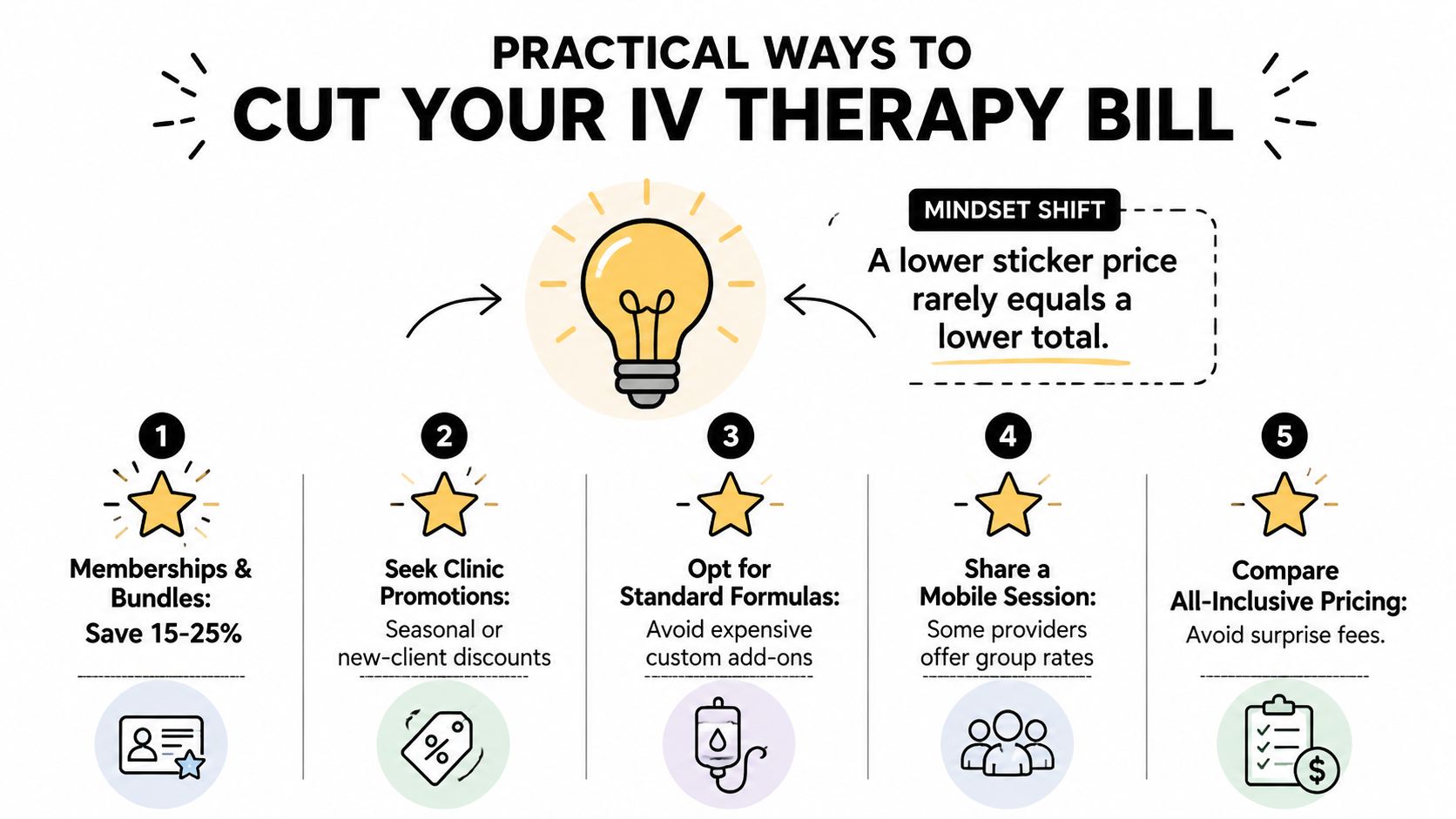
The best-value option is the formula that matches a legitimate goal, delivered by a qualified provider with clear sourcing and no surprise charges. A discount doesn't compensate for poor screening, questionable compounding, or an unsuitable treatment plan.
Insurance, HSAs, and Medical Considerations
Elective wellness IV therapy is generally treated as a self-pay service. The JAMA review of IV hydration spas found that these treatments generally weren't covered because insurers didn't consider them medically necessary. That doesn't mean every infusion is excluded. Medical infusion therapy can be handled differently when a clinician documents a diagnosed condition and bills the service through the appropriate medical benefit.
Potentially qualifying situations may include documented migraines, severe morning sickness, dehydration after medical treatment, or physician-administered iron infusions. Coverage depends on the diagnosis, treatment plan, insurer rules, prior authorization requirements, and the provider's billing arrangement. Ask your insurer and prescribing clinician before scheduling, rather than trusting a clinic's reimbursement promise.
An HSA or FSA may be usable when the service treats a diagnosed medical condition and you have the documentation required by your plan, which can include a letter of medical necessity. Request an itemized receipt that identifies the provider, service, diagnosis information when applicable, and treatment details. Keep the clinician's order and any authorization correspondence with the receipt.
Lucidoura's overview of integrative medicine can help you understand how wellness services may sit alongside conventional care, but it isn't a substitute for insurance guidance or medical advice.
Be cautious of “guaranteed reimbursement” claims. Regardless of who pays, ask about the compounding pharmacy, lot tracking, sterile procedures, emergency protocols, clinician credentials, and what happens if you experience a reaction.
Lucidoura helps you discover and compare local wellness businesses, including venues that list IV drips, shots, and related therapies. Visit Lucidoura to filter nearby options by city and service, then request an all-in quote and verify credentials before you book.