Holistic Pain Management: A Practical 2026 Guide
Explore holistic pain management in 2026 with evidence-based modalities, a practical framework, safety tips, and how to find trusted local providers.
Written by Editorial Team
You've lowered your medication dose because the fatigue was becoming as disruptive as the pain. Now your back feels stiff in the morning, sleep is broken, and every movement carries the fear that you'll make things worse. The problem isn't merely deciding whether medication is good or bad. It's recognizing that symptom control alone may not address the full experience of persistent pain.
That's where pain management earns a serious place in care. The useful version doesn't reject diagnosis, rehabilitation, or appropriate medication. It combines medical oversight with movement, mind-body practices, selected hands-on treatments, sleep support, stress management, and practical changes that fit your daily life. Chronic pain affects roughly 20% of adults globally, and a systematic review covering 19 studies across 34 countries reported a weighted mean prevalence of 30.3% among 182,019 respondents. (Global chronic pain review)
The standard I recommend is simple: choose a small, coordinated plan, measure what changes, and stop confusing a long treatment menu with good care. This guide separates stronger evidence from wellness marketing, shows which combinations make sense, and tackles the access problem most articles ignore. You'll also see how local discovery tools such as Lucidoura can reduce the guesswork between choosing a modality and finding a suitable place nearby.
The Moment a Single Pill Stopped Being Enough
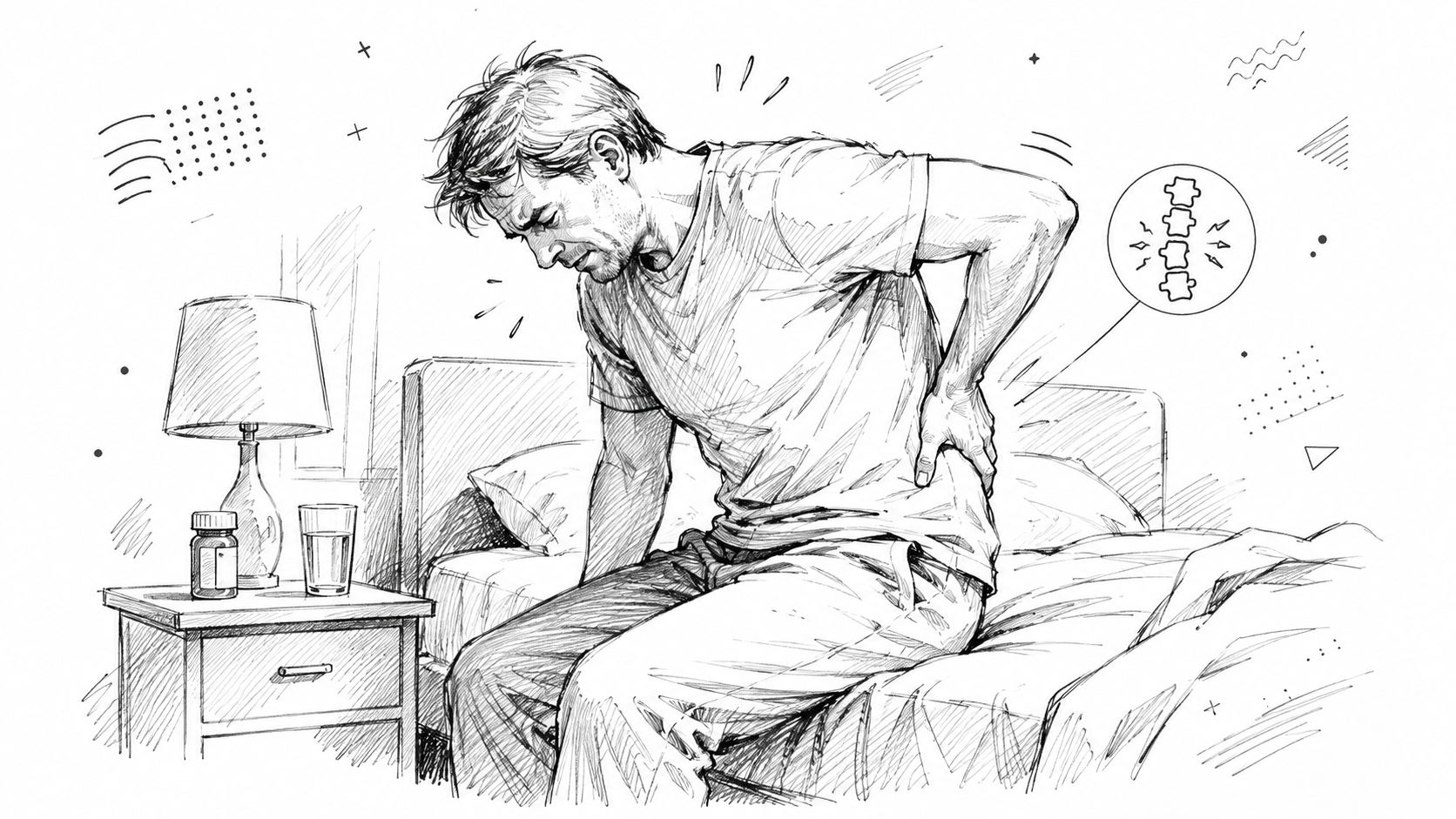
The man in the photo may be facing a familiar problem. His lower back pain has lasted long enough to shape his routine. He has reduced medication because fatigue and poor concentration interfere with daily life, yet the pain remains. Sleep is disrupted, bending feels risky, and ordinary movement has become something to avoid.
One treatment seldom addresses every part of that situation. Medication can ease symptoms without rebuilding strength or confidence. Stretching can improve mobility while leaving fear, poor sleep, or an unsuitable workstation untouched. Meditation may reduce distress, but it cannot replace clinical assessment when a structural problem needs attention.
The target is function
A useful plan asks more than, “What is your pain score?” It asks whether you can walk farther, sleep more consistently, complete work tasks, climb stairs, or move with less apprehension. Pain intensity matters, but it isn't the whole outcome.
Chronic pain is common, persistent, and often shaped by several factors. Older global estimates cited in the chronic pain literature placed the burden at about 1.5 billion people and at least $560–$635 billion annually in 2010 dollars in societal costs. (Global chronic pain review) The scale supports a coordinated public-health response, not a wellness trend built around isolated treatments.
Practical rule: Keep appropriate medical care in place, then add the lowest-burden interventions that target the parts of life pain has taken away.
Build care around biology, movement, emotional load, routines, and access. Do not promise a cure. Choose a plan modest enough to follow and specific enough to measure. If progress stalls, change the plan rather than adding treatments at random. Evidence from your own function, sleep, activity, and daily tolerance should guide the next decision.
What Holistic Pain Management Means
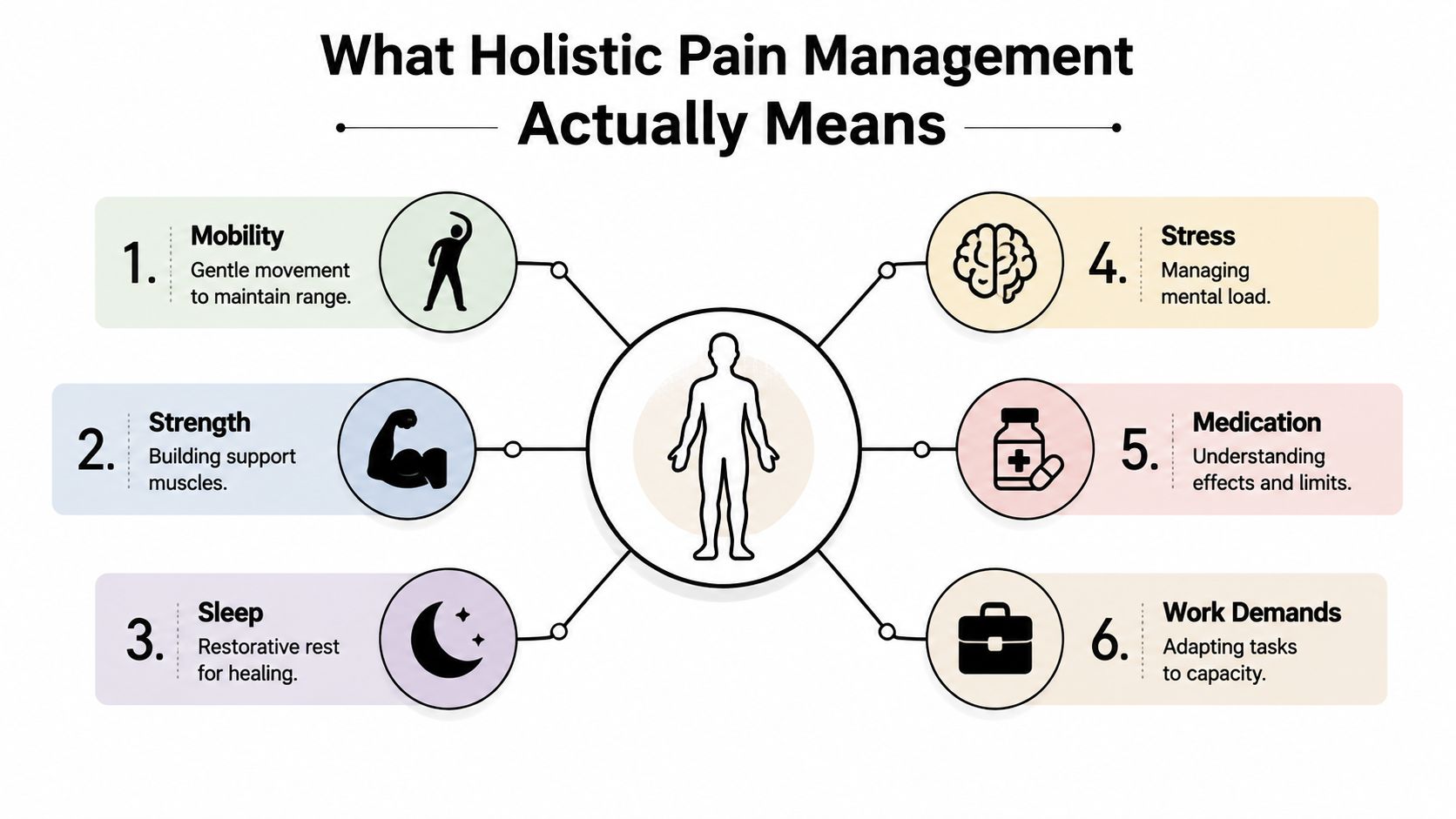
Person-centered pain management is a framework for making pain decisions. It connects pain signals with mobility, strength, sleep, stress, mental health, work demands, medication effects, and personal priorities. The goal is a coordinated plan, not a checklist of every available therapy or a substitute for appropriate medical care.
A practical plan has four layers:
- Clinical understanding: Confirm the likely pain condition, review medications, and screen for symptoms requiring prompt medical attention.
- Movement-based care: Use physical therapy, graded activity, strength work, or adapted yoga to rebuild capacity.
- Mind-body support: Add mindfulness, relaxation, breathwork, or psychological treatment when stress, anxiety, low mood, or pain sensitivity intensify the problem.
- Selected complementary treatment: Consider acupuncture, massage, tai chi, or another modality when it fits the diagnosis, goal, and available evidence.
Single-modality care asks one intervention to solve several interacting problems. Indiscriminate alternative care can dismiss conventional diagnosis and add treatments without a clear reason. Integrative care means coordination, not accumulation. The broader distinction appears in this guide to what integrative medicine means.
Measure the life you want back
A pain score can remain unchanged while function improves, or improve while sleep and confidence stay poor. Track outcomes tied to your priorities:
- Movement: Walking duration, range of motion, lifting tolerance, or stair use.
- Recovery: Sleep quality, morning stiffness, and next-day fatigue.
- Participation: Work tasks, household responsibilities, hobbies, and social activities.
- Self-management: Confidence moving, exercise consistency, and reliance on rescue medication.
Whole-person care may support chronic musculoskeletal pain, headaches, fibromyalgia, arthritis, and cancer-related pain, but each component must fit the condition. New neurological symptoms require clinical evaluation, not a wellness package. Established knee osteoarthritis may suit a movement plan supported by tai chi or another carefully adapted practice.
Access also shapes whether a plan works. A directory such as Lucidoura can help compare nearby providers across spa, studio, and clinical settings, then match the setting to the care required.
For a concise visual introduction to the whole-person model, the following video offers a useful starting point:
The Main Modalities and What the Evidence Really Shows
The evidence doesn't support a simple split between “natural” treatments and medical treatments. It supports matching a modality to a condition, a goal, and a delivery method. Benefits are often modest, and a treatment that helps one pain phenotype may be a poor choice for another.
A synthesis of 21 meta-analyses covering 127 unique studies found that mindfulness-based interventions improved pain severity, anxiety, and depression, but not pain interference or disability. (Mindfulness evidence synthesis) That's a useful reality check. Mindfulness can help you respond to pain with less distress, but it shouldn't be sold as a guaranteed way to remove the underlying cause.
What belongs in the toolbox
- Acupuncture, moderate signal: It has the strongest support among several integrative options for selected pain syndromes, with benefits that remain variable and generally modest. It's a reasonable trial for some back pain, headaches, and osteoarthritis when delivered by a qualified practitioner.
- Yoga and tai chi, moderate signal: Adapted practice can support mobility, balance, function, and confidence. The movements must be adjusted to your current capacity, especially during a flare.
- Massage, limited to moderate signal: Massage can provide short-term relief and relaxation. It's less convincing as a stand-alone strategy for durable functional change.
- Mindfulness and breathwork, moderate for coping: These tools can reduce pain-related distress, stress reactivity, and emotional amplification. They're support practices, not replacements for diagnosis or rehabilitation.
- Chiropractic manipulation, condition-specific: It may help selected low-back and neck pain cases when performed by an appropriately trained, licensed clinician. It isn't universal care, and rare but relevant risks mean screening matters.
- Sound therapy, limited signal: Sound-based sessions may support relaxation and symptom relief. Claims that they cure disease go beyond the evidence described here.
- Hydrotherapy, limited signal: Warm-water movement can make exercise more tolerable and may support relaxation and function. Detoxification claims aren't an evidence-based reason to choose it.
The evidence is more credible when a modality has a defined role inside a broader plan. Treatment quality, adherence, expectations, and the specific condition all affect the result. A practical introduction to acupuncture and related wellness options appears in this acupuncture and wellness guide.
| Modality | Likely role in a pain plan | Evidence signal | Important limits |
|---|---|---|---|
| Acupuncture | Adjunct for selected musculoskeletal pain and headaches | Moderate | Effects vary, and it doesn't replace diagnosis |
| Yoga | Adapted mobility, strength, and confidence practice | Moderate | Poorly adapted poses can aggravate symptoms |
| Tai chi | Gentle movement, balance, and function support | Moderate | Requires consistent practice |
| Massage | Short-term relief and relaxation | Limited to moderate | Durable benefits are less certain |
| Mindfulness | Distress reduction and coping | Moderate | May not improve disability |
| Chiropractic care | Selected back or neck pain cases | Condition-specific | Screening and practitioner qualifications matter |
| Breathwork | Nervous-system regulation and relaxation | Limited to moderate | Not a structural treatment |
| Sound therapy | Relaxation and symptom support | Limited | Don't treat disease-cure claims as established |
| Hydrotherapy | Comfortable movement and relaxation | Limited | Benefits depend on access and medical suitability |
A Practical Framework for Building Your Own Plan
Start with the problem that's limiting your life, not with the most fashionable modality. If your main issue is fear of bending after recurring low-back pain, a graded movement plan may deserve priority over a passive relaxation session. If headaches worsen with stress and poor sleep, regulation work may be a sensible companion to medical headache care.
Four decisions to make this week
1. Name the pattern. Write down where the pain occurs, what triggers it, what it prevents, and whether sleep, mood, or medication effects are involved. Include the diagnosis if you have one. If the pattern has changed sharply, pause self-directed experimentation and seek clinical advice.
2. Choose one primary modality. Pick the treatment most closely connected to your main goal. Physical therapy or adapted yoga may fit mobility and strength. Acupuncture may fit selected back pain or headache patterns. A clinician should guide choices for complex, post-surgical, or medically unexplained pain.
3. Add one supporting practice. Pair the primary treatment with one manageable habit, such as brief breathwork, a walking progression, sleep scheduling, or gentle strength work. Combination beats stacking. Two practices you can repeat consistently are more useful than six treatments sampled randomly.
4. Set a review point. Reassess after several weeks, using sleep, movement, mood, daily function, and medication load rather than pain alone. If nothing meaningful changes, modify the plan instead of paying indefinitely for the same result.
Match the condition to the goal
| Condition | Primary Modality | Strong Support | Supporting Practice |
|---|---|---|---|
| Low-back pain | Movement-based rehabilitation | Acupuncture and yoga have stronger support among complementary options | Walking progression or breathwork |
| Migraines | Clinician-led headache plan | Relaxation techniques show support for headaches and migraine | Mindfulness and sleep routine |
| Knee osteoarthritis | Strength and mobility work | Tai chi has relevant support | Water-based exercise or adapted yoga |
| Fibromyalgia | Multimodal rehabilitation | Mindfulness may help, with significant benefit reported for fibromyalgia in the reviewed analysis | Pacing, sleep support, or gentle strength |
| Post-surgical recovery | Medical and rehabilitation oversight | Complementary care should be selected around healing status and restrictions | Relaxation practice approved by the care team |
Budget belongs in the plan from the beginning. Ask about single-session pricing, packages, cancellation rules, group alternatives, and remote options. A theoretically excellent plan that you can't afford or reach won't produce consistent care. Resources on health coaching services can help clarify where practical accountability may fit, but coaching shouldn't replace clinical assessment.
In-Studio, Group, or Digital Choosing the Right Delivery Mode
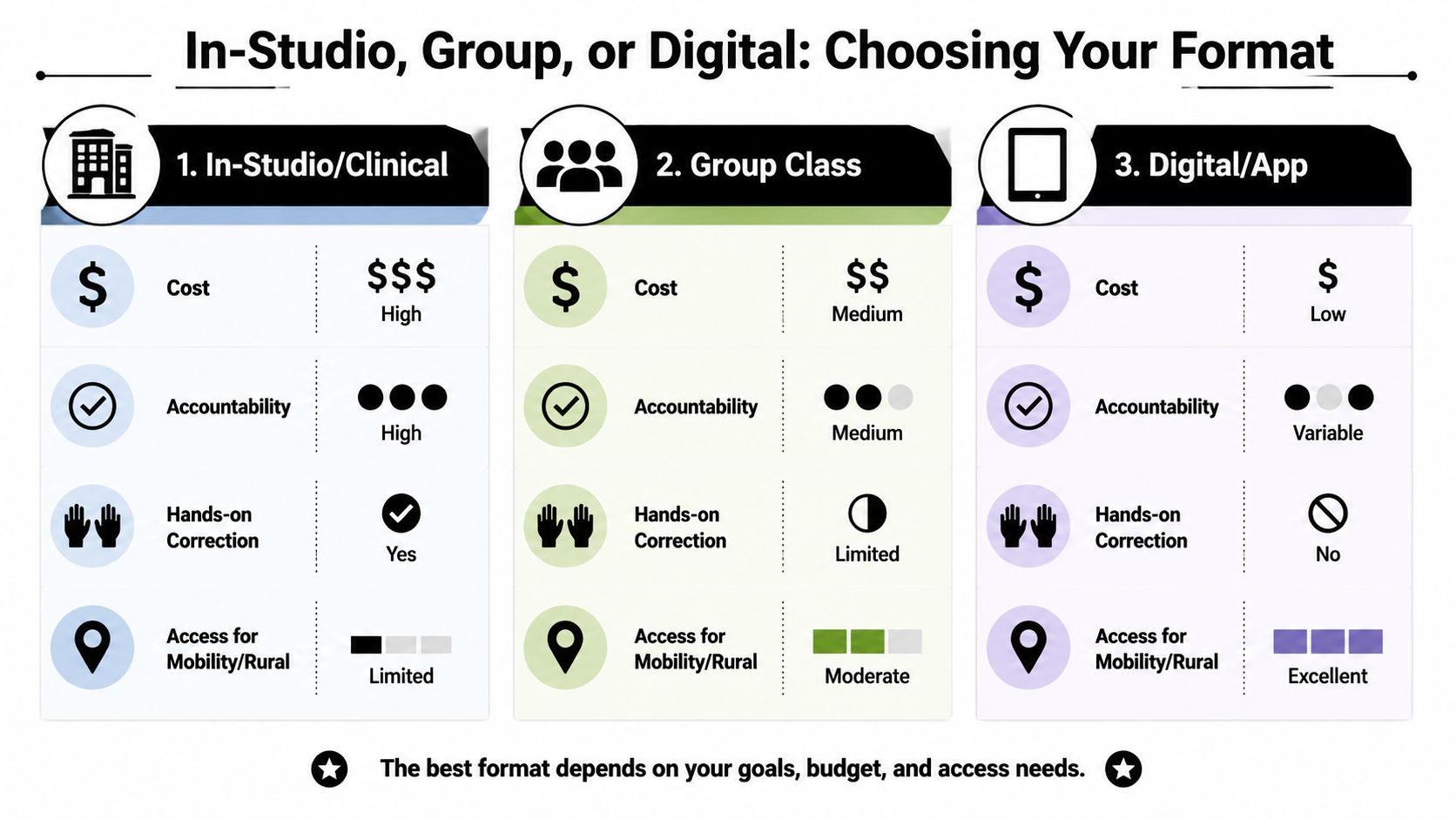
Delivery format changes the treatment, even when the modality has the same name. An in-studio session may reveal a movement fault that a video cannot see. A group class may make practice more consistent because other people expect you to attend. A digital program may be the only realistic option for someone living far from a qualified provider.
Compare the trade-offs
| Format | Cost | Accountability | Hands-on correction | Access |
|---|---|---|---|---|
| In-studio or clinical | Usually higher | High | Strongest | Limited by location and mobility |
| Group class | Often moderate | Social and moderate | Limited | Better reach than individual visits |
| Digital or app-based | Usually lower | Variable | None or limited | Strongest for rural or mobility-limited users |
In-studio care wins when technique and safety screening matter. That includes acupuncture, spinal manipulation, complex exercise progression, and a new patient assessment. A group format works well for adapted yoga, tai chi, mindfulness, and gentle movement when the instructor can offer modifications.
Digital care is especially practical for daily mindfulness, breathwork, education, and home exercises already demonstrated by a clinician. It's a weak substitute for needle-based care or adjustment-based treatment that depends on precision and direct examination. Virtual reality, wearables, digital assessments, hypnosis, and music-based interventions are emerging areas, but emerging doesn't mean proven for every pain condition.
The strongest real-world arrangement often blends formats: periodic hands-on review, a group session for structure, and short home practice between appointments. That isn't a fixed prescription. Choose based on pain intensity, safety needs, schedule, transport, and budget. If symptoms are unstable, prioritize clinical contact. If the main barrier is consistency, choose the format you'll use.
Safety Red Flags and When to See a Clinician First
Adding more wellness practices doesn't automatically make care safer. Some pain patterns need evaluation before acupuncture, massage, yoga, manipulation, or self-directed exercise.
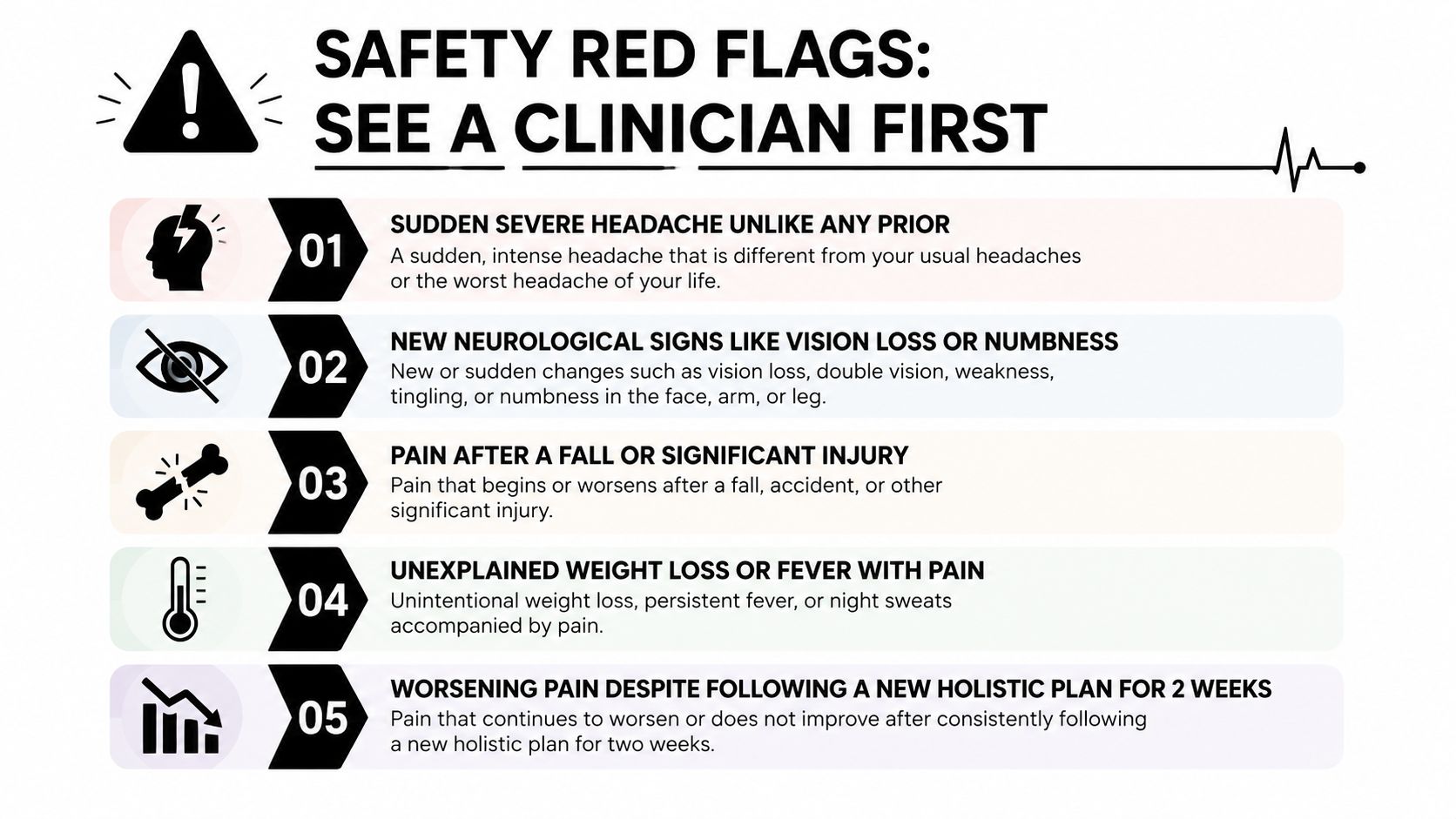
Seek prompt clinical assessment for:
- A sudden, severe headache: Especially when it's unlike any headache you've had before.
- New neurological changes: Vision loss, new numbness, weakness, confusion, or trouble speaking require urgent attention.
- Pain after significant trauma: A fall, collision, or other injury may involve a fracture or internal damage.
- Fever, swelling, or unexplained weight loss: These findings can signal an inflammatory, infectious, or systemic problem.
- Pain that changes character or keeps worsening: Don't continue a new plan indefinitely when symptoms are deteriorating or waking you from sleep.
Practitioner behavior matters just as much. Walk away from anyone who discourages conventional diagnosis, promises a cure, refuses to explain credentials, or pressures you into an expensive package before an assessment. A responsible provider should explain expected benefits, limitations, alternatives, and signs that warrant referral.
Certain treatments need extra caution. Discuss acupuncture with a clinician if you have a bleeding disorder or take medication that affects clotting. Avoid chiropractic manipulation when a fracture is suspected, and seek medical evaluation first. If your pain changes character, stop the new intervention and contact an appropriate clinician. Integrative care complements evaluation. It doesn't override red flags.
Finding Vetted Holistic Pain Providers Near You
Choosing a modality is only half the job. You still need a practitioner who understands your pain type, communicates clearly, and can work within the rest of your care.
Use a five-point vetting checklist
- Confirm licensure and registration. Requirements vary by profession and location, so verify credentials through the relevant professional or government register.
- Look for pain-specific training. General wellness certification isn't the same as experience with chronic pain, fibromyalgia, osteoarthritis, headaches, or post-surgical recovery.
- Ask for a documented plan. The provider should identify goals, explain how progress will be measured, and tell you when the approach should be reconsidered.
- Clarify the financial terms. Get session prices, package conditions, cancellation rules, and insurance information before committing.
- Test coordination. A strong provider won't object to communication with your primary clinician or rehabilitation team when that coordination is appropriate.
A useful profile should make the decision easier. Look for clear modality categories, condition tags, service descriptions, treatment-room photos, verified reviews, and a bio that explains how the practitioner works rather than listing credentials alone. Be cautious when a profile relies entirely on vague promises such as “balances everything” or “guarantees healing.”
Turn a local search into a shortlist
Lucidoura is one option for this discovery step. Its curated directory organizes wellness venues across categories such as acupuncture, massage, yoga, meditation, sound healing, breathwork, spas, and integrative medicine. You can narrow results by city or neighborhood, inspect place profiles for modality and condition tags, and compare relevant options without sorting through unrelated local-search results.
Consider someone with knee osteoarthritis in a mid-sized city. They might search the city for acupuncture, then filter for yoga or tai chi, and finally inspect integrative or clinical listings that mention chronic pain or post-surgical recovery. Within a short search session, they can build a shortlist, then call two or three providers with focused questions:
- Do you regularly work with knee osteoarthritis?
- Who supervises the treatment, and what credentials do they hold?
- What would you measure besides pain?
- How would you adapt treatment during a flare?
- What does a first visit cost, and do you offer individual or group options?
- Will you coordinate with my clinician if needed?
The directory can speed up discovery, but it doesn't replace credential checks or a proper intake. Treat the profile as a starting point, not a medical endorsement.
Bringing It All Together Plus Your Top Questions Answered
Use this decision rule: match the modality to the mechanism, start with one low-risk option, measure function, and escalate to clinical care when red flags appear. The right plan may combine a clinic, a studio, a group class, and home practice, but every component should have a reason for being there.
Lucidoura's category, city, and tag filters can turn that rule into a practical local search. You can look for the modality that fits your goal, narrow it to nearby providers, and compare descriptions before making calls.
Common questions
How long should I try a plan?
Allow enough time to judge trends in sleep, movement, mood, and daily function, then reassess over weeks rather than expecting an immediate dramatic change. The AHRQ review found small improvements across follow-up periods, which supports realistic expectations and regular review rather than indefinite treatment. (AHRQ review of comprehensive pain management)
Can I combine modalities with prescription medication?
Often, complementary care can sit alongside medication, but tell every provider what you take. Acupuncture, supplements, exercise intensity, and manual treatments may require condition-specific safety checks.
What evidence level should I expect?
Ask for at least a plausible, condition-relevant evidence signal, a clear goal, known limitations, and a plan to stop or change course if you don't improve.
Will insurance pay?
Coverage varies by plan, profession, diagnosis, and location. Ask the provider and insurer directly, then compare covered clinical care with self-pay group or digital options.
How do I know whether it's working?
You're looking for better function, sleep, confidence, mood, or tolerability, not only a lower pain score. If those markers don't improve, pivot.
The next step isn't adding another treatment. It's finding the right qualified provider for the job you need done.
Lucidoura helps you discover local wellness spaces through organized categories, city filters, and concise place profiles. Visit Lucidoura to compare nearby options for acupuncture, movement, meditation, breathwork, and other supportive services, then use the vetting questions above before booking.