Cold Plunge vs Ice Bath: Which Cold Therapy Is Right for You
Cold plunge vs ice bath compared by temperature, benefits, risks, and recovery outcomes. Learn which cold therapy fits your goals and where
Written by Editorial Team
The popular advice is simple: the colder the water, the better the recovery. The evidence doesn't support that shortcut. “Cold plunge” and “ice bath” usually describe the same intervention, cold-water immersion, and the meaningful differences come from the temperature, duration, timing, and your health status, not from whether a chiller or bags of ice cool the water.
A January 2025 systematic review in PLOS One pooled 11 controlled studies involving 3,177 participants, with a mean PEDro quality score of 6.4. The review found time-dependent effects, including reduced stress during the first 12 hours after exposure, while findings for sleep quality and quality of life were less consistent and immunity claims weren't well supported. The full systematic review and meta-analysis also shows why a label-based comparison can mislead: the studies used water temperatures from roughly 7–15°C and exposure durations from about 30 seconds to 2 hours.
This guide treats cold exposure as a dose question. You'll see what the research can reasonably support, where marketing gets ahead of evidence, and how to choose a safer option for soreness, alertness, general wellness, or no purpose at all.
Why the Cold Plunge vs Ice Bath Debate Misses the Point
Cold plunge and ice bath are marketing labels for the same biological intervention. In peer-reviewed research, both generally fall under cold-water immersion, or CWI. The body responds to the water's thermal load, including its temperature and exposure time, rather than the name printed on the tub.
A temperature-controlled plunge pool and an ice-filled household container can both cause vasoconstriction, activate the autonomic nervous system, and change heat transfer at the skin. These responses may affect perceived soreness, stress, and recovery. Their intensity and practical value depend on the protocol and the person using it.
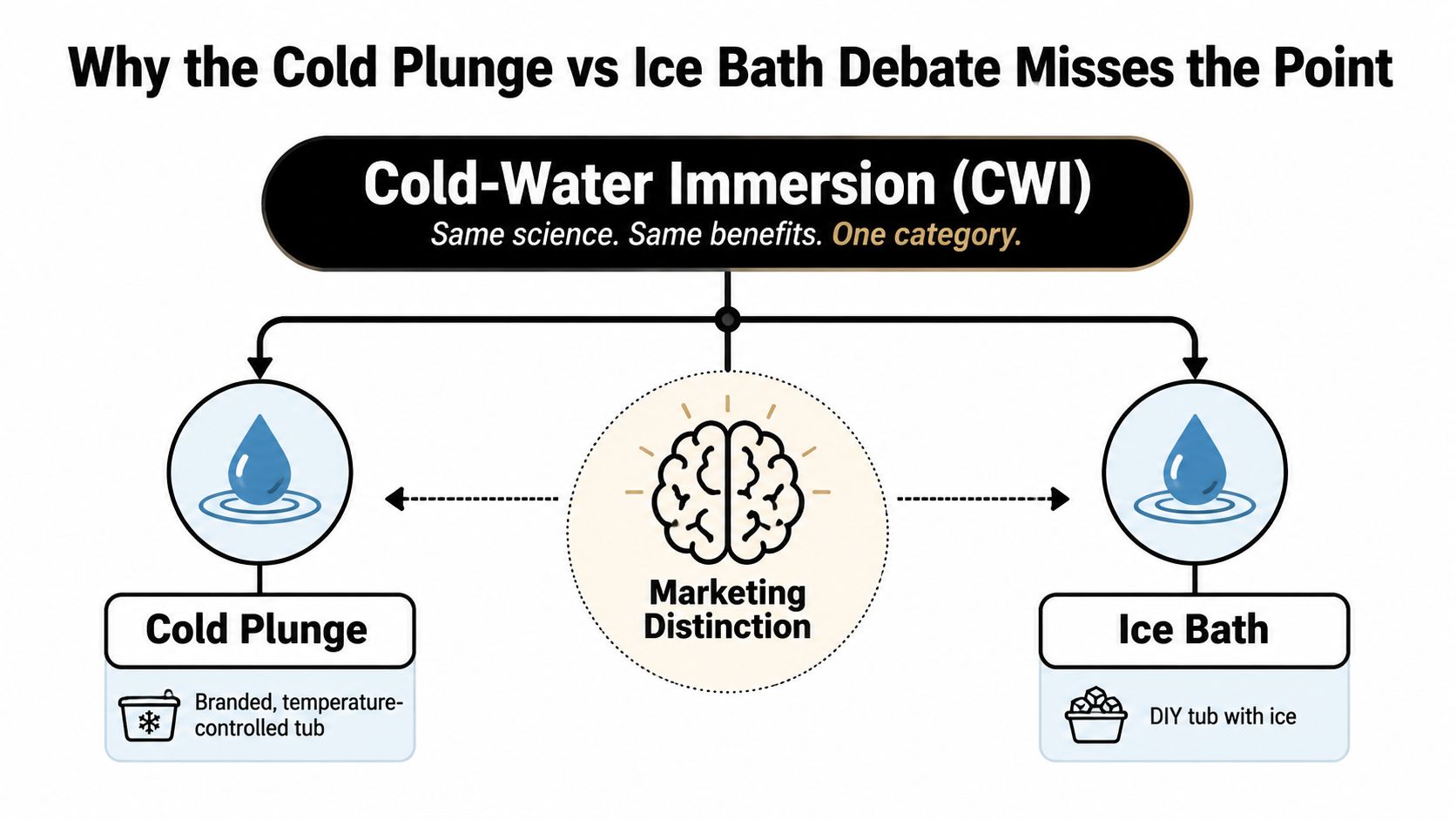
The label hides the dose
The wellness market often presents a cold plunge as a polished, chiller-controlled experience and an ice bath as a harsher, do-it-yourself option. That description identifies the setting, but it leaves out the intervention's actual dose. A plunge can use relatively moderate water, while an ice bath may change considerably as the ice melts and the water warms.
Research has not established one universal protocol. Studies use different temperatures, exposure durations, participant groups, and goals, which limits direct comparisons. A peer-reviewed review of cold-water immersion research shows the same pattern: CWI research covers varied protocols rather than one standardized treatment.
Practical rule: Ask for the actual water temperature and session length. “Cold plunge” describes a product, not a dose.
What the debate should compare
A useful comparison examines three variables:
- Temperature: Colder water transfers heat more quickly and generally creates a stronger acute physiological challenge.
- Duration: Longer exposure increases the total thermal load, even when the water is not at its coldest.
- Timing: A session aimed at perceived soreness may not suit every strength-training session immediately afterward.
The meaningful decision concerns protocol fit. Does the selected temperature, duration, and timing match the goal without imposing unnecessary stress? This framing also clarifies the evidence. CWI research can support modest recovery effects in some contexts, while falling short of broad claims about universal immunity, mood improvement, or performance enhancement.
Temperature Ranges and Protocols That Matter
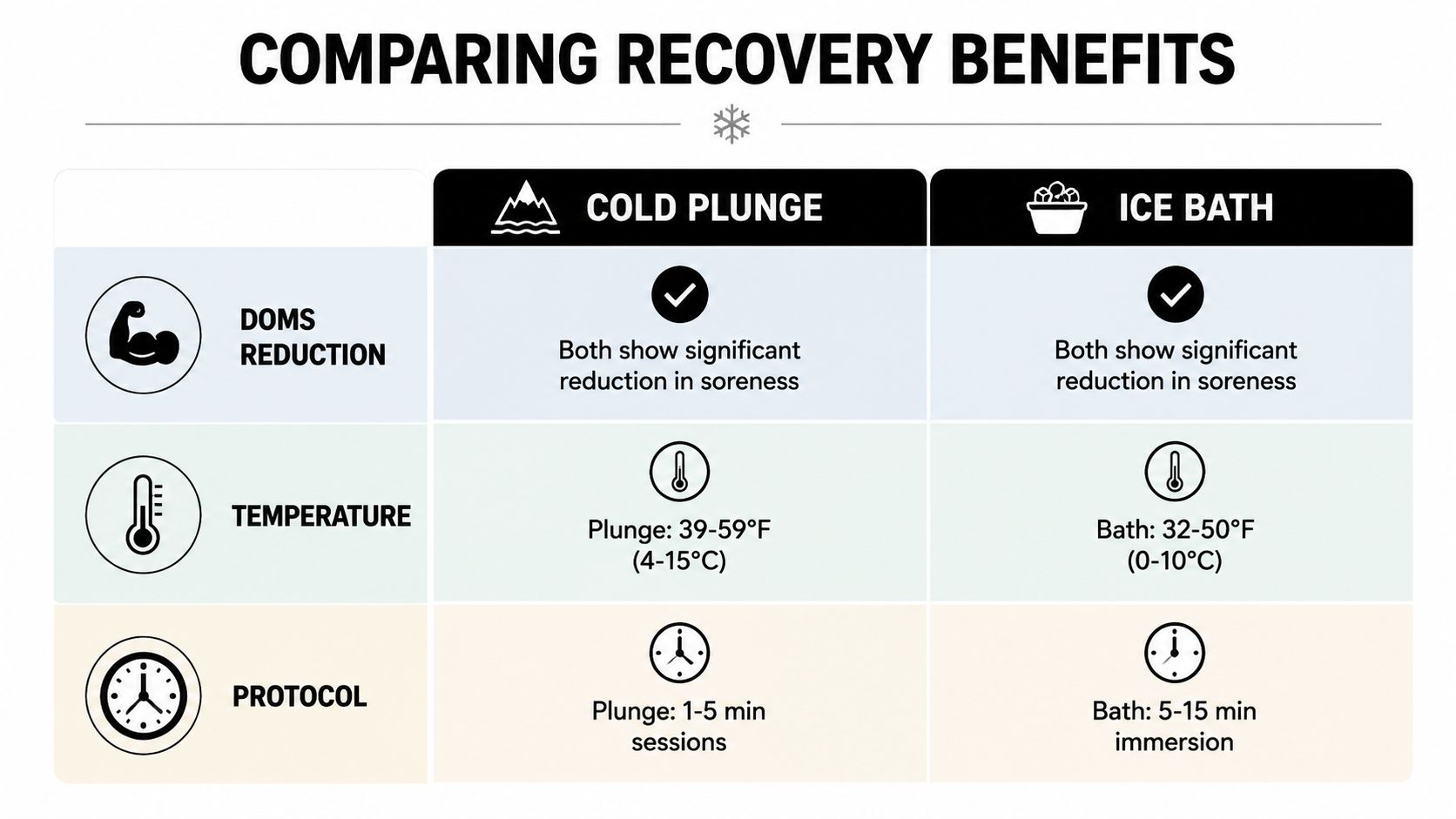
Temperature is the clearest practical difference between many commercial cold plunges and ice baths, but the boundaries vary. A typical cold plunge is commonly placed around 5–15°C, or 41–59°F, while an ice bath is often described closer to 0–5°C, or 32–41°F. This review of cold-water immersion and post-exercise recovery explains that colder water can produce a stronger cardiovascular and metabolic response, without establishing a better outcome for every goal.
The peer-reviewed literature most often examines water around 7–15°C and exposures from 30 seconds to 2 hours, according to the 2025 systematic review in PLOS One. Another review identifies 10–15°C for 10–15 minutes as a frequently studied range. These findings describe research conditions, not a universal personal prescription.
A practical protocol comparison
| Protocol Type | Temperature Range | Duration | Primary Application |
|---|---|---|---|
| Moderate cold-water immersion | 10–15°C | About 10–15 minutes in commonly studied protocols | Perceived soreness and recovery support |
| Controlled cold plunge | About 5–15°C | Varies by temperature and purpose | Repeatable exposure with temperature control |
| Ice bath | Often about 0–5°C | Usually shorter than moderate protocols | Higher-intensity cold exposure |
| Research-defined CWI | Roughly 7–15°C | About 30 seconds to 2 hours across studies | Studying stress, recovery, sleep, and other outcomes |
Use these ranges to compare protocols, not to prescribe one. Lower temperatures generally require shorter exposure because they create a larger thermal challenge more quickly. A brief ice bath can therefore place more immediate stress on the body than a longer session in moderately cold water.
Consistency matters more than prestige
A chiller lets operators monitor and reproduce a target temperature. An ice bath is still a form of CWI, but its temperature shifts as the ice melts. Starting conditions also depend on the water, container, amount of ice, and surrounding environment. That variability makes the received dose harder to identify and repeat.
For people combining heat and cold, this guide to contrast therapy provides context for alternating modalities. The practical conclusion is straightforward: moderate exposure isn't automatically inferior. Colder, longer sessions may increase discomfort and physiological stress without clear evidence of proportionally greater benefit. Choose the protocol that can be measured, tolerated, and repeated for the intended recovery goal.
Comparing Recovery Benefits and Physiological Effects
The strongest practical case for cold-water immersion is short-term, subjective recovery. People may feel less sore or more recovered after demanding exercise, and reviews have reported reduced soreness in some protocols. That doesn't mean cold exposure repairs every form of tissue damage, improves every performance measure, or produces identical results for every athlete.
The 2025 systematic review found that outcomes were time-dependent. Stress reduction appeared in the first 12 hours after exposure, while sleep quality and quality of life improved in some studies. The same review found that immunity claims weren't well supported, which is an important limit when wellness marketing presents cold exposure as a broad health enhancer.
What changes, and what doesn't
Both a plunge and an ice bath can produce an acute cold response. Water temperature and exposure time determine how intense that response becomes, so two sessions with different labels can be physiologically similar, while two products with the same label can be very different.
| Outcome | What the evidence supports | What remains uncertain |
|---|---|---|
| Perceived soreness | Some reviews report reduced soreness after CWI | The ideal dose and individual response vary |
| Subjective recovery | Some people report feeling more recovered | Feeling recovered doesn't prove improved performance |
| Stress | Reduced stress has been observed during the first 12 hours in the 2025 review | The effect isn't a universal mood intervention |
| Sleep and quality of life | Improvements appeared in some studies | Findings aren't consistent across all groups |
| Immunity | Claims are not well supported by the strongest recent synthesis | Cold exposure shouldn't be marketed as immune protection |
| Strength and endurance | Results remain mixed | Immediate post-resistance-training immersion may blunt strength gains |
The review of cold-water immersion and recovery also cautions against assuming that reduced soreness equals better training adaptation. Cold exposure may change pain perception and inflammatory processes, but athletes pursuing hypertrophy have a different priority from athletes trying to feel functional before another event.
The delivery method isn't the main variable
A controlled tub is easier to repeat. An ice bath may be more accessible, but its temperature is less stable and its setup requires more manual attention. Those are meaningful practical differences, yet neither method has a separate mechanism that makes it superior.
Both can also create cold shock and cardiovascular stress if the exposure is too severe. The risk comes from the dose and the person, not from whether the water was chilled mechanically or with ice.
The evidence doesn't justify promising universal performance gains. It supports a narrower conclusion: cold-water immersion can help some people perceive less soreness or stress, but colder water isn't a reliable shortcut to better adaptation.
How to Choose Based on Your Recovery Goals
Choose the outcome first, then use the least severe protocol that plausibly serves it. This keeps the decision tied to recovery needs rather than to branding. “Cold plunge” and “ice bath” describe different setups, but both deliver cold-water immersion. Temperature, duration, timing, and supervision determine the practical choice.
Match the exposure to the objective
| Recovery Goal | Recommended Temperature | Duration | Frequency | Best Modality |
|---|---|---|---|---|
| Short-term soreness support | Moderate cold, commonly around 10–15°C in studied protocols | Often about 10–15 minutes in research contexts | Based on training demands and personal response | Controlled plunge or carefully monitored bath |
| Repeatable general wellness exposure | Moderate rather than extreme cold | Keep the session brief enough to maintain controlled breathing | Individualized | Temperature-controlled plunge |
| Alertness or resilience practice | Cold exposure that remains tolerable and supervised | Brief exposure, especially for beginners | Individualized | Plunge with precise monitoring |
| Hypertrophy-focused resistance training | Avoid assuming immediate intense CWI is beneficial | Consider timing rather than escalating severity | Discuss with a qualified professional if used regularly | A conservative, non-extreme approach |
| Unclear goal | Don't begin with the coldest available protocol | Start conservatively or skip it | Reassess whether it adds value | Supervised venue |
The evidence doesn't establish a universal winner between a 10°C session for 10–15 minutes and a 4°C session for 2 minutes. A moderate, longer exposure may create a different thermal dose from a very cold, brief exposure, while the available studies do not show that one combination consistently works better for everyone.
Use the simplest decision rule
For soreness relief before another demanding session, moderate CWI fits the recovery literature better than pursuing the lowest available temperature. A controlled plunge may offer more consistent dosing, while an ice bath can still be reasonable when its temperature and exposure time are monitored.
Mental challenge calls for a tolerable protocol that allows controlled breathing and a safe exit. Distress can make an ice bath feel more intense, but intensity alone does not demonstrate greater recovery value.
Strength athletes should treat immediate cold exposure after resistance training cautiously. Research reports mixed effects on performance, strength, and endurance, and some reviews raise concern that post-training cold immersion may blunt strength gains. Timing therefore matters as much as the choice between a plunge and a bath, particularly when hypertrophy is the priority.
A dramatic sensation is not a validated recovery outcome. The better choice is the protocol you can control, repeat appropriately, and connect to a specific goal.
Safety Risks and Who Should Avoid Cold Exposure
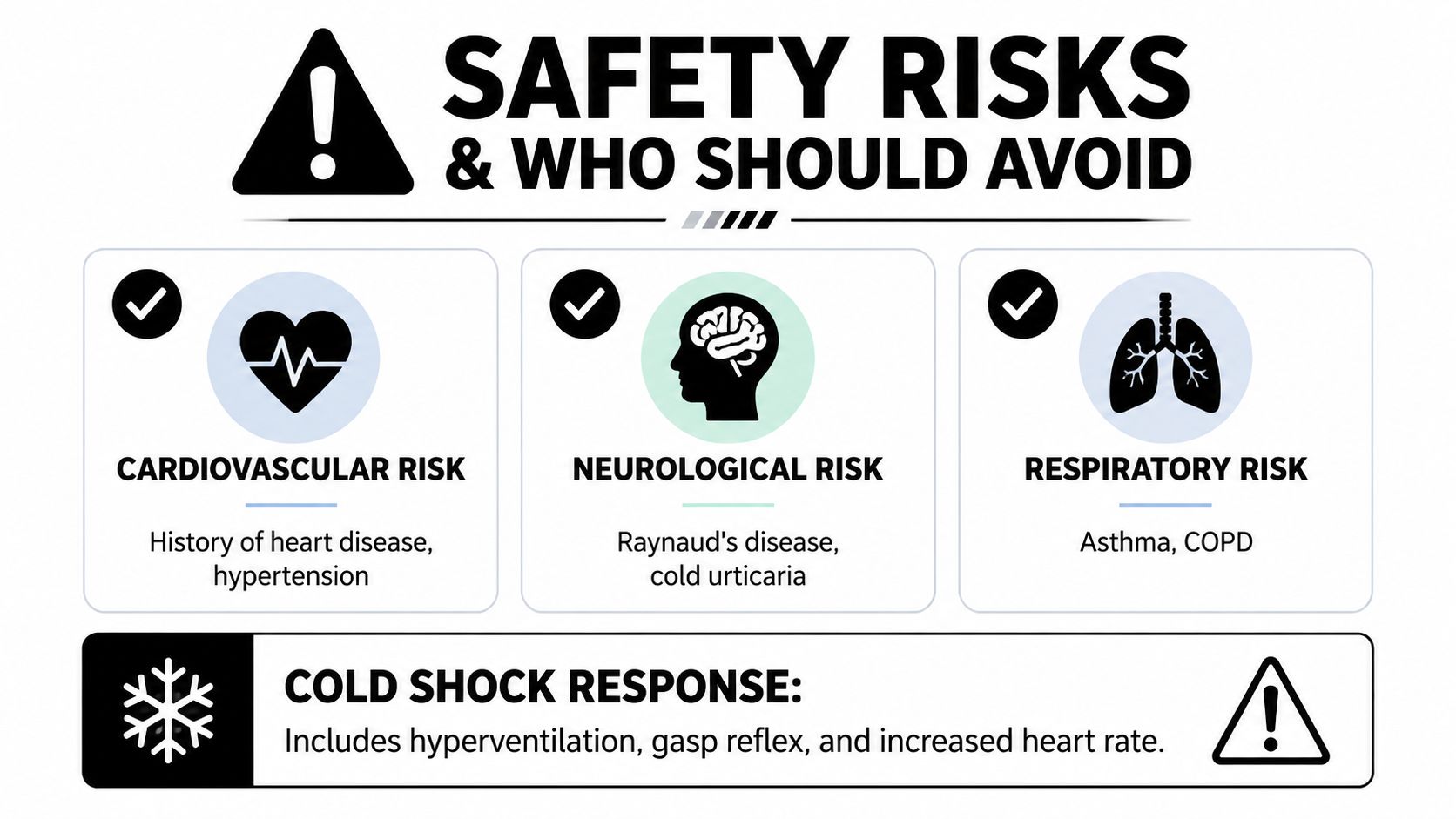
Cold-water immersion can trigger a rapid stress response before any recovery benefit becomes relevant. Sudden immersion may cause involuntary gasping, rapid breathing, increased heart rate, and cardiovascular strain. A person who enters water that's too cold, stays too long, or loses control of breathing can turn a wellness session into a medical emergency.
The evidence summaries identify potential harms including hypothermia, arrhythmias, and cardiovascular stress, particularly for susceptible people. They also note that inflammation can rise within an hour of immersion in some studies, which further weakens the idea that every cold response should be interpreted as therapeutic.
Treat health history as a decision point
A 2025 summary of the PLOS One review specifically warns people with heart disease, hypertension, diabetes, or poor circulation to seek medical advice before trying cold-water immersion. People with known arrhythmias, Raynaud's disease, cold urticaria, reduced sensation, or other conditions affected by temperature should also avoid self-prescribing an extreme protocol.
Pregnancy, cardiovascular medication use, and any history of fainting or abnormal response to cold deserve individualized medical guidance. A venue's staff can't replace a clinician who understands your history.
Before booking, ask yourself:
- Cardiovascular history: Have you been diagnosed with heart disease, hypertension, or an arrhythmia?
- Circulation and sensation: Do you have poor circulation, Raynaud's disease, diabetes-related sensory loss, or another condition that affects your extremities?
- Cold reactions: Have you experienced hives, swelling, wheezing, fainting, or unusual pain after cold exposure?
- Supervision: Will someone monitor the session, and can you exit immediately?
- Environment: Is the water clean, the surrounding floor safe, and emergency support available?
Safety boundary: Medical clearance isn't optional when a known cardiovascular, circulation, respiratory, or temperature-sensitivity condition is involved.
Don't enter alone, don't use breath-holding to intensify the experience, and don't remain in the water because a timer says you should. If you feel chest pain, severe shortness of breath, confusion, faintness, uncontrolled shivering, or an irregular heartbeat, exit and seek urgent help.
For readers comparing whole-body cold exposure with other services, this explanation of cryotherapy treatment can help distinguish different modalities. They shouldn't be treated as interchangeable safety experiences.
Finding and Evaluating Local Cold Therapy Venues
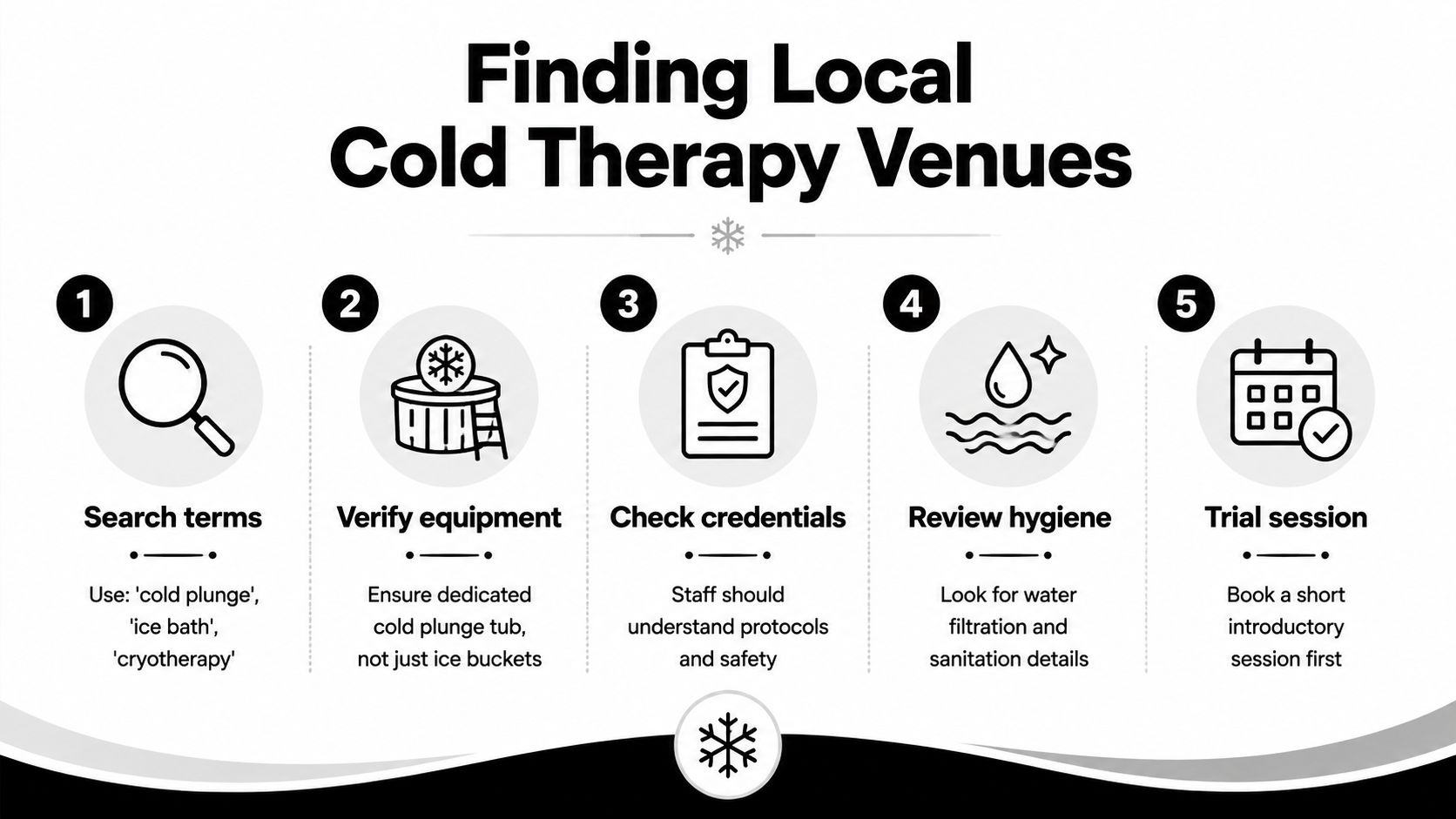
A venue's marketing label tells you less than its operating procedure. Before booking, ask the facility to state its actual water temperature, typical session duration, cleaning process, and supervision policy. If staff can't answer those questions clearly, you don't have enough information to evaluate the exposure.
Search for “cold plunge,” “ice bath,” “contrast therapy,” and “recovery studio” alongside your city. Wellness directories can reduce generic search noise, but you still need to verify the details directly with the venue.
Five checks before you enter
- Temperature records: Ask whether staff measure and log water temperature, rather than relying on a displayed target.
- Sanitation: Look for an explanation of filtration, water treatment, cleaning intervals, and how the facility manages shared immersion.
- Staff readiness: Confirm that an attendant understands cold shock, can stop the session, and knows the venue's emergency procedure.
- Facility design: Check for secure entry and exit points, non-slip flooring, towels, and a warm area nearby.
- Trial format: Choose a short introductory session that lets you assess the staff, instructions, and environment before committing to repeated visits.
A responsible venue should distinguish moderate cold exposure from an ice bath that operates near the colder end. It should also explain who shouldn't participate instead of framing discomfort as a test of character.
Lucidoura is a curated directory where people can browse local wellness venues and review listed modalities such as cold plunges, saunas, bathhouses, and recovery services. Explore local sauna and cold-plunge options as a starting point, then contact the venue to confirm current temperatures and safety procedures.
Red flags include unclear water temperatures, no visible sanitation information, unattended sessions, pressure to stay longer, and claims that cold exposure guarantees immunity or athletic performance. A premium setting doesn't remove the need for basic risk controls.
Real Scenarios for Choosing Your Cold Therapy Experience
An endurance athlete finishing a demanding race may want to manage soreness before returning to training. A supervised CWI session within a moderate recovery range may be more rational than an extremely cold bath. The athlete receives a repeatable exposure, can monitor symptoms, and accepts a trade-off: less discomfort does not necessarily mean greater training adaptation.
A strength athlete pursuing hypertrophy faces a different decision. Immediate, intense cold immersion after resistance training may interfere with signaling associated with adaptation. Harsher exposure also has no established advantage for reliably improving strength or endurance. CWI may therefore fit occasions when short-term soreness management outweighs the adaptation goal, rather than becoming an automatic post-workout ritual.
The wellness user
A professional without a competitive performance goal may choose a controlled plunge because consistency matters more than severity. A moderate session with clear instructions and an easy exit offers a structured stress experience without turning cold exposure into a contest.
The intended outcome should guide the choice. Someone seeking alertness can assess how they feel afterward. Someone seeking better sleep or immunity should keep expectations limited, because recent synthesis found inconsistent sleep results and weak support for immunity claims.
The beginner
A first-time user should prioritize supervision and breathing control over temperature bragging rights. A venue that explains the water temperature, starts conservatively, and allows immediate exit is a better fit than an unattended tub containing an unknown amount of ice.
Success means completing a controlled exposure without alarming symptoms, then deciding whether the practice offers a meaningful benefit. The labels cold plunge and ice bath describe the same underlying mechanism, cold-water immersion. The practical choice depends on dose, purpose, repeatability, and safety, including temperature and session control.
If you want to compare local cold plunges, ice baths, saunas, and other recovery-focused wellness spaces, visit Lucidoura to browse curated venue listings by category and city. Use the information to ask each facility about temperature control, supervision, sanitation, and whether its service matches your actual recovery goal.