8 Best Infrared Sauna Options for Wellness Venues
Compare 8 best infrared sauna options by technology, capacity, price, space, and venue fit to choose the right wellness investment.
Written by Editorial Team

The most expensive infrared sauna isn't automatically the best choice for a wellness venue. A premium cabin can deliver an impressive guest experience, yet still be the wrong investment if it consumes scarce floor space, requires complex installation, limits session turnover, or appeals to a narrower audience than your business serves.
The right choice depends on the experience you're building. Operators need to compare full-spectrum and far-infrared heating, single-user and group capacity, residential and commercial durability, session flow, installation demands, add-ons, serviceability, and total budget. A private infrared pod may suit an urban treatment room, while a larger commercial cabin may work better for a gym, resort, or wellness club with predictable demand.
This roundup compares eight supplied options using the same venue-focused lens. The recommendations emphasize customer experience, floor-space efficiency, throughput, installation, and audience fit rather than treating every sauna as interchangeable.
For people looking for an actual local session, Lucidoura's infrared sauna discovery guide can help surface nearby spas, saunas, bathhouses, and wellness studios by category and city. Confirm current pricing, configuration, availability, session length, and booking requirements directly with the supplier or venue before purchasing or booking.
1. Clearlight Sanctuary Y Sauna
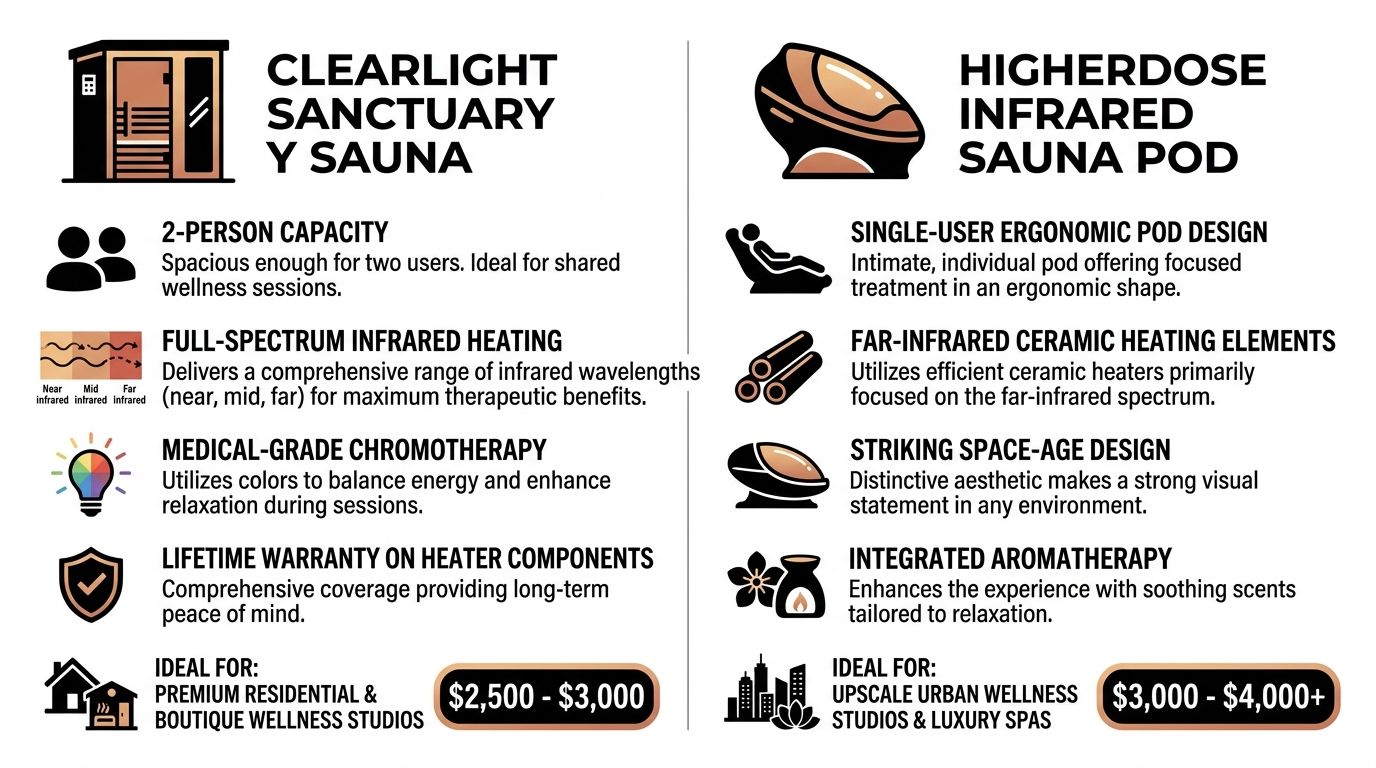
The Clearlight Sanctuary Y is the strongest fit for a premium private experience where design quality and perceived personalization matter as much as heat delivery. Its two-person format suits boutique wellness studios, luxury spa clubs, yoga spaces, meditation centers, and residential wellness rooms that need more than a basic recovery cabin.
The sauna uses full-spectrum infrared heating, which gives operators a clear marketing distinction over far-infrared-only models. Its hypoallergenic materials, precise temperature controls, medical-grade chromotherapy, and polished interior support a calm, high-touch session rather than a utilitarian gym amenity. The USA-made positioning can also help a venue frame the unit as a considered premium investment.
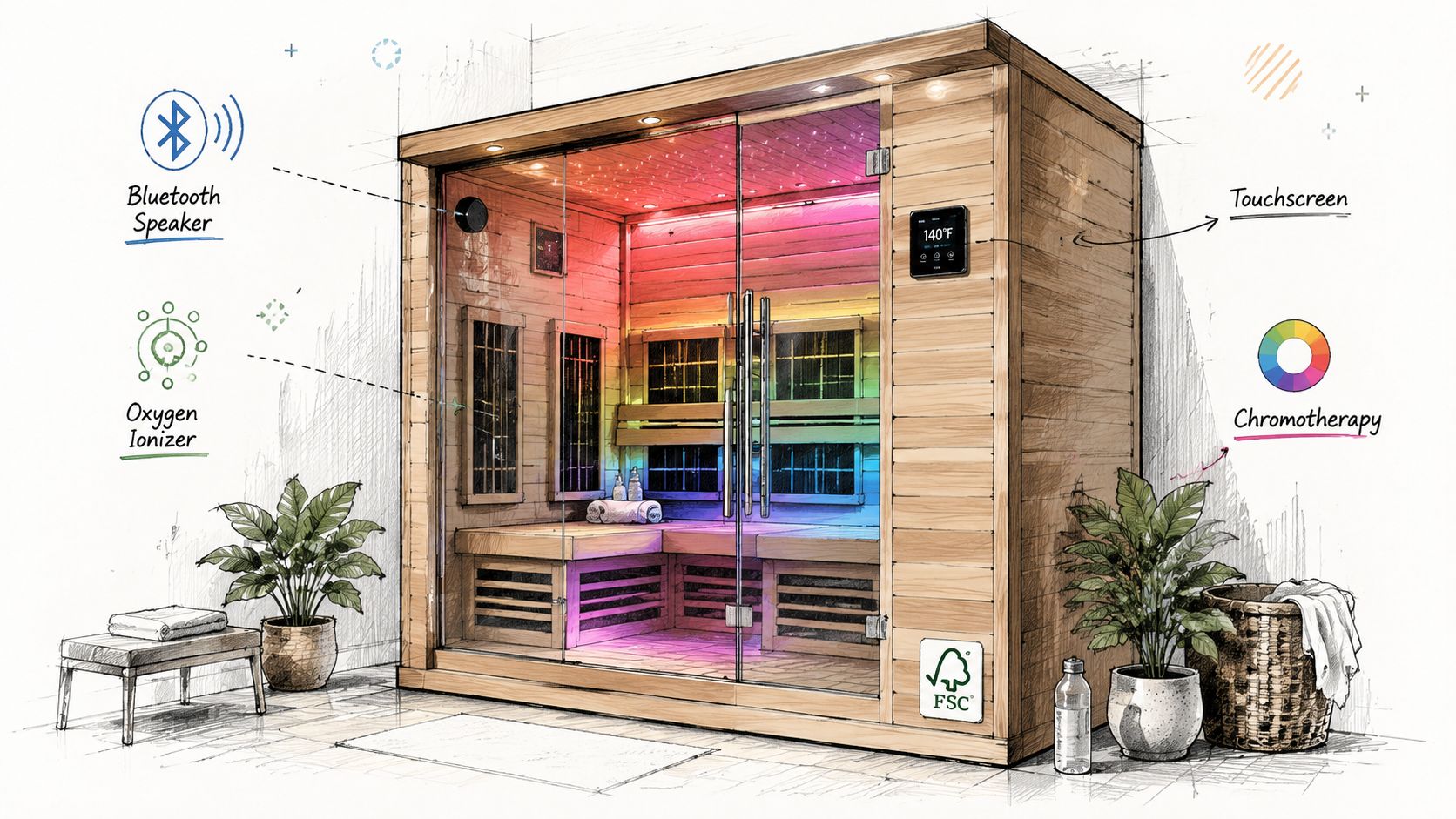
Best venue fit
Choose the Sanctuary Y when your customers value privacy, aesthetics, and a guided wellness ritual. A luxury spa can place it in a dedicated suite, while a small studio can use the two-person capacity for couples, practitioner-led sessions, or premium appointments. It isn't the most efficient choice for high-volume, low-price access because the experience depends on controlled scheduling rather than rapid, anonymous turnover.
Installation deserves planning. The venue should provide suitable ventilation, keep the surrounding installation area below the recommended humidity conditions, and confirm electrical requirements with the supplier before delivery. Preheating before a booking helps the sauna feel ready when guests arrive, but operators should build that preparation time into staff routines and the booking calendar.
Practical rule: Sell the Sanctuary Y as a personalized private session, not simply as heated floor space.
Start customers with shorter sessions and let them build familiarity gradually. Chromotherapy should support the room's intended mood, while regular inspections help protect the premium presentation. For a studio that wants a refined, two-person cabin with broad infrared positioning, this is the best infrared sauna option in the list.
2. HigherDOSE Infrared Sauna Pod
The HigherDOSE Infrared Sauna Pod earns its floor space through presentation, not capacity. Its space-age form, full-body exposure, far-infrared heating, chromotherapy, and aromatherapy suit upscale urban wellness spaces, biohacking studios, performance centers, resort properties, and luxury spas where the visual identity is part of the purchase.
Treat the pod as a premium service asset and schedule it for customers who already understand recovery memberships or want a distinctive ritual. It fits best beside complementary services such as cryotherapy, IV therapy, performance consultations, or guided recovery sessions. That positioning gives the venue a broader program and helps justify a higher-value appointment.
How to make the pod commercially useful
The commercial return depends on how clearly the venue presents and programs the experience. Use professional photography, consistent lighting, and an exact description of what each session includes. Staff should explain aromatherapy options without making unsupported medical promises. The booking page should state the session format, preparation instructions, privacy arrangements, and restrictions before the customer pays.
A 45-minute appointment provides a predictable rhythm for premium scheduling. Build cleaning, guest orientation, and changeover into the calendar rather than treating the session length as the full operating cycle. Membership packages can pair the pod with other services, but keep the menu easy to understand. Customers should know what they are booking without decoding several tiers.
For operators comparing local demand, Lucidoura's guide to infrared sauna locations shows how nearby wellness venues can be organized by category and city. Discovery matters because a distinctive pod produces value only when prospective customers can find the venue, understand the modality, and connect it to their routine.
Choose HigherDOSE for a design-led, high-margin appointment aimed at an affluent or biohacking-oriented audience. A community gym focused on broad affordability should choose another format. An urban wellness venue that wants a memorable, visually distinctive service can use this pod as an anchor, provided its schedule and surrounding offer support premium pricing.
3. Sunlighten mPulse Infrared Sauna
The Sunlighten mPulse is the clearest choice for integrative and practitioner-led environments. Its medical-grade positioning, third-generation far-infrared technology, Solocarbon heating, and emphasis on consistent delivery make it more suitable for integrative medicine clinics, physical therapy and recovery centers, medical spas, advanced wellness facilities, and athletic performance environments than for casual drop-in use.
The strongest commercial advantage is protocol control. A clinic can connect sauna sessions to an intake conversation, a client's stated goals, and documented follow-up. That gives the service a more structured identity than placing a cabin beside the gym floor. Operators should train practitioners to explain the session accurately and avoid presenting infrared sauna use as a substitute for diagnosis or treatment.
Build the service around consistency
A consultation-first workflow makes sense for this format. Staff can ask what the customer wants from the experience, explain the session process, review relevant health considerations, and record the appointment details. Serial treatment packages may encourage repeat use, but the venue should describe them as scheduled wellness services rather than promise a specific health outcome.
Keep session logs if the practice already documents client visits. Notes can cover the selected protocol, customer feedback, comfort, and any changes the practitioner decides to make. Referral relationships with qualified healthcare providers can also support responsible positioning, provided the venue communicates the limits of its service.
The broader distinction between far-infrared, full-spectrum, and hybrid formats is explained in Lucidoura's guide to infrared sauna types. For a venue operator, the key question isn't which label sounds most advanced. It's whether the system supports the service protocol, staff expertise, customer expectations, and documentation standards your business can maintain.
4. Jacuzzi Infrared Sauna
The Jacuzzi Infrared Sauna is the practical mid-range choice for broad customer access. The brand's familiarity can reduce the explanation required at the point of sale, while far-infrared heating gives a wellness studio, gym, day spa, hotel, or community facility a recognizable service to add without leading with the highest premium tier.
This option suits venues that want to make infrared sessions approachable. A yoga studio can pair appointments with classes, a massage practice can offer sauna access before or after bodywork, and a hotel can include the sauna in a wider wellness amenity program. The format works best when the business already has customer traffic and can introduce the service through an existing relationship.
Make accessibility part of the offer
Don't market this sauna only to experienced wellness consumers. Explain the session in plain language, show customers how to use the controls, and offer an introductory appointment that removes uncertainty. A clear first-visit process can matter more than adding another feature to the cabin.
Bundle design should remain simple. A venue might offer sauna access with a massage, yoga class, or recovery appointment, then create a loyalty path for customers who return. The unit can also serve as an entry point for people who are curious about infrared but aren't ready to commit to a luxury spa package.
Operators should still verify the unit's current configuration, electrical needs, warranty, cleaning requirements, and suitability for commercial use. Brand recognition doesn't replace due diligence. If the venue plans to build a broader heat-and-recovery menu, Lucidoura's sauna and cold plunge guide provides useful category context for customers comparing complementary experiences.
Choose Jacuzzi when you need a credible, accessible service for a mixed audience. It's a better fit for steady everyday use than for a highly customized practitioner protocol or a design-first luxury suite.
5. Sauna Works SA2412DX Infrared Sauna
The Sauna Works SA2412DX is aimed at commercial throughput and operational durability. It makes the most sense for established wellness facilities, fitness centers, resort and hotel amenities, corporate wellness spaces, health centers, and multi-location spa operators that expect repeated daily sessions rather than occasional private use.
A commercial sauna has to perform beyond the first customer impression. The operator needs reliable opening procedures, consistent cleaning, straightforward guest orientation, and a maintenance schedule that doesn't depend on one enthusiastic staff member. The SA2412DX's professional-grade positioning supports that operating model.
Plan the room around throughput
Floor planning should account for guest movement, privacy, towel storage, cleaning access, and waiting space. A venue can stagger appointments to prevent congestion, then use the booking system to protect the changeover period. Group programming may also work where the layout allows it, especially if the venue pairs sauna use with breathwork or guided relaxation.
The commercial case is strongest when the sauna supports a broader service menu. A gym can sell recovery access to members, a hotel can place the unit inside a wellness area, and a spa network can standardize the guest orientation across locations. Consistency helps customers know what to expect, while staff training reduces avoidable misuse.
Commercial insight: High-volume sauna revenue depends on the whole operating system, including scheduling, cleaning, orientation, maintenance, and customer support.
Before committing, confirm the supplier's commercial warranty terms, service response process, installation requirements, ventilation plan, and electrical specifications. Those details can affect downtime and operating costs more than a decorative feature. Choose the SA2412DX when your venue already has enough demand to justify a purpose-built commercial installation.
6. Saunacore Traditional-Electric Hybrid Infrared Sauna
Saunacore's traditional-electric hybrid format is the best choice for a venue that wants to offer different heat experiences in one wellness suite. By combining far-infrared heating with traditional sauna elements, the system can serve customers who prefer a gentler infrared session and others who want a more conventional sauna environment.
That flexibility suits destination wellness centers, luxury hotels, high-end spas, resorts, and premium residential installations. It also gives an operator a stronger programming story. Instead of selling one generic sauna appointment, the venue can offer distinct experiences based on heat preference, time available, and the atmosphere the customer wants.
Use the hybrid deliberately
A hybrid unit can complicate staff training and customer communication. Employees need to understand both heating modes, explain the controls, and prevent guests from assuming that the two formats feel or function identically. The booking system should identify the selected experience so the room is prepared correctly.
Custom construction is another planning issue. Operators should consult Saunacore early about dimensions, interior materials, control placement, electrical work, ventilation, and the visual relationship between the sauna and the rest of the suite. A custom installation may reward careful design, but it shouldn't be added to a project at the last minute.
A venue can create differentiated pricing for traditional and infrared sessions, or include both modes in a premium membership. Keep the naming clear and avoid unsupported claims about therapeutic superiority. The strongest selling point is choice, not a promise that one heat modality works for every customer.
Choose Saunacore when your concept depends on variety and customization. It isn't the simplest plug-in addition, but it can become the centerpiece of a resort or spa suite where a single-format cabin would feel limiting.
7. Health Mate Infrared Sauna
Health Mate offers a balanced option for emerging studios and value-conscious established facilities. Its USA-manufactured cabins, low-EMF Solocarbon heaters, and adaptable configurations can suit yoga studios, natural health practices, fitness facilities, small and medium-sized spas, and residential wellness rooms.
The main appeal is not spectacle. It's a credible combination of performance, configuration flexibility, and accessible positioning. A new wellness studio can use the sauna to expand its service menu without making the entire brand feel inaccessible, while an established facility can add private sessions alongside meditation, breathwork, or movement programming.
Lead with transparency
Health-conscious customers often ask specific questions about heater design and EMF. Operators should publish the information the supplier provides, explain what has and hasn't been independently verified, and avoid turning technical language into a health guarantee. Clear education builds more trust than vague references to advanced technology.
A simple introductory package can help the studio build a regular user base. Pairing sauna appointments with meditation or breathwork creates a complete visit and gives customers a reason to return for the overall routine rather than heat alone. Staff should also explain cleaning, hydration, session preparation, and controls during the first appointment.
The venue should confirm the exact configuration before promoting the sauna. Product variations can affect capacity, floor space, controls, electrical planning, and available features. USA manufacturing may be useful in the brand story, but service access, replacement parts, commercial warranty coverage, and installation support deserve equal attention.
Choose Health Mate when you need a dependable middle path between entry-level affordability and luxury positioning. It fits businesses that want to educate customers, build repeat use, and integrate infrared into a broader wellness program.
8. Infrared Sauna Pod by CLEARLIGHT Elements
The CLEARLIGHT Elements infrared sauna pod is the best fit for space-constrained venues that need a scalable format. Its modular pod design can work in urban boutique spas, office-building wellness suites, modern yoga studios, hotel rooms, treatment rooms, and temporary or pop-up installations where a full cabin would consume too much valuable floor area.
The pod's commercial value comes from flexibility. A venue can install it as a premium add-on, schedule sequential appointments, or place it inside a consultation room that serves more than one purpose. In dense urban settings, that floor-space efficiency can matter more than a larger internal capacity.
Build the appointment around privacy and flow
A pod still needs a thoughtful environment. Use calm sound and lighting, provide clear instructions, and make the surrounding room feel intentional rather than improvised. The customer should understand where to change, what the session includes, how staff can be reached, and how the space will be cleaned between appointments.
Sequential scheduling is essential. The booking system should include customer orientation, turnover, and any required preheating rather than treating every appointment as back-to-back occupancy. If the venue combines the pod with quick-access services, keep the overall visit simple.
This format can support premium pricing when the venue presents it as a modern, private wellness experience. Marketing should emphasize compact convenience and design, not make unsupported claims about medical outcomes. Operators considering pop-ups or temporary installations should confirm transport, assembly, electrical, ventilation, accessibility, and supplier support before signing a lease or event agreement.
Choose CLEARLIGHT Elements when floor space is your primary constraint and you want a modern infrared service that can scale with demand. It's especially suitable for urban operators who need to monetize a small treatment room without building a larger sauna suite.
Top 8 Infrared Saunas: Side-by-Side Comparison
| Product | 🔄 Implementation Complexity | ⚡ Resource Requirements | ⭐📊 Expected Outcomes | Ideal Use Cases | 💡 Key Advantages |
|---|---|---|---|---|---|
| Clearlight Sanctuary Y Sauna | Moderate–High, professional 240V install, dedicated ventilation | High, 240V circuit, space for 2, low-maintenance upkeep | High therapeutic efficacy; clinical backing; precise temp & chromotherapy | Premium residential, boutique wellness studios | Lifetime heater warranty; full‑spectrum IR; low EMF; medical‑grade chromotherapy |
| HigherDOSE Infrared Sauna Pod | Moderate, professional install; single‑user pod setup | Medium, single‑user power, aromatherapy integration, compact footprint | Very good full‑body exposure; strong design/aesthetic impact | Upscale urban spas, biohacking studios, luxury wellness centers | Striking space‑age design; aromatherapy; Instagram-worthy; compact |
| Sunlighten mPulse Infrared Sauna | High, technical setup, zoning configuration, pro installation | High, pro electrical, variable footprint (1–3 person), app integration | Clinical‑grade, customizable therapy programs; validated Solocarbon heat penetration | Integrative medicine, PT clinics, research & medical spas | Solocarbon tech; medical certifications; adjustable zones; therapy protocols |
| Jacuzzi Infrared Sauna | Low–Moderate, straightforward install, user-friendly controls | Moderate, standard electrical, multiple size options (2–4) | Reliable mid‑range performance; consistent user experience | Community centers, mid‑range spas, residential wellness rooms | Affordable entry point; trusted brand; multiple configurations; easy UI |
| Sauna Works SA2412DX Infrared Sauna | Moderate, commercial install, heavier equipment handling | High, larger footprint (approx. 6'x4'), reinforced construction | Robust commercial performance; high throughput for multiple daily sessions | Commercial wellness facilities, fitness centers, hotel spas | Durable commercial build; cost‑effective for high use; 4‑person capacity |
| Saunacore Traditional‑Electric Hybrid | High, custom design, complex hybrid installation | High, advanced electrical & humidity control, longer lead times | Flexible heating modes (infrared + traditional); varied therapeutic options | Luxury resorts, custom spas, premium residential builds | Hybrid flexibility; deep customization; Canadian engineering & extended warranty |
| Health Mate Infrared Sauna | Low–Moderate, simple install, minimal smart integration | Moderate, standard power, multiple size models (1–4) | Solid, value‑oriented performance; low EMF for health‑conscious users | Yoga studios, wellness clinics, residential installations | USA‑made; Solocarbon low‑EMF heaters; mid‑range pricing; multiple options |
| Infrared Sauna Pod by CLEARLIGHT Elements | Low, modular, fast install; minimal construction | Moderate, single‑pod power per unit; scalable for multiple pods | Efficient space usage; consistent far‑IR therapy; scalable deployment | Urban boutique spas, pop‑ups, space‑constrained studios | Modular pods; quick install; contemporary aesthetic; scalable solution |
Choose by Venue Fit, Not Just Heat Technology
Selecting the best infrared sauna starts with the room, not the product brochure. Measure the available floor space, map customer and staff movement, and confirm electrical requirements before comparing finishes or lighting. A compact pod may be the right investment for an urban treatment room, while a commercial cabin can make more sense for a gym, resort, or spa with consistent appointment demand.
Next, define the experience. Decide whether customers will use the sauna alone, with a partner, in a guided group format, or as part of a practitioner-led service. The Clearlight Sanctuary Y and HigherDOSE Pod support premium private experiences. Sauna Works is better suited to repeated commercial use. Saunacore earns its place where the business wants traditional and infrared choices. Jacuzzi and Health Mate work well for broader audiences that need an approachable service.
Technology should follow the service model. Compare full-spectrum, far-infrared, and hybrid heating, then assess controls, chromotherapy, aromatherapy, materials, cleaning access, maintenance, and serviceability. Don't assume that a more elaborate specification automatically creates a better customer experience. The best system is the one your staff can operate consistently and your customers can understand quickly.
Throughput deserves its own calculation. Estimate how many sessions the venue can realistically sell, then account for preheating, orientation, cleaning, changing, and room turnover. A sauna that looks profitable at full occupancy may disappoint if the schedule leaves no time for resets or if staff must provide extensive support between bookings.
Evidence and safety communication also matter. Infrared sauna marketing often extends beyond what the research can firmly establish. A 2023 review found no PubMed studies specifically examining infrared sauna skin benefits and safety, while noting that digital cleansing and skin-health claims were widespread despite limited rigorous evidence (review of infrared sauna skin claims and evidence). Venue operators should describe the experience accurately, separate established information from marketing language, and encourage customers to discuss personal health concerns with an appropriate professional.
Before buying or booking, confirm:
- Current configuration: Verify capacity, heater type, included lighting, controls, accessories, and interior materials.
- Installation requirements: Ask about electrical specifications, ventilation, floor protection, delivery access, and assembly.
- Commercial suitability: Confirm warranty coverage, service arrangements, replacement parts, cleaning guidance, and expected maintenance.
- Customer operations: Check recommended session length, preheat needs, accessibility, privacy, cancellation rules, and booking policies.
- Total investment: Compare the sauna, installation, room preparation, staff time, software, maintenance, and planned add-ons rather than looking only at the purchase price.
Market context supports careful evaluation. Infrared sauna panels are reported to represent 42% of the global sauna market, according to a 2026 summary citing Grand View Research's 2025 data (history and market context for infrared sauna panels). That visibility can help venues attract customers, but it also increases the importance of clear product information and responsible service design.
For local discovery, Lucidoura's categories and city filters help people compare nearby spas, saunas, bathhouses, and wellness studios by modality and amenities. Use those listings to identify potential venues, then contact each business directly to confirm current availability, session details, accessibility, and booking requirements.
Visit Lucidoura to discover curated spas, infrared saunas, bathhouses, yoga studios, meditation spaces, and other holistic wellness businesses by category and city. Compare nearby venues, review the modalities they offer, and contact the location directly before booking your next infrared sauna session.