Acupuncture and Wellness: A Practical Guide
Discover how acupuncture and wellness practices can enhance your health. This guide covers benefits and tips for holistic care in 2026.
Written by Editorial Team
You're standing in front of a clinic listing, weighing a question that feels simple and isn't. You want something that could help with pain, stress, or recovery, but you also want to know whether acupuncture fits your goals, your budget, and your comfort level. That's the right place to start, because acupuncture and wellness works best when it's chosen with clear expectations, not vague hope.
The useful version of this topic isn't “Does it work, yes or no?” It's more practical than that. What does acupuncture mean in a modern routine, what does a first visit feel like, where is the evidence strongest, and how do you choose a practitioner who takes safety and coordination seriously?
What Acupuncture Means in a Modern Wellness Routine
A lot of people meet acupuncture through a friend's recommendation, a spa menu, or a search result after months of living with discomfort. That makes sense, because acupuncture has shifted from a niche complementary therapy to a widely used wellness service in major markets. In the United States, adult use more than doubled from 1.0% in 2002 to 2.2% in 2022, which NCCIH reports as about 2.9 million adults in 2002 and 7.4 million in 2022 NCCIH acupuncture overview.
That growth matters because it changes the kind of questions people should ask. Acupuncture is no longer something to treat as a mystery practice on the edge of wellness culture. It's a service people are booking for specific reasons, especially pain, and that means the decision is whether it belongs in your routine in a way that's sensible, safe, and worth the time.
Start with the reason you're considering it
If you're hoping for relaxation alone, you may end up disappointed if the clinic is set up primarily around pain care or rehabilitation. If you're dealing with chronic tension, headaches, or a stubborn recovery issue, you'll want a practitioner who talks plainly about goals, frequency, and what kind of response is realistic.
Practical rule: choose the reason first, then choose the clinic. A good fit starts with your actual need, not a pretty room or a wellness buzzword.
That's the frame for the rest of this guide. You'll get the basics of how acupuncture is explained, what the evidence supports, what a session involves, how it can fit with other wellness services, and how to vet a practitioner before you book.
How Acupuncture Works in Plain Language
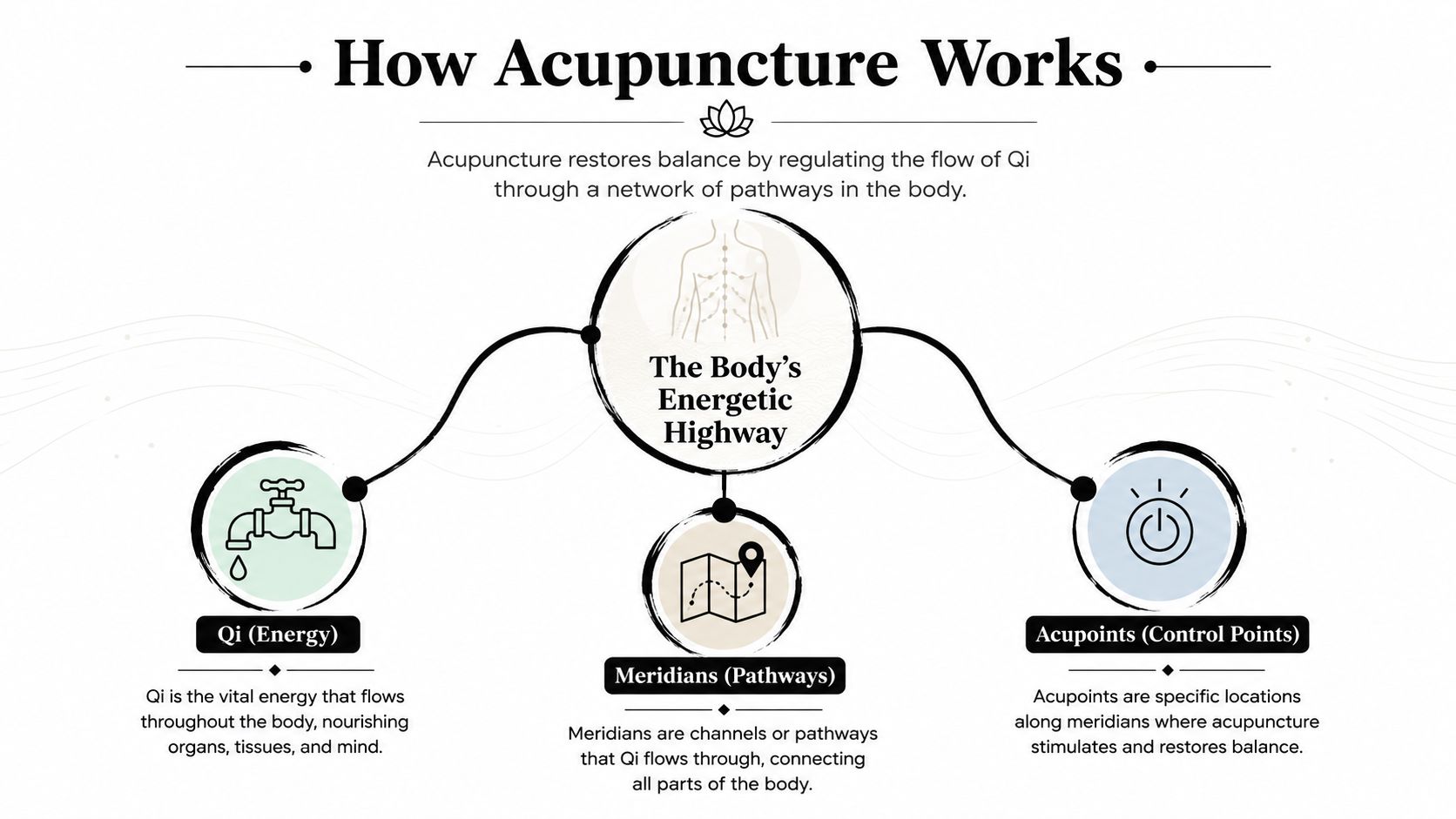
Traditional Chinese Medicine explains acupuncture through qi, meridians, and acupoints. If those terms feel abstract, a simpler image helps. Meridians work like pathways the body uses, qi is the flow moving through them, and acupoints are contact points where that flow can be encouraged, redirected, or eased. That model does not answer every question, but it gives you a workable picture without requiring you to learn the whole vocabulary first.
A modern biomedical explanation uses different language. Researchers often examine how needle stimulation may affect the nervous system, pain signaling, and local circulation. That is one reason acupuncture is often discussed alongside stress regulation and pain management, even though the traditional and biomedical frameworks describe the body in different ways.
The practical point is simple. Acupuncture is part of ordinary consumer wellness behavior, not an obscure outlier. The NCCIH summary shows that 72.8% of acupuncture users in 2022 used it for pain. That helps explain why serious conversations about acupuncture and wellness often center on discomfort, mobility, and function instead of broad “balance” language.
Acupuncture makes more sense when you treat it like a targeted modality, not a lifestyle identity. It is a tool people use for a reason.
For a related look at how nervous-system-focused care gets discussed in wellness contexts, see this guide to nervous system healing.
A clear clinic should be able to explain what the needles are intended to address in your case, in plain language. If that explanation is missing, that is a warning sign. You do not need a mystical script, and you do not need a debate about whether the practice is old enough to trust. You need a straightforward explanation of the intended use, the expected course, and the limits of the approach.
Evidence-Based Benefits and Where the Research Is Thin
The strongest version of acupuncture and wellness isn't “it fixes everything.” It's more specific than that. The most credible uses tend to cluster around pain-related care, which lines up with the NCCIH user data showing that 72.8% of users in 2022 sought acupuncture for pain NCCIH acupuncture overview. That's a useful reality check, because marketing language often spreads much wider than the actual evidence base.
For consumers, “evidence-based” should mean three things. First, the claim has been tested in controlled research, ideally against a sham or comparison treatment. Second, the result has been considered in clinical guidance, not just in a single positive trial. Third, the benefit needs to matter to the person, not just to a statistic in a paper.
Where acupuncture is usually discussed most seriously
In everyday wellness conversations, acupuncture is most often connected to chronic pain, headache patterns, nausea related to cancer treatment, and some headache prevention use cases. Those are the areas where people are least likely to be buying a vibe and most likely to be looking for a concrete functional change.
That doesn't mean every person will get the same result. Two people can read the same evidence and have very different experiences, because symptom severity, treatment plan, and the rest of the care routine all matter. It also means clinics should be careful about how they talk. A serious practitioner can say a modality may help, while still explaining that response varies and that no outcome is guaranteed.
Where caution is smarter than hype
Acupuncture is often marketed for sleep, digestion, allergy relief, stress relief, and broad “detox” style promises. Some people do report subjective improvements in those areas, but the evidence is thinner or more mixed than the promotional language usually suggests. That gap is where readers get burned, because a glossy wellness claim can sound more certain than the actual research is.
Use this filter when you read a clinic page:
- Look for the target problem. A strong page says what the treatment is meant to address, not just that it “supports balance.”
- Check for scope. A good practitioner doesn't promise universal results.
- Ask about the plan. One-off sessions can be pleasant, but many care plans depend on a series and a reassessment point.
- Watch for overreach. If a clinic claims to cure unrelated conditions, the marketing is outrunning the evidence.
If you want the cleanest read on a service, look for language that sounds measured rather than inflated. That usually tells you more than a long list of buzzwords.
What a First Visit Actually Looks Like
The first appointment is usually much more ordinary than people expect. It starts with an intake conversation about your medical history, current symptoms, medications, and any reason you're seeking care. That's where a qualified practitioner figures out whether acupuncture is appropriate, what they should avoid, and whether they need to coordinate with another provider.
After that comes a traditional assessment that may include looking at the tongue and checking the pulse. Those steps can sound strange if you've never heard them explained, but in practice they're part of how many practitioners build a picture of your overall state, not a theatrical ritual meant to impress you.
What the session feels like
Needle placement is usually described as a dull ache, pressure, warmth, or tingling rather than sharp pain. Some points are barely noticeable, while others feel more active. Once the needles are in place, you typically rest for a period before they're removed, and many sessions last around 30 to 60 minutes according to common clinical practice patterns described in wellness settings.
Good prep matters: eat beforehand, wear loose clothing, and tell the practitioner about pregnancy, medications, and any implanted devices before treatment starts.
A lot of people also want to know what happens after the visit. Hydration is a common recommendation, and it's wise to skip intense workouts right away if you feel fatigued or unusually loose afterward. Mild soreness or tiredness can happen, and that's different from a warning sign that needs medical attention.
If you're unsure how often you'd go, think in terms of a series rather than a single test drive. Many people start with repeated visits and then reassess based on response, which is more honest than expecting one session to define the whole experience.
Pairing Acupuncture With Sauna, Breathwork, Meditation, and Sound Healing
Acupuncture usually makes the most sense as part of a stack, not as a lonely purchase. People who already use sauna, breathwork, meditation, or sound healing often notice that these modalities affect similar questions, like tension, recovery, and how settled they feel before or after a session. The difference is in the mechanism and the timing.
Breathwork and meditation are often easiest to place around acupuncture because they can help someone arrive calm and stay receptive. Sauna is different. Heat exposure can be helpful in a wellness routine, but it also demands attention to hydration and energy levels, so many people are better off separating a sauna day from an acupuncture day instead of packing both into the same afternoon.
| Modality | Main Wellness Effect | Pairs Well With Acupuncture Because | Sequence Tip |
|---|---|---|---|
| Sauna | Heat exposure and relaxation | It can support a recovery routine on a separate day | Leave space and hydrate well |
| Breathwork | Downshifts stress and attention | It can help you arrive calmer for a session | Do it before treatment |
| Meditation | Mental quiet and body awareness | It can extend the sense of rest after treatment | Use it after or on off-days |
| Sound healing | Auditory relaxation | It can create a low-stimulation transition into care | Keep the session light and unhurried |
For people browsing multiple kinds of venues, a directory that groups related wellness spaces can save time. A tool like Lucidoura's sound bath and meditation guide can help you compare overlapping categories without jumping between scattered searches. That matters when you're trying to build a weekly rhythm instead of collecting disconnected appointments.
The main caution is sequencing. Don't stack heat, intense movement, and needling in a way that leaves you depleted. If you're already tired, a quieter pairing usually works better than a big all-in wellness marathon.
Safety, Contraindications, and Who Should Pause Before Booking
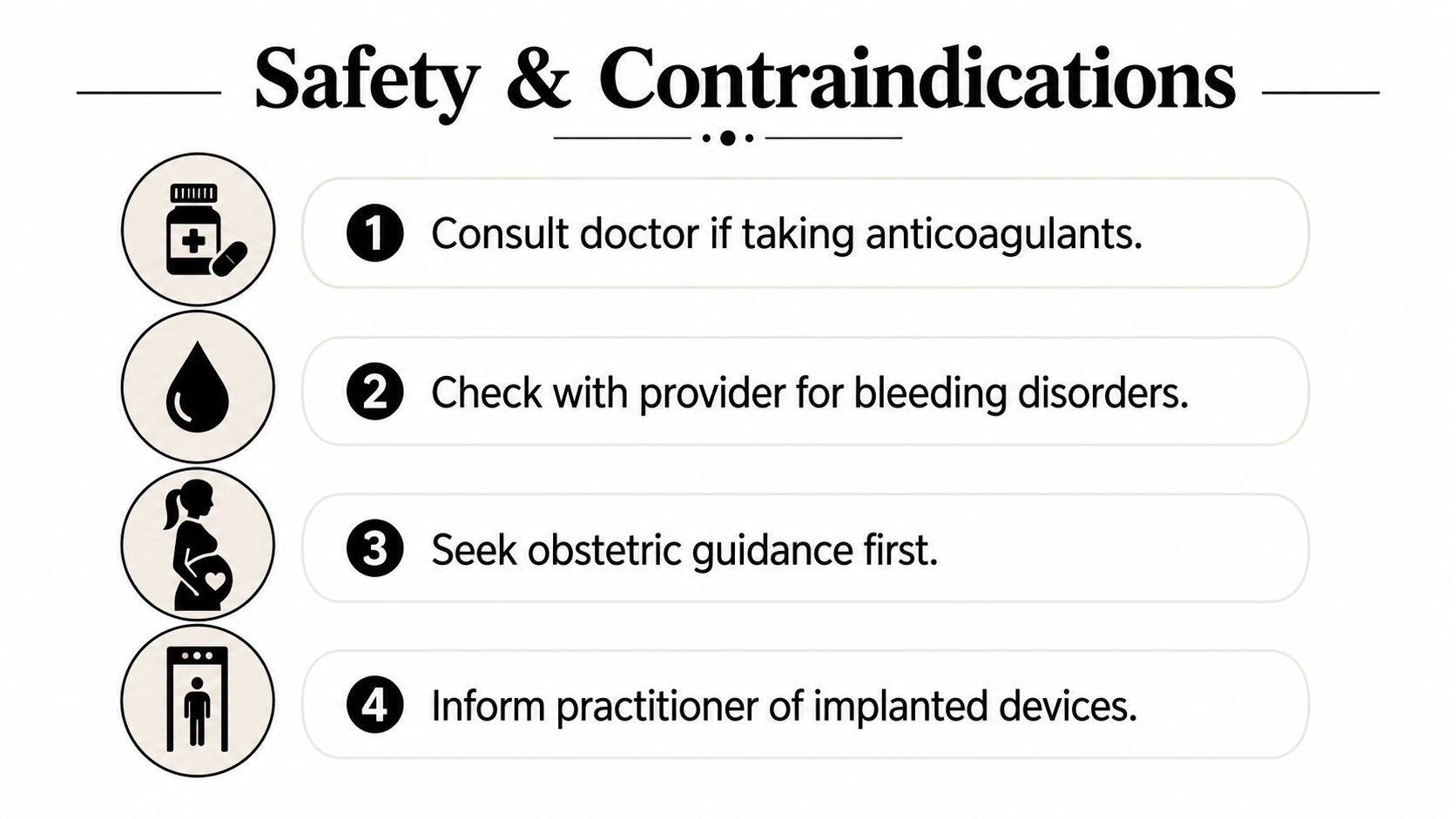
Safety should be part of the first conversation, not the fine print. Before a session starts, a responsible practitioner asks about medications, major diagnoses, pregnancy, bleeding tendencies, immune status, and any implanted electrical devices. That screening helps them decide whether to proceed, adjust the approach, or send you to a physician first.
People on anticoagulants, people with bleeding disorders, pregnant patients, and people with compromised immune systems should be careful about disclosure and coordination. The same applies to anyone with an implanted electrical device, because that information shapes what the practitioner can do safely. Single-use sterile needles are the standard you should expect, and hygiene should be clear enough that you never have to guess.
Minor effects versus real warnings
Some after-effects are common and usually minor. Soreness, fatigue, or a brief flare of the symptoms you came in with can happen, and those effects are uncomfortable without pointing to a serious complication.
If something feels unusual, severe, or persistent after treatment, contact a provider. A clinic that brushes off your concern is a poor sign, even if the room looks polished and calm.
Access matters here because safety and equity are tied together. An implementation review on acupuncture access found that low-income, immigrant, refugee, and minority patients face barriers around affordability, availability, and finding a provider who fits their needs, and that when those barriers are reduced, marginalized groups do use acupuncture implementation review on acupuncture access. The same review points to satellite clinics, hospital-based settings, and group treatment models as ways to improve uptake in underserved communities, and it also notes that education, dedicated acupuncture space, supportive clinic environments, funding, and insurance coverage help adoption implementation review on acupuncture access.
If access is hard, the problem may not be your interest level. It may be the clinic model.
That is why the best safety question is not only whether acupuncture is safe in general. Ask whether the practitioner is set up to screen you properly, and whether the clinic model is accessible enough for you to stay with care if it helps. The safety and contraindications checklist below shows the main health precautions to raise before booking: medication use, medical conditions, pregnancy, and medical implants.
How to Vet Practitioners and Use a Directory Like Lucidoura
The easiest way to narrow your search is to start with credentials, not decor. In the United States, that means checking licensure and, where relevant, certification such as NCCAOM Diplomate of Oriental Medicine or an equivalent national credential. After that, look at years in practice, areas of focus, whether the clinic handles pain care or broader wellness support, and whether the intake process includes a clear health screen.
Transparent pricing matters too. If you can't tell what a first visit costs, what follow-ups look like, or how long sessions usually run, you're being asked to commit without enough information. A good clinic also explains hygiene standards and is willing to coordinate with your physician, physical therapist, OB-GYN, or another provider when that makes sense.
A simple vetting checklist
- Credentials: verify licensure and relevant certification.
- Experience: check how long they've treated clients and what they focus on.
- Scope: ask whether they work with your specific concern.
- Hygiene: look for sterile single-use needles and a clean treatment room.
- Intake: expect medical screening, not just a quick upsell.
- Communication: notice whether they answer questions directly and without pressure.
A curated directory can speed this up because it lets you compare listings side by side instead of digging through scattered search results. Lucidoura's integrative medicine listings can be useful when you want to see how acupuncture fits alongside other wellness services in the same venue, especially if you're trying to pair it with breathwork, saunas, or other complementary modalities. The point isn't to outsource judgment. It's to shorten the time between curiosity and a competent shortlist.
Bringing It All Together Into a Personal Plan
Start with the problem you want to address, not the trend you've heard about. Vet credentials before ambiance, treat acupuncture as a series instead of a single novelty visit, and tell the practitioner about every other wellness modality you use so they can sequence care sensibly. If you're comparing clinics, use the same questions every time so the answer is based on fit, not first impression.
Pick two or three nearby venues, compare their summaries against the checklist in this guide, and book a short intake call before committing. That small step turns acupuncture and wellness from a vague idea into a decision you can evaluate on its merits.
Lucidoura organizes local wellness venues into searchable categories, so you can compare acupuncture alongside other options without starting from scratch each time. If you're ready to narrow your choices, visit Lucidoura and look for listings that match your goals, your schedule, and the level of coordination you want from a practitioner.